Foreign Patients Visiting Korea Increase Faster Than Tourists
Card Payments at Dermatology and Plastic Surgery Clinics Surpass Department Stores and Duty-Free Shops
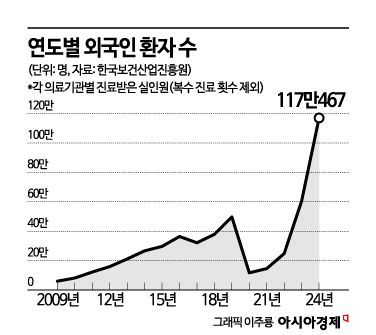
Last year, the number of foreign patients visiting South Korea reached an all-time high of approximately 1.17 million, with their total medical expenditures amounting to at least 1.4 trillion won. Foreign patients spent more money at dermatology and plastic surgery clinics than at department stores, duty-free shops, or restaurants.

According to the "2024 Statistical Analysis Report on the Attraction of Foreign Patients" published by the Korea Health Industry Development Institute on July 28, the actual number of foreign patients who received medical treatment in Korea last year (excluding duplicate visits) was 1,170,467, which is about 1.9 times higher than the previous year (605,768). This is the first time the number of patients has surpassed one million since the attraction project began in earnest in 2009, with the cumulative total reaching 5.05 million.
Among the foreign patients who visited Korea, 919,104 used cards issued overseas to pay for medical services in Korea. Their total spending in the medical sector was 1.4052 trillion won, averaging about 1.529 million won per person. By sector, card payments were highest for dermatology clinics (585.5 billion won), followed by plastic surgery clinics (359.4 billion won), department stores (278.8 billion won), duty-free shops (188.4 billion won), and general restaurants (183.3 billion won).
Han Dongwoo, Director of the International Medical Department at the Korea Health Industry Development Institute, explained, "The card payment figures are conservatively estimated based on actual data from credit card companies." He added, "Considering that about 260,000 Chinese patients visited Korea last year, if we include payments made through Alipay, UnionPay, and cash?which are widely used by these patients?the total amount spent is likely to be several hundred billion won higher."
Foreign patients came from a total of 202 countries, with the largest numbers from Japan (441,000), China (261,000), the United States (102,000), Taiwan (83,000), and Thailand (38,000). Notably, the number of patients from Japan and Taiwan increased by 135% and 550%, respectively, compared to the previous year, indicating a sharp rise in demand for medical services from these countries.

By medical specialty, dermatology accounted for 56.6% of the total (705,000 patients), ranking first by a large margin over plastic surgery (11.4%) and integrated internal medicine (10.0%). The number of dermatology patients increased by 194.9% compared to 2023, while integrated Korean medicine grew by 84.6%, suggesting that the foreign patient attraction project is evolving into a structure where both short-term outpatient care and mid- to long-term treatment coexist.
By region, Seoul attracted 85.4% of all patients (1 million), maintaining a strong concentration in the capital area. However, Busan (30,000) and Jeju (20,000) saw significant growth, with increases of 133.6% and 221.0%, respectively, compared to the previous year. This demonstrates that non-capital regions are also experiencing rapid growth by combining specialized care in dermatology, Korean medicine, and dentistry with tourism resources.
 Dongwoo Han, Director of International Medical Division, Korea Health Industry Development Institute
One of the most notable points about attracting foreign patients last year is that the recovery pace was faster than that of inbound tourists (16.37 million). While the tourism recovery rate for Japan, China, and Taiwan remained around 90% compared to 2019, the number of foreign patients increased by two to three times.
Director Han projected, "Unless there are major changes in the second half of the year, the number of foreign patients is expected to increase to 1.3 to 1.4 million this year." He explained, "For foreign patients, hospitals can earn more revenue than from health insurance reimbursements for domestic patients, which provides a strong incentive to attract them." He also emphasized, "Going forward, enhancing the quality of services with a focus on trust and convenience in Korean healthcare, and creating an ecosystem that coevolves with related industries, will be key tasks in ensuring the sustainability of the foreign patient attraction project."
© The Asia Business Daily(www.asiae.co.kr). All rights reserved.
![Clutching a Stolen Dior Bag, Saying "I Hate Being Poor but Real"... The Grotesque Con of a "Human Knockoff" [Slate]](https://cwcontent.asiae.co.kr/asiaresize/183/2026021902243444107_1771435474.jpg)

















