US and China Agree to Extend Tariff Suspension in Third Round of Talks
Valuation Pressures Persist Despite Easing Trade War Concerns
Weak Earnings from Whirlpool and UPS
FOMC Rate Decision on the 30th... Internal Divergence in Focus
Job Openings Decline, While Consumer Sentiment Rebounds
The three major indices of the New York Stock Exchange all closed lower on July 29 (local time). Although concerns over a tariff war have somewhat subsided, investors remained cautious as they digested mixed corporate earnings and awaited the upcoming decision on the Federal Reserve's benchmark interest rate scheduled for the following day. Signals of slowing employment combined with easing trade uncertainty have led to a decline of more than 10 basis points (1bp = 0.01 percentage point) in the yield on 10-year U.S. Treasury bonds.
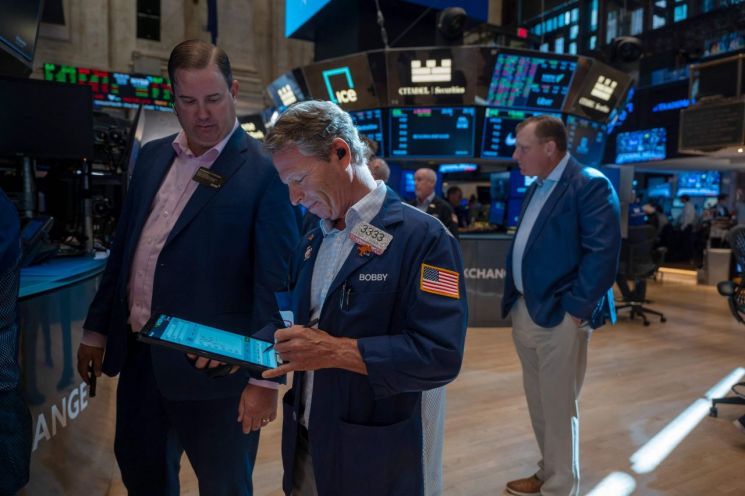
On this day, the Dow Jones Industrial Average, which focuses on blue-chip stocks, closed at 44,632.99, down 204.57 points (0.46%) from the previous trading day. The S&P 500, which is centered on large-cap stocks, fell by 18.91 points (0.3%) to 6,370.86, while the tech-heavy Nasdaq declined by 80.29 points (0.38%) to 21,098.29. Both the S&P 500 and Nasdaq hit new intraday record highs, but selling pressure intensified during the last hour of trading.
The downward pressure is analyzed to have stemmed from valuation burdens caused by the recent market rally. The stock market rebounded after hitting a low following the announcement of reciprocal tariffs in early April. As stock prices surged in a short period, the market's sensitivity to tariff issues appears to be decreasing, with only modest gains seen even after trade agreements were reached recently between the United States and major countries such as the European Union (EU) and Japan.
Even on this day, the market's response to tariff-related news was limited. The United States and China concluded the third round of high-level trade talks held in Stockholm, Sweden, and reached a tentative agreement to extend the tariff suspension measures. Previously, at the first round of talks held in Geneva, Switzerland in May, the two countries had agreed to mutually reduce tariffs by 115 percentage points for 90 days, a measure set to expire on the 11th of the following month. Scott Besant, the U.S. Treasury Secretary and lead negotiator, stated that a 90-day extension of the tariff suspension was one option, but emphasized that the final decision would be made by President Donald Trump. President Trump also described the talks as "very good."
The market's attention is now focused on the Federal Reserve's benchmark interest rate decision scheduled for July 30. The Fed is holding a two-day Federal Open Market Committee (FOMC) meeting starting on this day to decide on the benchmark interest rate, which currently stands at 4.25% to 4.5% per annum. While a rate freeze is widely expected, investors are paying close attention to differences in outlook among Fed officials regarding the future rate path, as well as the tone of remarks by Fed Chair Jerome Powell.
Corporate earnings are also a key variable for the market. This week, major big tech companies?including Microsoft (MS), Meta (the parent company of Facebook), Apple, and Amazon?are scheduled to announce their results. Whether investments in artificial intelligence (AI) are translating into actual profits is a major focus. So far, the corporate earnings released have generally shown solid performance. According to market research firm FactSet, 170 S&P 500 companies have reported earnings so far, with more than 83% surpassing market expectations.
The economic indicators released on this day were mixed. According to the Job Openings and Labor Turnover Survey (JOLTs) published by the U.S. Department of Labor, the number of job openings in June was tallied at 7,437,000. This represents a decrease of 275,000 from May's figure of 7,712,000 and also falls short of the market expectation of 7.51 million. This is interpreted as a sign that companies are becoming more cautious about new investments and hiring amid uncertainty over tariff policies, leading to a cooling labor market.
In contrast, consumer sentiment improved. The Conference Board (CB) announced that the Consumer Confidence Index for July rose by 2 points from the previous month to 97.2. This is 1.3 points above the market forecast of 95.9. The series of trade agreements between the United States and major trading partners is seen as having a positive effect on the recovery of consumer sentiment.
Ian Lyngen of BMO Capital Markets commented, "The two indicators showed divergent results," and analyzed, "Overall, they do not have a substantial impact on price (stock price) trends or the macroeconomic outlook."
Other economic indicators are also scheduled to be released this week. On July 30, the U.S. Department of Commerce will announce the preliminary estimate of second-quarter Gross Domestic Product (GDP). On July 31, the June Personal Consumption Expenditures (PCE) Price Index will be released, followed by the July employment report from the Department of Labor on August 1.
Ulrike Hoffmann-Burchardi, Chief Investment Officer (CIO) and Global Head of Equities at UBS Global Wealth Management, forecast, "With major U.S. economic data releases, the outcome of the Fed policy meeting, and second-quarter earnings announcements from the Magnificent 7 (M7), investor sentiment in the market could be put to the test in the coming days."
U.S. Treasury yields are falling sharply, especially for long-term bonds, amid signs of slowing employment. The yield on the 10-year U.S. Treasury, the global benchmark for bond yields, dropped by 12 basis points from the previous trading day to 4.32%, while the yield on the 2-year Treasury, which is sensitive to monetary policy, fell by 5 basis points to 3.87%.
By stock, Boeing, the U.S. aircraft manufacturer, fell 4.37% even after announcing strong results and delivering the highest number of aircraft since 2018. Whirlpool and UPS, which reported results below market expectations, declined by 13.43% and 10.58%, respectively. Nvidia dropped by 0.7%. Apple slipped by 1.3%, and Tesla fell by 1.35%.
© The Asia Business Daily(www.asiae.co.kr). All rights reserved.
![Clutching a Stolen Dior Bag, Saying "I Hate Being Poor but Real"... The Grotesque Con of a "Human Knockoff" [Slate]](https://cwcontent.asiae.co.kr/asiaresize/183/2026021902243444107_1771435474.jpg)















