U.S. and China Conclude Two-Day Stockholm Talks
Tariff Suspension Likely Extended by 90 Days... "Trump to Decide"
Trump Gives Positive Assessment of Talks... "Possible Xi Meeting Within the Year"
The United States and China reached a provisional agreement on July 29 (local time) to extend tariff suspension measures during the third round of high-level trade talks held in Stockholm, Sweden. President Donald Trump described the talks as "very good."
According to Bloomberg News, Li Chenggang, China's Vice Minister of Commerce and Chief Representative for International Trade Negotiations, told reporters that the two countries had agreed to extend the tariff suspension. However, he did not specify the length of the extension.
He stated, "The two countries engaged in frank and in-depth discussions," and added, "We will continue to maintain close communication in the future."
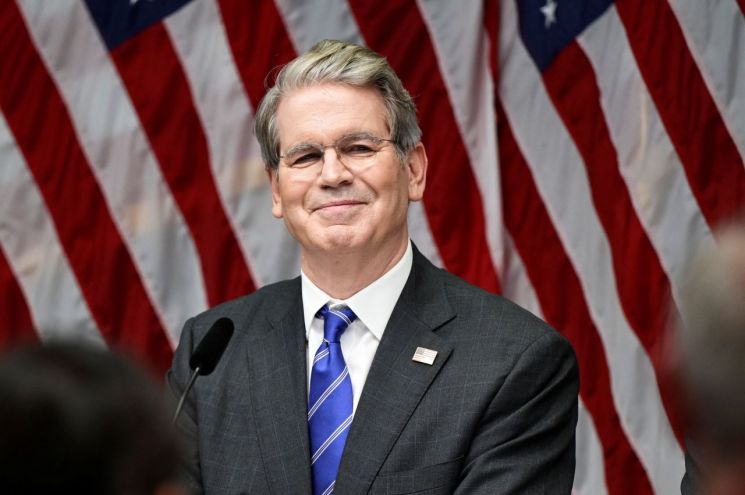
Scott Besant, the U.S. Treasury Secretary and head of the U.S. negotiating team, said that a 90-day extension of the tariff suspension was one possible option, but emphasized that the final decision would be made by President Trump. He added, "There are still technical details that need to be resolved," and noted, "China appears to want broader discussions."
The central agenda of this round of talks was the extension of the U.S.-China tariff suspension, which is scheduled to expire on August 11. Previously, at the first round of talks in Geneva, Switzerland, in May, the two countries agreed to reduce mutual tariffs by 115 percentage points for 90 days. At the second round in London, United Kingdom, in June, the United States agreed to ease export controls on semiconductors, while China agreed to ease export controls on rare earths.
Secretary Besant also explained that during this meeting, he raised concerns about China's imports of Iranian crude oil and the impact of China's overproduction on the global market.
Additionally, the talks covered U.S. tariff measures on semiconductors, copper, and pharmaceuticals, based on Section 232 of the Trade Expansion Act.
Jamison Greer, the U.S. Trade Representative (USTR) who participated in the negotiations with Secretary Besant, said, "China asked questions about the Section 232 investigations into copper, semiconductors, and pharmaceuticals," and added, "We explained that the tariffs are applied globally without exceptions for individual countries."
Section 232 of the Trade Expansion Act is a law that allows the president to impose tariffs or other import restrictions if the import of specific items is deemed a threat to national security. Based on investigations conducted under this provision, the United States is expected to announce tariffs on these items soon.
Representative Greer also emphasized, "China wants to maintain smooth exports of rare earths and permanent magnets to the U.S., so that both countries can focus on more critical trade issues."
During this third round of talks, both sides agreed to extend the existing agreements, but the final decision requires approval from each country's head of state.
Meanwhile, President Trump gave a positive assessment of the third round of high-level U.S.-China trade talks concluded that day. Speaking to reporters aboard Air Force One on his return flight from Scotland to the United States, he said, "I just received a call from Scott Besant, who said the meeting with China went very well," and added, "Tomorrow (the 30th), I will receive a briefing from the negotiating team and decide whether to approve it." He further commented, "Besant's impression of the meeting was very good."
President Trump also said that both he and Chinese President Xi Jinping want a summit and predicted that the two leaders could meet "before the end of this year."
© The Asia Business Daily(www.asiae.co.kr). All rights reserved.
![Clutching a Stolen Dior Bag, Saying "I Hate Being Poor but Real"... The Grotesque Con of a "Human Knockoff" [Slate]](https://cwcontent.asiae.co.kr/asiaresize/183/2026021902243444107_1771435474.jpg)















