Butcher Shops and Marts with Over 3 Billion KRW in Annual Sales
Operate Through New Corporations and "Corporate Splitting"
Complacent Attitude of Some Local Governments
Undermines Policy to Support Small Businesses and the Self-Employed
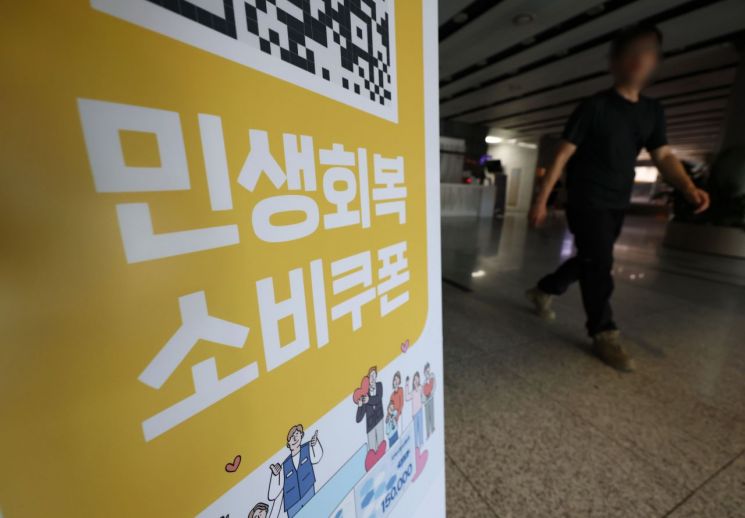 A notice for applying for the 'Minsheng Recovery Consumption Coupon,' which can be applied for regardless of the last digit of the birth year, is placed on the first floor of Gwanak District Office in Seoul on the 26th. Photo by Yonhap News
The "Livelihood Recovery Consumption Coupon," which has been distributed since last week to boost sales for small business owners and self-employed individuals, has been found to be fraudulently circulated in the Gwangju area through "disguised merchants," such as large-scale companies with annual sales exceeding 3 billion KRW creating new corporations.
So-called "corporate splitting," where large companies use existing corporations with annual sales below 3 billion KRW or establish new ones to attract consumers of the consumption coupon, is openly taking place. However, there are no effective sanctions in place, making a comprehensive investigation at the local government level urgent.
Moreover, due to these disguised merchants, the original purpose of the "Livelihood Recovery Consumption Coupon" is being undermined, and the surrounding commercial district is being negatively affected. Nevertheless, some local governments are being criticized for making excuses such as "we do not have the authority to take administrative action" and failing to act.
According to the five autonomous districts of Gwangju on the 29th, complaints have recently been filed?two in Seo-gu and one in Nam-gu?stating that "despite not being eligible as a place to use the Livelihood Recovery Consumption Coupon due to reasons such as annual sales exceeding 3 billion KRW, the coupon is being improperly circulated through disguised merchants."
In fact, at Butcher Shop A in Maewol-dong, Seo-gu, a sign stating "Livelihood Recovery Support Fund Usable Here" was openly displayed at the entrance throughout last week. When a payment was made using the Livelihood Recovery Consumption Coupon at Butcher Shop A, the receipt showed a different name, OO Livestock, instead of the shop's name. At a similar time, when payment was made with a regular card, the receipt showed the shop's actual name. This raises suspicions that a new corporation was created by the same business to use the Livelihood Recovery Consumption Coupon.
Kim, a resident of Seo-gu, said, "This butcher shop usually has high sales and does not accept the local coexistence card, so I do not understand how it can accept the consumption coupon. If companies are allowed to use loopholes like this to create new corporations, the Livelihood Recovery Consumption Coupon, which is meant to support small businesses and boost consumption, will become meaningless."
Additionally, at Mart B in Chipyeong-dong, Seo-gu, it was found that the consumption coupon was distributed by utilizing a butcher shop corporation operating within the store. At this business, it was possible to shop using the consumption coupon through a corporation with low annual sales located inside the mart.
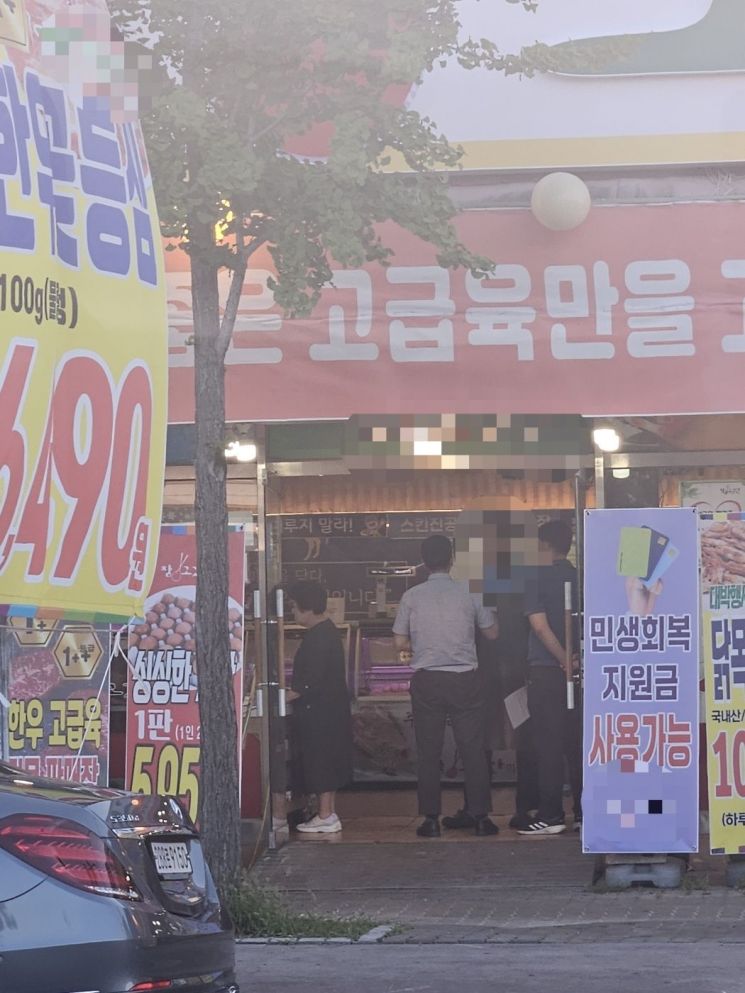 Employees of Seo-gu Office in Gwangju are conducting an on-site investigation at A Butcher Shop in Maewol-dong regarding the fraudulent distribution of livelihood recovery consumption coupons. Photo by Reader
After these complaints were received, Seo-gu conducted on-site investigations and began issuing guidance measures. Seo-gu decided to report any violations related to the consumption coupon to the Ministry of the Interior and Safety according to relevant guidelines. The results of the investigation will be reported to the Livelihood Recovery Consumption Coupon card agency, and a decision to suspend usage will be made.
In contrast, Nam-gu stated that it does not have the authority to investigate disguised merchants or take administrative action.
Recently, a complaint was also filed in Nam-gu, stating that "a mart with annual sales exceeding 12 billion KRW is operating two corporations and receiving the Livelihood Recovery Consumption Coupon." However, instead of conducting an on-site investigation, the district office only inquired with the Ministry of the Interior and Safety as to whether there were any problems with the corporation's use of the Livelihood Recovery Consumption Coupon. They only confirmed whether the corporation exceeded 3 billion KRW in annual sales, rather than determining whether the mart was illegally distributing the consumption coupon as a disguised merchant.
Nam-gu also gave an irresponsible response, saying, "We do not have the authority to determine whether the corporation was newly established after closing the previous one or whether it actually gained unfair profits. We received a reply from the Ministry of the Interior and Safety that compulsory administrative measures at the local government level are impossible."
As a result, there are growing voices that the government policy, which was implemented to increase sales for small business owners and self-employed individuals, is losing its intended purpose due to the complacent and hands-off approach of some local governments.
Regarding this, a Nam-gu official explained, "Disguised merchants can be punished under the Specialized Credit Finance Business Act and must be reported to the local tax office. We are only following the Ministry of the Interior and Safety's guidelines, and it is difficult for us to directly crack down on or identify disguised merchants."
© The Asia Business Daily(www.asiae.co.kr). All rights reserved.


















