25 Out of 40 Stores in Central Seoul Found Practicing Open-Door Cooling
Despite the extreme heatwave, self-employed business owners continue to operate with their doors open and air conditioners running, a practice known as 'open-door cooling'.
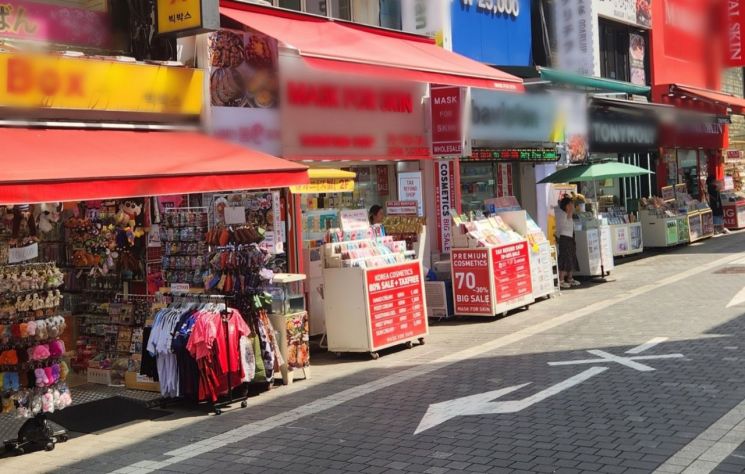 Stores around Myeongdong, Jung-gu, Seoul, are seen using 'open-door air conditioning.' Photo by Byeon Seonjin
Around noon on July 31, when the temperature in Seoul reached 35 degrees Celsius, a survey was conducted of 20 first-floor stores each in the areas around Gwanghwamun Station, Jonggak Station, and Myeong-dong Station, totaling 40 stores. Of these, 25 stores (62.5%) were operating with their doors open while using air conditioning. In Myeong-dong, many cosmetics and clothing stores were open-door cooling, and the cool air from the air conditioners could be felt when passing by.
Employee A (36) at a cosmetics store in Myeong-dong said, "Since competing stores are all running their air conditioners with the doors open as a marketing strategy, if we don't do the same, customers won't come in." Store owner B (57) of an optician's shop said, "Open-door cooling is very effective in attracting passing customers with the cool air," and added, "It feels like about 20% more customers come in compared to when we keep the doors closed while operating."
The problem is that open-door cooling is a major cause of energy waste. According to data released by the Ministry of Trade, Industry and Energy in 2023, electricity consumption increases by about 66% when cooling with the doors open compared to keeping them closed. In addition, open-door cooling worsens the urban heat island effect, as the strong hot air expelled from outdoor units raises the overall temperature of the city center.
If open-door cooling occurs, the Ministry of Trade, Industry and Energy can issue a corrective order based on the Energy Use Rationalization Act, and failure to comply can result in a fine of up to 3 million won. Typically, if the power reserve ratio falls below 10%, the ministry can announce a notice restricting energy use and begin enforcement.
However, since no such notice has been issued since January 2023, enforcement is currently nonexistent. Regarding this, an official from the ministry explained, "Even if it is pointed out as a cause of energy waste, since it could restrict the right to operate a business, we are approaching the issuance of related notices with caution," and added, "Even if a related notice is issued, open-door cooling must be included in the enforcement details."
Recent energy supply indicators do not suggest a reassuring situation. According to the Korea Power Exchange's electricity statistics information system, the average maximum power demand this month was 84,445 MW, a 4.8% increase compared to the same period last year (80,515 MW). This is the highest figure since statistics began to be compiled.
Park Jongbae, professor of electrical engineering at Konkuk University, said, "To reduce inefficient cooling practices like open-door cooling, both pricing policies and incentive policies should be implemented together," and added, "When electricity demand surges in the summer, temporarily raising electricity rates can help curb excessive cooling use." He also emphasized, "Subsidies should be provided when replacing old cooling equipment with high-efficiency models."
© The Asia Business Daily(www.asiae.co.kr). All rights reserved.

















