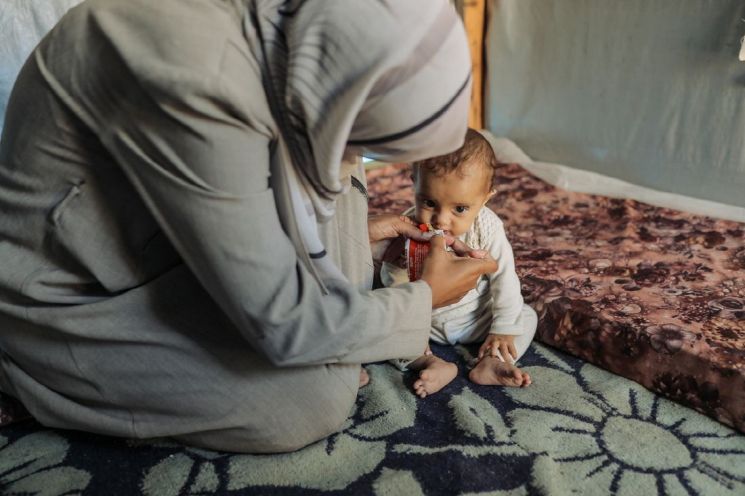
 A mother feeding her 10-month-old child with a malnutrition therapeutic food (RUFT) provided by the International Rescue Committee at the Shams camp in Gaza Strip. International Rescue Committee
The International Rescue Committee (IRC), a global humanitarian organization whose Korea representative is Lee Eunyoung, warned on the 29th that "the food and water systems in the Gaza Strip have effectively reached the point of collapse," and called for an immediate and robust response from the international community to ensure comprehensive humanitarian access.
According to the IRC, despite Israel allowing limited entry of relief supplies since the end of May, the humanitarian situation in the Gaza Strip has continued to deteriorate. The Office of the United Nations High Commissioner for Human Rights (OHCHR) reported that from the end of May to July 7, daily shootings and casualties occurred at Gaza Humanitarian Foundation (GHF) distribution centers and along aid convoys, resulting in a total of 1,054 people being killed while trying to receive aid.
Additionally, according to the Gaza Strip Ministry of Health, the cumulative number of deaths from hunger and malnutrition since the outbreak of war in October 2023 has exceeded 147. The World Health Organization (WHO) warned that in July alone, 63 people, including 24 children under the age of five, died from starvation, and most are facing severe malnutrition.
Currently, approximately 470,000 residents of the Gaza Strip are classified as being in Phase 5, "Famine," the most severe stage of the Integrated Food Security Phase Classification (IPC), and among them, about 90,000 women and children are suffering from life-threatening severe acute malnutrition.
The IRC has defined the crisis in the Gaza Strip as a "man-made disaster" caused by human decisions and neglect, not a natural disaster, and has strongly demanded that the international community ensure: comprehensive humanitarian access across Gaza; immediate and stable entry of essential life-saving supplies such as food, therapeutic food for malnutrition, fuel, and medical supplies; and the resumption of a ceasefire and an end to armed conflict to protect civilians and guarantee humanitarian activities.
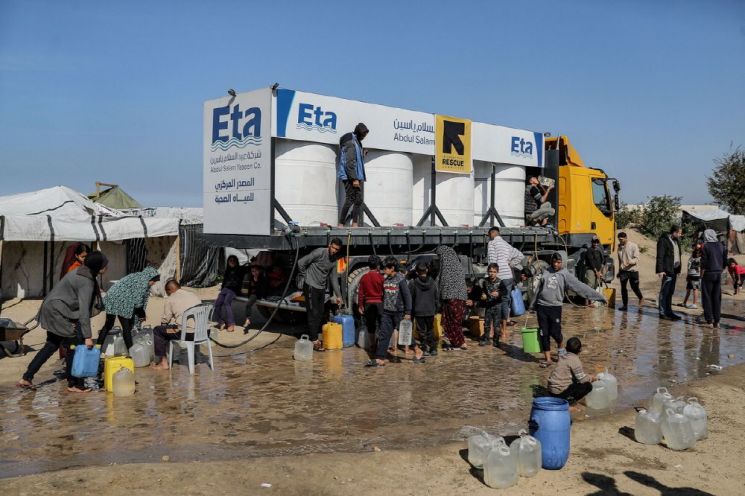 The International Rescue Committee is conducting a water distribution project at the Asdaa camp located in Khan Younis, Gaza Strip. International Rescue Committee
The IRC explained that, since the conflict began, it has been working with local partners to provide humanitarian assistance?including drinking water, sanitation, cash support, nutrition treatment, protection services, and psychosocial support?to more than 430,000 residents. The organization aims to support an additional 150,000 people by the end of 2025, but faces significant constraints in relief activities due to limited access and a lack of resources.
In addition to the food crisis, the collapse of water infrastructure is also severely threatening the survival of residents. Currently, more than 75% of the water infrastructure in the Gaza Strip is not functioning properly, and 83% of all reservoirs have completely stopped operating. Desalination facilities and pumping stations have halted due to fuel shortages, resulting in most residents receiving far less water than the WHO-recommended standard of 15 liters per person per day.
The IRC is distributing 40,000 liters of desalinated clean water daily in Asda City in the Khan Younis area, and 20,000 liters daily at the Almutahabeen temporary shelter camp in Mawasi. However, the IRC reported that water delivery operations are becoming increasingly difficult due to insecurity, overcrowding, and fuel shortages, and in some areas, the water is depleted before trucks even reach their destinations. In addition, in parts of Khan Younis and the central region, garbage collection has been reduced to just three times a week, making a serious public health crisis a reality.
David Miliband, President of the IRC, said, "The International Rescue Committee has secured tons of relief supplies that can treat thousands and support the collapsing medical system. However, due to limited access, hospitals across the Gaza Strip are being reduced to ruins, and children are being left to starve to death." He emphasized, "Symbolic measures such as airdrops are not enough?comprehensive humanitarian access by land must be guaranteed immediately."
Lee Eunyoung, IRC Korea representative, warned, "Even at this very moment, countless children in the Gaza Strip are losing their lives to hunger. Although the international community has begun airdrops, this method is more expensive, less efficient, and more dangerous than land transport. If the international community does not act now, even more loss of life will be inevitable."
Key Figures on the Food and Water Crisis in the Gaza Strip (as of July 2025)
- Cumulative deaths from hunger and malnutrition: more than 147 (59 adults, 88 children)
- Deaths in July 2025: total of 63 (including 24 children under the age of five)
- Number of residents classified as Phase 5 "Famine" under the IPC: approximately 470,000.
Of these, more than 90,000 women and children are in a state of severe acute malnutrition
- Water and Sanitation Infrastructure
- Water facilities operating normally: about 40% of the total
- Reservoirs that have stopped operating: 83% of the total
- Current water production: less than half the level at the time of the March 2025 ceasefire
- 2 out of 3 official water pipelines: currently out of operation
- 79% of water and sanitation infrastructure: located in military zones or areas under forced evacuation orders
- IRC water supply status: Asda City: 40,000 liters per day, Mawasi camp: 20,000 liters per day
© The Asia Business Daily(www.asiae.co.kr). All rights reserved.


















