Allowance Paid Until the Child Turns Three
All Children in Multi-Child Families Eligible to Apply
Specific Payment Timing to Be Determined According to Regional Circumstances
China, facing a severe low birth rate issue, has introduced a childcare allowance policy.
On July 29, local Chinese media outlets such as Jiemian News and Dazhongwang reported, "A nationwide childcare allowance of 3,600 yuan (approximately 700,000 KRW) per year will be provided for infants under the age of three." This move is interpreted as a measure by the Chinese government to overcome the low birth rate crisis.
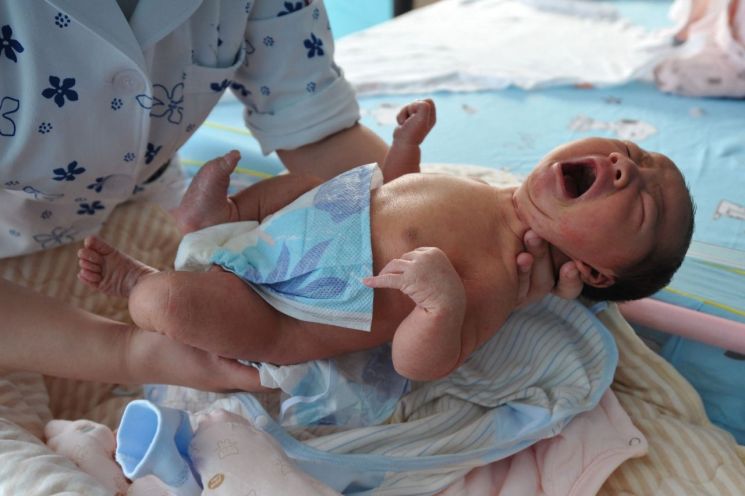
For children born from January 1, 2025... Targeting infants under age three
According to multiple Chinese media reports, the childcare allowance will be provided for infants under the age of three in accordance with the "Implementation Plan for the Childcare Allowance System" (hereinafter referred to as "the Plan"), jointly announced by the General Office of the Communist Party Central Committee and the General Office of the State Council.
Although local governments in China have previously implemented individual childcare support policies, this is the first childcare allowance system led by the central government. Under this policy, infants under the age of three who are born in accordance with laws and regulations from January 1 of this year will receive the childcare allowance on an annual basis. The national basic standard is 3,600 yuan (approximately 698,000 KRW) per child per year, and the allowance will be provided until the child turns three. For infants under the age of three who were born before January 1 of this year, the allowance will be retroactively applied according to the remaining number of months.
According to the details of the national childcare allowance plan, the first, second, and third child are all eligible to apply for the allowance.
Experts: "Contributes to raising the birth rate... Comprehensive policies are necessary"
The childcare allowance fund will be jointly financed by the central and local governments. The central government will establish a new "childcare allowance subsidy" category and provide differentiated subsidies according to the eastern, central, and western regions. If local governments raise the allowance standard on their own, the additional costs will be fully covered by local finances. The specific timing of payments will be determined according to regional circumstances to ensure that subsidies are paid in full and on time.
Song Jian, professor at the School of Population and Health at Renmin University of China, said, "Most advanced countries that first encountered the low birth rate crisis supported childbirth through the provision of childcare allowances." He analyzed that, although the impact of the childcare allowance may differ for each household on a micro level, on a macro level, it helps to increase the overall birth rate or prevent further decline.
Mao Zhuoyan, professor at the Population Development Research Center at Capital University of Economics and Business, emphasized, "The childcare allowance system is not a panacea for solving the low birth rate problem." He pointed out that the childcare allowance must be linked with other policies such as parental leave, childcare, education, and housing, and that a single policy alone has limited effectiveness.
The introduction of the childcare allowance system had been anticipated since last year. On October 19 of last year, the General Office of the State Council announced "Several Measures to Accelerate the System of Childbirth Support Policies and Promote the Construction of a Childbirth-Friendly Society," which mentioned the establishment of a childbirth subsidy system and guidance for local governments to coordinate policies. In March of this year, Premier Li Qiang of the State Council clearly stated in the government work report the establishment of policies to encourage childbirth, the provision of childcare allowances, and the expansion of childcare services.
At the local government level, there have been preemptive moves regarding the childcare allowance. According to data from the National Health Commission, as of October 28, 2024, a total of 23 provincial-level regions nationwide were piloting various forms of childbirth subsidy systems. The first place to provide a childcare allowance was Panzhihua City in Sichuan Province, which, starting in 2021, provided 500 yuan (approximately 95,000 KRW) per month per child until age three to families with household registration in the city who had a second or subsequent child. Afterwards, several regions, including Jinan City in Shandong Province, Shenzhen City in Guangdong Province, Yunnan Province, and Huanggang City in Hubei Province, introduced policies to provide monthly childcare allowances ranging from 300 to 1,200 yuan (approximately 57,000 to 228,000 KRW) or one-time childbirth subsidies ranging from 1,000 to 20,000 yuan (approximately 190,000 to 3,800,000 KRW).
The low birth rate problem in China is not a recent issue. In 1987, when the population was rapidly increasing, China introduced the "one-child per family" policy. However, as the declining birth rate and aging population became social problems, the "two-child policy" was implemented in 2016, followed by the allowance of three children in 2021. Nevertheless, the birth rate continued to decline. The annual number of newborns in China has remained below 10 million for three consecutive years since 2022. The total population has also decreased for three consecutive years.
© The Asia Business Daily(www.asiae.co.kr). All rights reserved.
![Clutching a Stolen Dior Bag, Saying "I Hate Being Poor but Real"... The Grotesque Con of a "Human Knockoff" [Slate]](https://cwcontent.asiae.co.kr/asiaresize/183/2026021902243444107_1771435474.jpg)

















