Hanwha, with Defense, Energy, and Shipbuilding Capabilities
Capable of Practically Implementing U.S. Cooperation
First Korean Shipbuilder to Acquire a U.S. Shipyard
Recognized as the Foundation for the MASGA Proposal
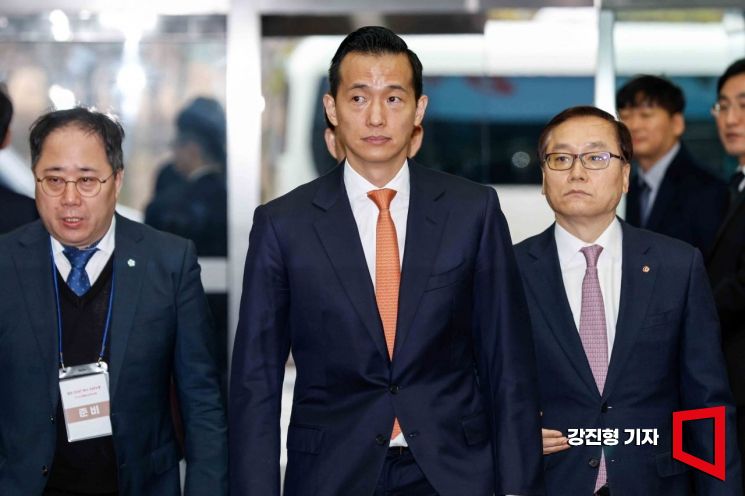
The government has reportedly chosen Kim Dongkwan, Vice Chairman of Hanwha Group, as the key figure representing the business sector in tariff negotiations with the United States, based on the assessment that Hanwha, with its portfolio spanning defense, energy, and shipbuilding? all strategic industries? is the main private entity capable of implementing the proposed cooperation plan. In particular, Vice Chairman Kim is seen as someone who can personally guarantee the execution of the government's proposal, and is said to be providing practical support for the negotiations. Last year, Hanwha Ocean became the first Korean shipbuilder to acquire the U.S.-based Philly Shipyard, which is now regarded as the foundation for the government's proposed "Make American Shipbuilding Great Again (MASGA)" project. Vice Chairman Kim plans to support the implementation plan from the private sector by explaining the project vision alongside the negotiation team on site.
According to the business community on the 29th, Vice Chairman Kim departed for Washington, D.C. the previous day to join the Korean government delegation in the tariff negotiations. This move is aimed at supporting the realization of the MASGA project, a shipbuilding industry cooperation plan proposed by Korea to the United States. The MASGA project name combines "Make America Great Again (MAGA)," the signature political slogan of U.S. President Donald Trump, with "Shipbuilding," meaning "Make American Shipbuilding Great Again." It is reported that Minister of Trade, Industry and Energy Kim Jeongkwan met with U.S. Secretary of Commerce Howard Lutnick in New York on the 25th (local time) and proposed this project.
This cooperation plan is structured as a large-scale industrial package that includes local investment by private shipbuilders in the U.S., technology transfer, workforce training, and government financial support. The specific proposal is valued at several tens of billions of dollars, or several trillion Korean won, and the U.S. side has reportedly shown significant interest. The government selected Hanwha Group, which covers defense, shipbuilding, and energy, as the main implementing entity for the MASGA project. The proposal to bundle these three industries into a single package is regarded as a differentiated strategy unique to Korea, unmatched by any other country.
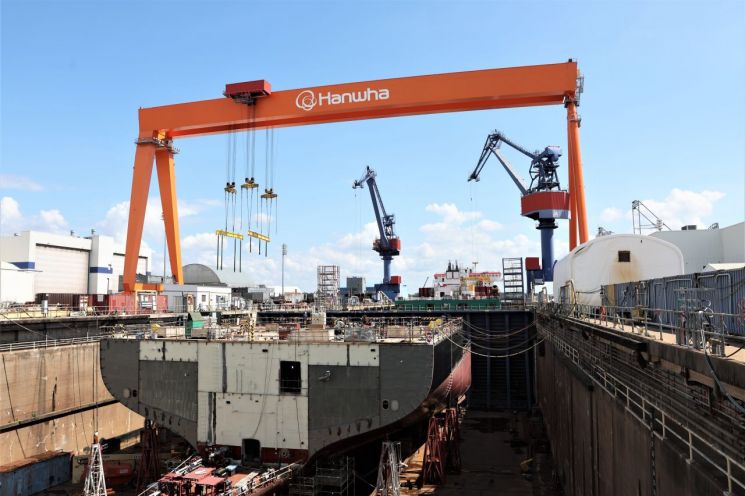
Hanwha Group, in particular, is considered the core player in the MASGA project. Among Korea's three major shipbuilders, it is the only one currently making direct investments in the United States. Earlier this year, Hanwha Group acquired Philly Shipyard (now Hanwha Philly Shipyard) for $100 million. This shipyard serves as the physical foundation for the MASGA project and is a key asset that aligns with the U.S. strategy of expanding local manufacturing and employment, as well as the Trump administration's emphasis on "Made in America" production.
Vice Chairman Kim has reportedly already proposed to the government additional investment in Hanwha Philly Shipyard, local technology transfer, and workforce training measures to strengthen the tariff negotiations. An industry insider commented, "From the U.S. perspective, a partner who presents concrete investment plans and execution capability to contribute to their strategic industries is far more persuasive than one who simply asks for tariff reductions. Hanwha is positioned to play that role, and Vice Chairman Kim Dongkwan is the person who can sit at the negotiation table and sign the agreement himself."
Vice Chairman Kim is expected to remain in the U.S. until August 1, the deadline for the expiration of the U.S. tariff suspension, and to participate in the ongoing tariff negotiations alongside Deputy Prime Minister and Minister of Economy and Finance Koo Yooncheol, Minister Kim, and other Korean government officials. The business community believes that in these negotiations, Vice Chairman Kim will play a key role as the guarantor of the MASGA project's implementation and as a crucial link between the government and the private sector. While the MASGA project is a government-designed strategy, actual execution must be carried out by the private sector. As an investor owning a shipyard in the U.S., Vice Chairman Kim is regarded as the person who can directly answer the question at the negotiation table: "Who can take responsibility for and drive this project forward?"
Vice Chairman Kim is also expected to serve as a strategic bridge who can coordinate both policy direction and business execution. An industry official stated, "The fact that the private sector entity responsible for project implementation is participating in the negotiations alongside the government, rather than acting separately, can make a strong impression on the U.S. side." Some observers interpret that Vice Chairman Kim's selection may have been influenced in part by his personal connections with the Trump family. In April, Vice Chairman Kim reportedly held a private meeting with Donald Trump Jr. during his visit to Korea, where he explained Hanwha's plans for defense and energy cooperation with the U.S. It is suggested that the trust built through such prior contact may have played a role in his prominent involvement in the current negotiations.
Within the industry, there is also the view that "Vice Chairman Kim's involvement is evidence of how urgent the government considers the situation." With the European Union having effectively concluded trade negotiations with the U.S. through a $1.35 trillion energy import and investment commitment, there is a growing recognition that Korea must also present an alternative in the "U.S.-preferred format" to avoid discriminatory auto tariffs. The Korean government and industry consider the 15% reciprocal tariff proposed by the Trump administration as the negotiation's bottom line, and are making an all-out effort to secure a rate lower than that imposed on automobiles from Japan and the EU, at least for the automotive sector.
© The Asia Business Daily(www.asiae.co.kr). All rights reserved.


















