Professor Lee Hajung's Team at Seoul National University
Analyzes Biosignals Minute by Minute During Surgery
A domestic research team has developed an artificial intelligence (AI) model that can predict the risk of postoperative acute kidney injury (PO-AKI)?one of the most fatal complications after surgery?by utilizing intraoperative biosignals for early detection.
 Hajung Lee, Professor, Department of Nephrology, Seoul National University Hospital. Korea Health Industry Development Institute
The Korea Health Industry Development Institute announced on the 29th that a joint research team led by Professors Lee Hajung and Park Sehun from the Department of Nephrology at Seoul National University Hospital, Professor Kim Kwangsoo from the Department of Translational Medicine, and researcher Jung Sumin has successfully developed an AI model that predicts the risk of acute kidney injury based on real-time biosignals measured during surgery. This was achieved by utilizing large-scale surgical data from Seoul National University Hospital, Seoul National University Bundang Hospital, and Boramae Medical Center.
Postoperative acute kidney injury is one of the most common complications following various types of surgery, in which kidney cells are damaged, leading to a rapid decline in kidney function. This can delay recovery, increase the risk of dialysis, and raise the likelihood of mortality, making intensive monitoring and early intervention extremely important. However, existing models mostly rely only on preoperative baseline information, resulting in low accuracy and an inability to reflect real-time changes in the patient's condition during surgery.
To address this, the research team designed a deep learning model that analyzes biosignals?such as blood pressure and heart rate?collected every minute during surgery to predict the risk of acute kidney injury. They also incorporated 11 major clinical variables from existing models to further enhance predictive performance.
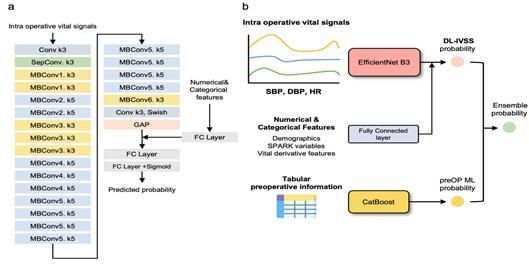 Overall Structure of the Postoperative Acute Kidney Injury (PO-AKI) Prediction Model. This figure shows the overall structure of the postoperative acute kidney injury (PO-AKI) prediction model developed in this study. (a) illustrates the internal structure of the deep learning algorithm designed to analyze real-time intraoperative biosignal data, and (b) presents the overall design flowchart of this study.
This model was trained and externally validated using data from approximately 110,000 surgeries. As a result, its predictive accuracy (AUROC) reached 79.5% in the training cohort and 76.2% and 78.6% in two separate validation cohorts, demonstrating more consistent and superior performance than existing models and proving its potential for clinical application. Notably, the model maintained stable predictive power even at a sensitivity and specificity threshold of 95%, suggesting that it could enable rapid identification of high-risk patient groups.
Professor Lee Hajung, the principal investigator, stated, "This study implemented an AI-based predictive model utilizing real-time intraoperative data in a large-scale clinical environment and completed external validation. While previous models only used summarized information such as averages or minimum values, our model applies deep learning technology that captures 'moment-to-moment changes,' dramatically improving predictive accuracy."
Professor Park Sehun commented, "Because this model is based on clinical data, it has high practicality and scalability. If integrated with intraoperative monitoring systems, it could make a significant contribution to improving patient outcomes and raising the level of medical safety in the operating room."
This research was supported by the Ministry of Health and Welfare's Medical Data Protection and Utilization Technology Development (R&D) Project and the Ministry of Science and ICT's AI Global Innovation Talent Development Project. The findings were published in a recent issue of the internationally recognized medical journal 'PLOS Medicine.'
© The Asia Business Daily(www.asiae.co.kr). All rights reserved.
![Clutching a Stolen Dior Bag, Saying "I Hate Being Poor but Real"... The Grotesque Con of a "Human Knockoff" [Slate]](https://cwcontent.asiae.co.kr/asiaresize/183/2026021902243444107_1771435474.jpg)
















