'D Grade' Safety Rating... Demolition for Public Safety
Sequential Closure of City Hall ↔ Chungjeongno Section
Full Shutdown and Construction Begin September 21
New Overpass Construction to Start Immediately
The Seosomun Overpass, which connects Seosomun-dong in Jung-gu and Hap-dong in Seodaemun-gu, Seoul, will be demolished after 60 years. Although safety concerns have persisted, demolition was delayed due to fears of traffic congestion. However, it has now been determined that simple maintenance and repairs are no longer sufficient for proper management.
On July 29, the Seoul Metropolitan Government announced that demolition of the Seosomun Overpass, which was built in 1966 and has reached the end of its lifespan, will begin on August 17.
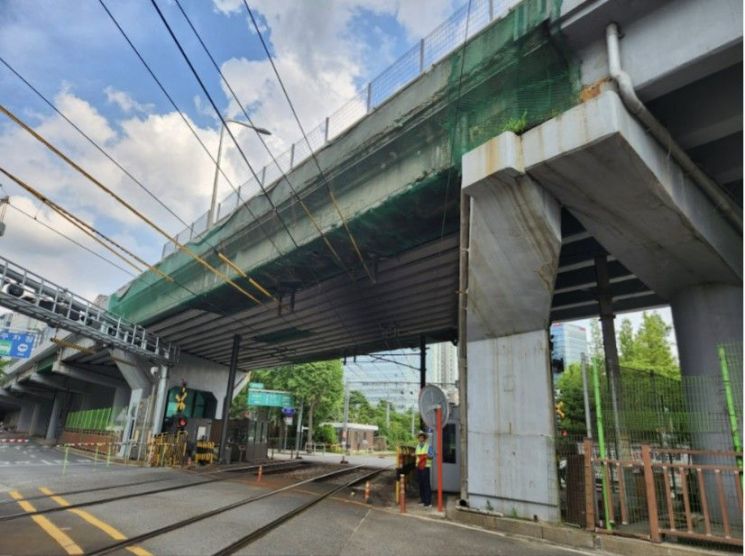
The Seosomun Overpass is 335 meters long and 14.9 meters wide, and serves as one of the major roads connecting Seoul Station and the Euljiro area. Unlike other elevated roads in downtown Seoul that have been demolished for impeding traffic flow, the Seosomun Overpass has played an important role within the city as the Gyeongui Line railway runs underneath it.
However, after a concrete falling accident in 2019, a detailed safety inspection found several critical issues: significant damage to key structural components; a ban on use due to structural dangers; and a "D grade" rating, indicating "insufficient safety" and the urgent need for emergency repairs and reinforcement. In particular, repeated incidents have occurred due to damage to both the internal and external steel cables supporting the bridge deck and a general decline in concrete strength throughout the structure. These incidents include the detachment of pier and slab concrete and corrosion of reinforcement bars in 2019, the detachment of the deck in 2021, and the detachment of beam concrete and breakage of beam steel cables in 2024.
To minimize inconvenience and traffic congestion for citizens, the demolition will proceed in stages starting August 17 by gradually reducing the number of lanes. Full closure and the main demolition work will begin on September 21. The construction period is expected to last about 10 months, with completion targeted for May 2026. Initially, one lane from City Hall toward Chungjeongno will be closed on August 17, and an additional lane from Chungjeongno toward City Hall will be closed on August 24. Full closure will begin on September 21.
Of the 43 bus routes passing through Seosomun-ro, 20 metropolitan bus routes will be detoured from August 17. Eleven Incheon bus routes will turn around at Hongdae Entrance Station and other locations, while nine Gyeonggi bus routes will avoid entering the city center as much as possible and detour via Tongil-ro, Sajik-ro, and Saemunan-ro. Some of the 23 Seoul city bus routes will begin detouring to surrounding roads starting September 21, but detours may be implemented earlier depending on changes in the traffic system and traffic conditions.
To reduce inconvenience for citizens, the Seoul Metropolitan Government will conduct targeted outreach to local residents, provide advance notice through the city’s official website and social media, and promote the changes on-site using road electronic signs (VMS), bus stop information terminals (BIT), banners, and posters. Online guidance will also be provided via traffic apps and navigation systems.
After demolition is completed, construction of a new overpass will begin. The new construction is scheduled to start immediately after demolition is finished in May 2026 and will take about 20 months, with completion targeted for February 2028. Ahn Daehee, head of the Seoul Metropolitan Government's Urban Infrastructure Headquarters, stated, "The Seosomun Overpass can no longer guarantee citizen safety, so demolition is an unavoidable measure. As traffic congestion is expected during construction, we ask citizens to avoid using Seosomun-ro and to use public transportation instead."
© The Asia Business Daily(www.asiae.co.kr). All rights reserved.

















