Amendments to Articles 2 and 3 of the Trade Union Act Pass Environment and Labor Committee
Concerns Rise Over Subcontractor Strikes Due to Expanded Definition of "Employer"
Managerial Decisions Also Become Subject to Collective Bargaining
"Industrial Disruption Likely to Spread, Careful Consideration Needed"
As the government and the ruling party accelerate the process of handling the amendments to Articles 2 and 3 of the Trade Union Act, commonly referred to as the "Yellow Envelope Act," the business community is expressing concerns about potential management disruptions. Given that key industries in South Korea?such as automobiles, steel, and shipbuilding?operate under multi-layered collaborative systems, there are concerns that the expanded definition of "employer" in the amendment could lead to more frequent strikes by subcontractor unions.
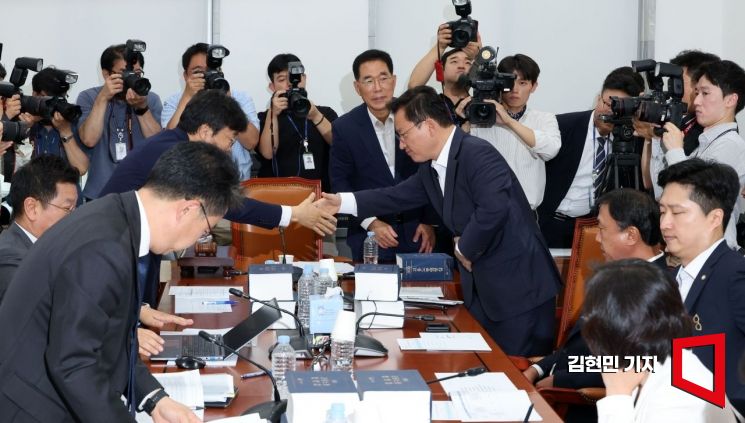 On the 28th, members of the ruling and opposition parties greet each other at the 1st Employment Labor Bill Review Subcommittee of the National Assembly Environment and Labor Committee held at the National Assembly Members' Office Building. 2025.7.28 Photo by Kim Hyunmin
According to industry sources on July 29, the Democratic Party of Korea intends to pass the Yellow Envelope Act at the National Assembly plenary session scheduled for August 4. The previous day, the National Assembly's Environment and Labor Committee held consecutive subcommittee and full committee meetings to approve the Yellow Envelope Act. The legislation has now cleared a major hurdle toward enactment.
The Yellow Envelope Act had previously passed the National Assembly plenary session during the 21st National Assembly and again last year, led by the Democratic Party. However, former President Yoon Suk-yeol exercised his right to request reconsideration (veto) twice, which delayed its enactment. The controversy stemmed from provisions in the amendment that expand the definition of "employer" and the scope of labor disputes, as well as limit companies' ability to claim damages against striking workers.
The Yellow Envelope Act seeks to expand the definition of "employer" to include anyone who has a substantial and concrete impact on working conditions. The issue is that the criteria are ambiguous, which leaves significant room for legal disputes over the scope of liability.
Additionally, if damages occur as a result of industrial action, the amendment stipulates that the extent of each liable party's responsibility should be determined individually, based on the reasons and degree of contribution to the damages. It also prohibits employers from seeking damages from third parties.

In response, the business community has proposed alternatives such as setting an upper limit on damages through a separate enforcement decree and prohibiting the seizure of wages. In particular, they have appealed for the current law to be maintained regarding the expansion of the employer definition and the concept of labor disputes under Article 2 of the Trade Union Act.
Following the passage of the bill in the Environment and Labor Committee, the Korea Employers Federation issued a statement expressing "deep regret and concern" that the bill was passed by reflecting only the demands of labor unions without in-depth discussion of the proposals from management, which is one of the key parties in labor relations.
The federation further warned, "If, as in the amendment, collective bargaining and industrial action come to cover high-level management decisions such as corporate investment, workplace relocation, and restructuring, it will not only make it difficult for our companies to respond to the rapidly changing industrial environment, but will also have a negative impact on the national economy."
They also urged, "For the sake of at least maintaining stability and balance in labor-management relations, we ask that both ruling and opposition parties engage in in-depth discussions and accept the proactive alternatives proposed by the business community."
© The Asia Business Daily(www.asiae.co.kr). All rights reserved.
![Clutching a Stolen Dior Bag, Saying "I Hate Being Poor but Real"... The Grotesque Con of a "Human Knockoff" [Slate]](https://cwcontent.asiae.co.kr/asiaresize/183/2026021902243444107_1771435474.jpg)
















