Total Efforts to Prevent Groundwater Leakage, Including Installation of Barriers
Heavy Metal Levels Below Detection Limits Since 2022
Air Quality Around the Smelter Monitored in Real Time by the Ministry of Environment
On July 25, at the Yeongpoong Seokpo Smelter in Bonghwa County, North Gyeongsang Province, CEO Kim Kiho of Yeongpoong spoke with a confident expression, stating that the company had embarked on a transformation to coexist with the environment during the two-month suspension of operations. Kim said, "It was an opportunity to reflect on the plant and the organization," and added, "Although operations were halted, we took the time to 'clean, tighten, and oil' the smelter, as the old saying goes."
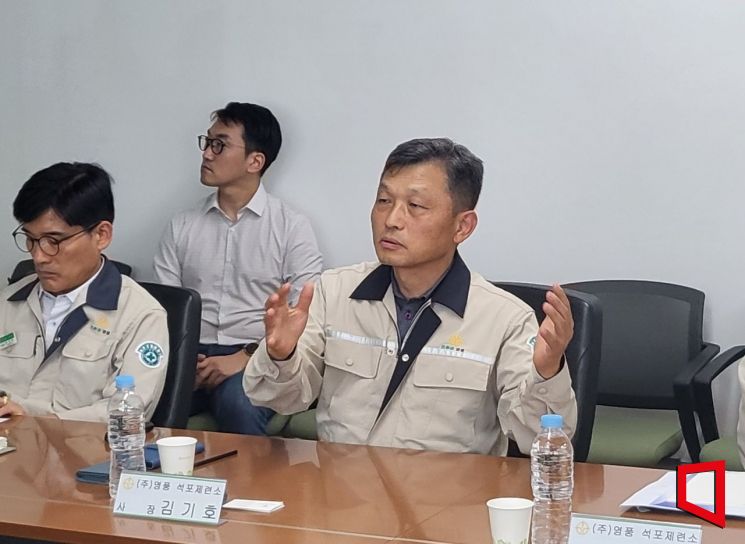 On the 25th, Kim Kiho, CEO of Yeongpung, met at the Seokpo Smelter in Bonghwa County, Gyeongbuk, and explained the changes at the Seokpo Smelter after about two months of suspension of operations. Photo by Shim Sunga
Regarding the soil remediation plan for the Seokpo Smelter, Kim emphasized, "We have established a plan, in consultation with the Ministry of Environment, to remediate all areas by 2027, and the government has accepted this plan." The total area that Yeongpoong must remediate independently is 111,820 square meters. Of this, Plant 3 has completed 100% remediation, while Plant 1 and Plant 2 have reached 37% and 26%, respectively.
Kim explained, "Due to the continuity of operations, it is realistically inevitable that remediation in currently operating areas will take time," but also stated, "For points where remediation is needed, we will improve the soil by demolishing buildings as necessary." He added, "We are thoroughly containing and managing contaminants within the smelter to prevent them from spreading outside."
Regarding the 'arsenic-only contaminated site,' where large amounts of arsenic have been detected, Kim said, "This area naturally accumulated arsenic due to past mining development," and explained, "To prove that this site is not our responsibility, we have commissioned a research study from the Korean Society of Mineral and Energy Resources Engineers, and the results are expected by the end of this year." In contrast, for 'complex contaminated zones' where various metals such as zinc are detected, he declared, "We will take 100% responsibility for remediation."
Strict Groundwater Management... Cadmium and Others Below Detection Limits
Kim expressed confidence regarding water quality improvement. To prevent groundwater leakage, a barrier has been installed beneath the smelter, and 1,200 tons of water are pumped up and purified daily before being recycled in the process. Kim said, "Since groundwater can carry heavy metals into the river, we monitor it daily," and added, "We pump up and purify about 300 tons of groundwater each day for reuse, and we are completely blocking any water from flowing into the Nakdong River."
The 'zero-discharge system,' which has been in operation since 2021, is also notable. This system recycles about 2,600 tons of water used in the factory each day, with no discharge to the outside. To prevent rainwater from transporting contaminants, a storage facility with a capacity of 40,000 tons?13 to 15 times the legal standard of 5 mm?has been built to store rainwater falling on the factory site.
Kim emphasized, "Until 2021, there were records of some heavy metals such as cadmium being detected, but since 2022, levels in the Nakdong River water system have remained below detection limits," adding, "Yeongpoong today is completely different from five years ago."
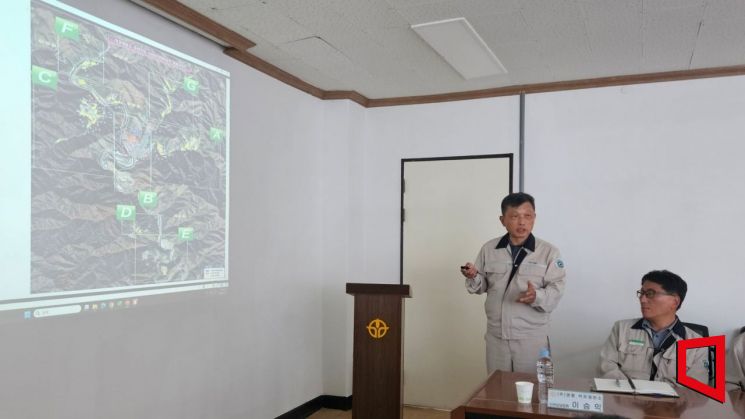 On the 25th, Kim Kiho, CEO of Yeongpung, met at the Seokpo Smelter in Bonghwa County, Gyeongbuk, and explained the changes at the Seokpo Smelter after a two-month suspension of operations. Photo by Shim Sunga
Air Quality Also Stable... Thorough Management with Real-Time Monitoring System
The Seokpo Smelter has a total of six oxygen plants. The most recently constructed, Plant 6, was completed last month. In addition, the facility is equipped with ozone equipment, a remote stack monitoring system (TMS), and indoor air quality measurement stations to maintain a constant monitoring system.
In particular, the TMS installed on the stacks is monitored in real time directly by the Ministry of Environment, making it impossible for the company to manipulate emission data. Kim explained, "Seokpo-myeon and Sinan County, Jeollanam-do, which has the best nitrogen oxide levels in the country, are at similar levels," and added, "Emissions of dust and gases are also stably maintained within legal standards."
Finally, Kim stressed, "The Seokpo Smelter is not just a machine, but a structure infused with over 50 years of accumulated technology and on-site expertise," and added, "If the plant is dismantled, it becomes mere scrap metal, and rebuilding would not immediately restore the current production capacity and eco-friendly systems."
He continued, "More than 70% of the residents in Seokpo-myeon are directly or indirectly connected to the smelter," and added, "For the local residents, the smelter is their very livelihood, so there needs to be serious consideration as to whether converting the smelter into green space makes economic sense for this region."
© The Asia Business Daily(www.asiae.co.kr). All rights reserved.
![Clutching a Stolen Dior Bag, Saying "I Hate Being Poor but Real"... The Grotesque Con of a "Human Knockoff" [Slate]](https://cwcontent.asiae.co.kr/asiaresize/183/2026021902243444107_1771435474.jpg)
















