Interview with Kakao's In-House Hackathon Winning Team
Developing a Program in Just 10 Hours with Vibe Coding
AI Implements Desired Features in Code... Accelerated Development Speed
"Vibe Coding Will Expand in Scope... Productivity Will Increase"
"If we hadn't had artificial intelligence (AI) tools, developing the program would have taken more than six months. Since it was a type of program I was developing for the first time, just studying for it would have taken several months," he said.
On July 23, at the Kakao headquarters in Pangyo, Seongnam, Gyeonggi Province, server developer Shin Hoseok shared his impressions of using AI at a hackathon. According to Shin, by utilizing vibe coding during development, he was able to dramatically reduce what would have otherwise been a development period of over half a year.
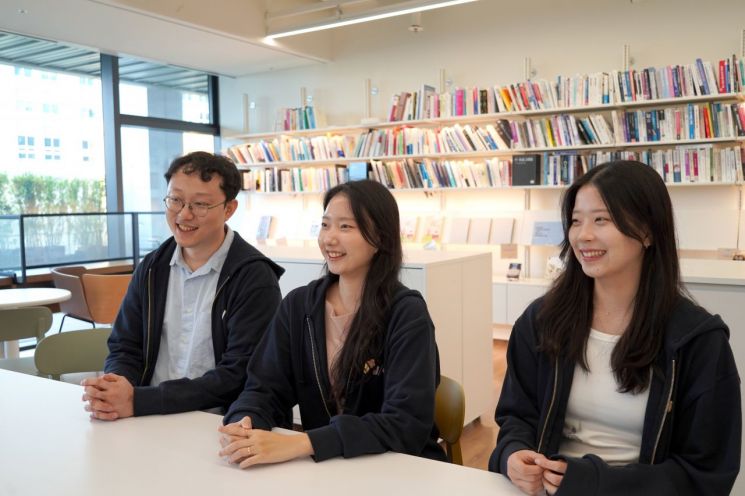 Server developers Hoseok Shin, Minju Hong, and Sujeong Kim (from left) who won first place in Kakao's internal hackathon '2025 10K' are being interviewed by Asia Economy. Photo by Kakao
The team 'Ige Moeyo', consisting of Shin Hoseok and fellow Kakao commerce server developers Kim Sujeong and Hong Minju, took first place at the in-house hackathon '2025 10K' held on June 26. A hackathon is a portmanteau of 'hacking' and 'marathon', referring to a development competition where participants solve a specific topic or implement their ideas as prototypes within a limited time frame.
Since 2013, Kakao has held its annual in-house hackathon under the name '24K', meaning '24 hours for crew (employees)'. This year, the event was renamed '10K' as the competition time was reduced from 24 hours to 10 hours. Participating teams had to complete the entire process?including program planning, minimum viable product (MVP) development, and presentation?within 10 hours.
Instead, the entire development process adopted 'vibe coding', an AI-based development technique. Vibe coding is a method where developers make conversational requests to AI, which then writes code accordingly. The name comes from the idea that the AI codes according to its 'vibe'. Participants were able to delegate coding tasks to AI development tools. Since AI could be used throughout the process, 5% of participating teams consisted solely of non-developers.
Another notable feature was that the first round of hackathon judging was conducted by AI models from Google or OpenAI. The AI models comprehensively evaluated the code written by participants, considering factors such as completeness, efficiency, and user experience (UX). If improvements were needed, the AI even provided feedback. Kim said, "The AI's evaluation was more reasonable than expected," adding, "In the second round, both AI and peer evaluations were conducted, and the results were similar."
Shin's team developed an AI-based assistant tool called 'Super AI Sales Management Assistant' for this hackathon. The tool integrates AI into the sales management pages used by sellers on commerce services like KakaoTalk Gift, allowing users to manage inventory or check sales performance through natural language conversations. If there are any abnormal figures among the sales indicators, they are highlighted on-screen for immediate attention. Developed as a Chrome extension, it can be installed and used directly in web browsers like Chrome or Edge.
Among the team members, Shin has worked exclusively as a backend developer for nearly a decade, while Kim and Hong each have around three years of server development experience. However, this was their first time using vibe coding throughout the entire development process. Shin explained, "It hasn't been long since AI's development capabilities have improved to this level," adding, "Until now, I only used AI for checking project status or testing code in progress."
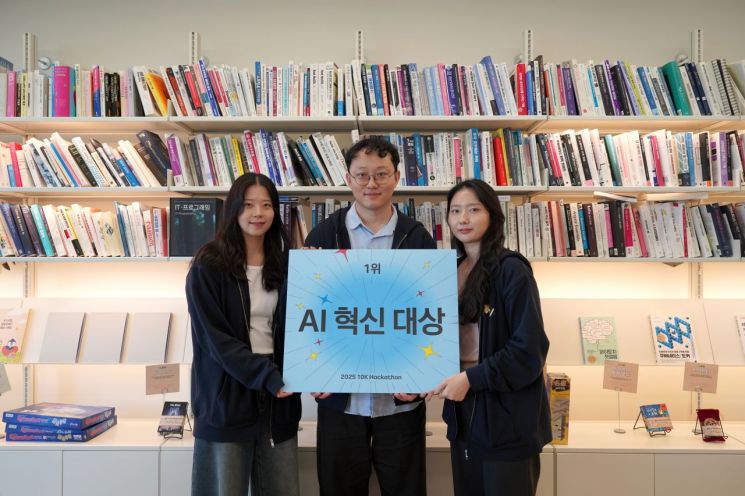 Developers Sujeong Kim, Hoseok Shin, and Minju Hong (from left) who won first place in Kakao's internal hackathon '2025 10K' are posing for a commemorative photo after an interview with Asia Economy. Provided by Kakao
The usefulness of vibe coding became apparent from the early stages of development. Since all team members were backend server developers, they had relatively little experience developing Chrome extensions, which are classified as frontend work. They also had to use Python and JavaScript, rather than their usual work language, Java. Some team members had never used Python before.
However, thanks to the AI tools used for vibe coding, they were able to write programs smoothly and quickly. The AI wrote code containing the desired functions just through conversation. The team members checked whether the generated code worked as intended and implemented the functions accordingly. ChatGPT and the AI-based integrated development environment (IDE) 'Cursor' were used in development. Hong said, "With vibe coding, the speed of development increased, making it easier to decide on and implement program features," adding, "Overall development speed improved, and we were able to quickly set the direction for development."
They also predicted that the use of vibe coding would increase in real development environments, since even with just a conceptual outline of a program, actual implementation and testing are possible through vibe coding. Shin said, "I think the scope of vibe coding will generally expand, and I am already using it myself," adding, "With vibe coding, anyone can clearly see a significant improvement in productivity."
So, could there ever be a time when AI completely replaces developers? All three developers agreed that AI will never fully replace developers. Rather than replacing developers, AI can be an excellent assistant. Shin said, "Although AI's development capabilities are rapidly improving, it still lacks decision-making skills," adding, "Handling the consequences of choices made during development is not within AI's domain." Kim also commented, "AI still falls short in understanding the complex context of programs," and, "It's still too early for AI to make comprehensive judgments and produce results by considering all program elements together."
The team members also suggested that ordinary people, not just developers, could use vibe coding to create programs. However, they emphasized that a basic understanding of program structure is a prerequisite. Hong explained, "I think ordinary people can develop to some extent using vibe coding," but added, "Users need to have fundamental background knowledge and be able to communicate the desired features to the AI."
© The Asia Business Daily(www.asiae.co.kr). All rights reserved.


















