Offices Evolving into Platforms for Realizing Corporate Vision
Building OS Wins CES Innovation Award
Scarcity Drives Up Office Values
Seongsu, Magok, Sindorim, Seocho... To Be Completed at Seoul Station and Namsan by 2031
"Beyond Providing Office Space, a Test Bed for New Technologies and Businesses"
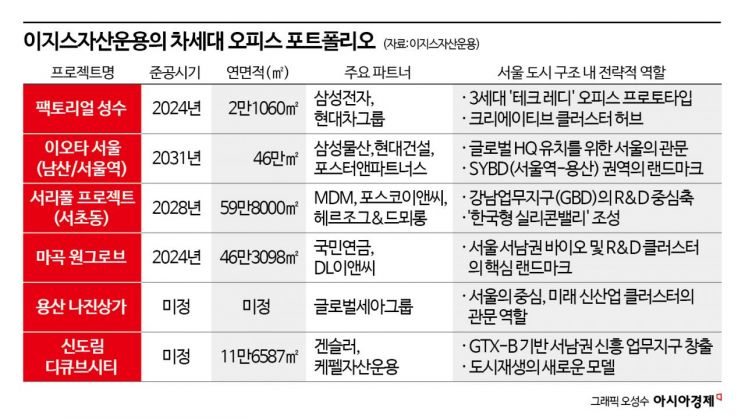
Aegis Asset Management, the second largest commercial real estate manager in Asia by assets under management, is drawing market attention with its next-generation office portfolio underway at six key locations in Seoul.
This is not just about providing office space; it is a massive project that aims to transform Seoul’s outdated offices, many over 30 years old, into new knowledge infrastructure and serve as a platform for realizing the future vision of companies. Leading corporations such as Samsung Electronics, Hyundai Motor, and Naver have partnered with Aegis Asset Management.
Offices Evolving into Platforms for Realizing Corporate Vision
Aegis Asset Management has taken note of the global trend where office spaces are evolving from simple workplaces into platforms for realizing corporate visions.
Companies leading the Fourth Industrial Revolution consider top talent in artificial intelligence (AI) and software as their most important asset. One of the most effective ways to attract and enable collaboration among these key talents is through the work environment itself.
More companies are investing in workspaces that can inspire top-level talent. This is increasingly recognized as a direct strategic investment to secure and retain talent, which is the core driver of corporate value creation. Notable examples include Google’s ‘Kings Cross HQ’ in London, Microsoft’s ‘Redmond Campus’ in Washington, Nvidia’s ‘Voyager Campus’, and Apple’s ‘Apple Park’.
Common features of these global headquarters include: expansive floor areas reminiscent of large campuses; AI-based digital amenity services; and digital twin technologies.
Offices have evolved into new platforms that naturally foster ‘serendipitous encounters’ among in-house talent (Serendipity Architecture) and provide an environment for focused work through AI-based digital amenities, thus enabling the realization of corporate visions.
The majority of buildings in Seoul’s major business districts are now 30 to 40 years old, and there is a severe shortage of offices suitable for global tech companies. In fact, there are only six offices with a floor area of over 1,650 square meters, including GFC and Centerfield. Aegis Asset Management is supplying next-generation offices that combine advanced operational systems at locations such as Sindorim D-Cube City and Iota Seoul (the former Namsan Hilton Hotel site), both with floor areas exceeding 3,300 square meters.
Iota Seoul will combine the Seoulro Tower and Metro Tower into a single complex, raising all technical specifications and physical features to the highest level. It will be a global landmark office space that also incorporates sustainability considerations such as carbon-neutral design.
An Aegis Asset Management representative stated, “Offices in the AI era are evolving into hybrid intelligent platforms that integrate technology, people, and sustainability,” adding, “Spaces are no longer just places to work; they are laboratories and brand symbols where AI and people create together.”
Building OS Wins CES Innovation Award
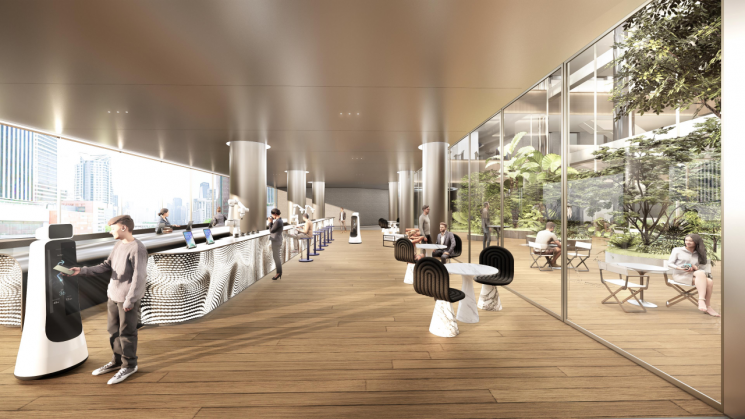
Aegis Asset Management has already showcased a prototype of the next-generation office in Seongsu-dong. Factorial Seongsu, completed in February last year, is equipped with its proprietary building operating system (OS) called ‘Taap & Ctrl.room’.
In the past, once a building was constructed, its functions were fixed, much like hardware. Factorial Seongsu has evolved into a platform where various technologies and services can be installed and updated like apps on top of the OS. Thanks to this design philosophy, it can flexibly integrate new robot technologies, AI-based environmental control systems, and next-generation software as they emerge in the future, continuously enhancing building value. In fact, Samsung Electronics tested its central air control platform technology at Factorial Seongsu, while Hyundai Motor Group experimented with autonomous parking robots and indoor/outdoor delivery robots. Pinpoint was responsible for developing solutions that combine space and digital technology.
Factorial Seongsu’s ‘Taap & Ctrl.room’ became the first commercial real estate OS to win an innovation award at CES 2025.
Scarcity Drives Up Office Values
The office portfolio of Aegis Asset Management is expected to have a direct impact on alternative investment returns for major domestic institutional investors.
Some in the market are concerned that office supply in the Jongno and Gwanghwamun areas will increase significantly by 2031, leading to intensified competition and higher vacancy rates. However, Aegis Asset Management argues that the focus should be on the ‘qualitative shift in supply’ rather than simply the increase in quantity. As seen in overseas cases, the office market is expected to experience severe polarization, with an accelerated ‘flight-to-quality’ phenomenon, where demand concentrates on high-quality assets. Landmark offices are expected to become even more valuable.
Aegis Asset Management’s Strategic Research Department recently published a report titled ‘Changes in Office Demand·Supply and Asset Cycles’, which analyzed the nominal occupancy cost (NOC) per 3.3 square meters for large offices in Seoul’s central business district (CBD), where the proportion of new supply exceeding 33,000 square meters (10,000 pyeong) has been high over the past decade. In 2010, the NOC per 3.3 square meters for large offices was 1.9 times higher than that of small offices, but by last year, the gap had widened to 2.5 times. In the Yeouido business district (YBD), the difference increased from 2.2 times to 2.8 times over the same period.
Most of the new prime offices to be supplied in the future are planned with top-tier specifications, including ESG certifications, state-of-the-art smart building systems, and premium amenities. This marks a fundamental departure from the past market structure, which was dominated by small-to-medium and lower-spec offices.
Among Grade A offices, the so-called ‘trophy assets’ at the very top have become even more valuable due to their scarcity. This is also supported by historical data. The IFC in Yeouido, which was built in 2011 at a cost of 1.5 trillion won, was sold to Brookfield for 2.5 trillion won in 2016. Its current value exceeds 4 trillion won.
Seongsu, Magok, Sindorim, Seocho... To Be Completed at Seoul Station and Namsan by 2031
Aegis Asset Management is executing a large-scale portfolio strategy to systematically upgrade the city’s knowledge production infrastructure by connecting major hubs throughout Seoul. This goes beyond the sum of individual projects and reflects a long-term vision to reshape Seoul’s economic landscape.
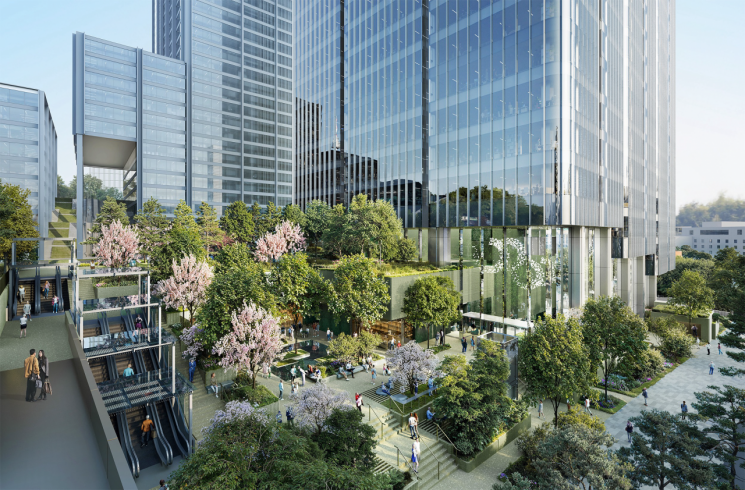
The flagship project is undoubtedly ‘Iota Seoul’. Located on the former Hilton Hotel site opposite Seoul Station?the heart and gateway of Seoul?this project is designed as a masterpiece to elevate the city’s competitiveness. With a total floor area of approximately 460,000 square meters, it is similar in size to the three IFC towers in Yeouido combined. The world-renowned architect Norman Foster’s Foster + Partners, who designed Apple’s new headquarters, is serving as the overseas design partner.
Iota Seoul is targeting global tech companies as its core tenants. In the heart of Seoul, the building’s advanced technological infrastructure and structural features will enable tenants to experiment with new visions. The ‘Mega Floor Plate’, with each floor exceeding 3,500 square meters, will allow more than 350 people to collaborate organically in a vast, column-free space.
This is the optimal structure for agile work and cross-departmental collaboration, both essential in the AI era. Forty percent of the total site area will be developed as green space for citizens, and escalators and other features will connect the previously disconnected pedestrian axis from Seoul Station to Namsan, enhancing urban public accessibility.
The Iota project, with a total project cost of 6.5 trillion won, is being carried out through two project financings (PF). While Iota 1 is centered around the Ritz-Carlton Hotel, Iota 2 will focus on a global landmark office.
"Beyond Providing Office Space, a Test Bed for New Technologies and Businesses"
Olive Young opened its first innovation store, ‘Olive Young SeongsuN’, at Aegis Asset Management’s ‘Factorial Seongsu’ at the end of last year. The store is about three times the size of its previous largest store in Myeongdong. It operates as a platform that provides lifestyle experiences beyond simply selling beauty products.
Samsung Electronics’ IoT technology has been applied to building operations, and Hyundai Motor Group’s robotics services have been used for parking and tenant services. Companies in related businesses are also using the space as a test bed for integrating new technologies while leasing offices.
In line with Aegis Asset Management’s strategy of ‘researching industries and providing the necessary spaces’, collaboration with large corporations has taken place in various ways. Samsung Electronics is actively targeting the AI B2B solution market beyond residential facilities to office buildings and commercial spaces through ‘SmartThings Pro’.
The ‘FIT Platform’, which will be applied to the remodeling of the Taepyeongno Building owned by Aegis Value REITs, is also a future space platform jointly developed by Samsung Electronics and Samoo Architects & Engineers. Naver will combine its smart technology with the FIT Platform to jointly develop a ‘Tech Convergence Space Platform’.
An industry official explained, “If large corporations’ solutions are successfully implemented in Seoul’s flagship projects and operational data is accumulated, it will become a powerful reference,” adding, “This will play an important role in expanding B2B businesses into overseas markets.”
© The Asia Business Daily(www.asiae.co.kr). All rights reserved.



















