Professors Minseong Ko and Sujong Chae Publish in Journal of Materials Chemistry A
Development of Impurity Control Technology in Microstructure
for High-Quality NCA Cathode Material
A research team at Pukyong National University has developed a technology that can reduce structural defects and solve performance degradation issues in NCA (Ni0.80Co0.5Al0.05) cathode material, a core material for high-energy density secondary batteries.
The research team led by Professors Minseong Ko (Department of Metallurgical Engineering) and Sujong Chae (Department of Energy Chemical Materials) at Pukyong National University developed an ion-exchange-based modification technology to remove anionic impurities from the NCA precursor, thereby overcoming the structural limitations of existing manufacturing methods.
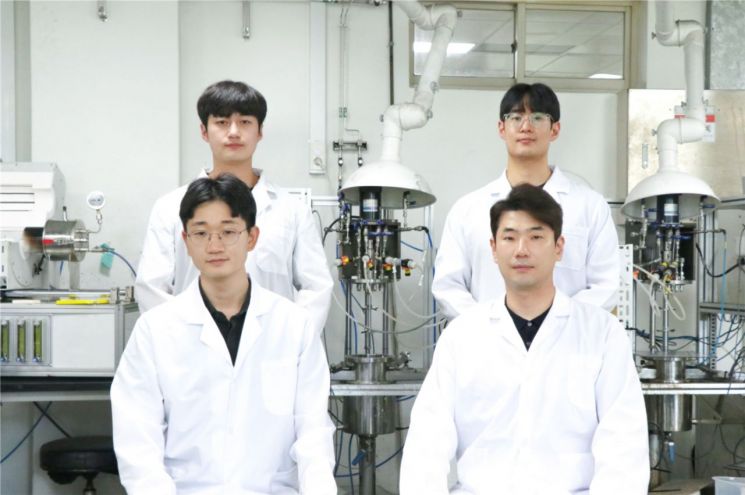 Research team, Professor Minseong Ko (front right) and Professor Sujong Chae (left). Courtesy of Pukyong National University
The results of this research were published in Volume 13, Issue 23 of Journal of Materials Chemistry A (IF=9.5), a world-renowned journal in the fields of energy and materials, in 2025.
The process developed by the research team effectively removes sulfate ion (SO₄²)-based impurities that cause structural instability in conventional processes. This suppresses the degradation of NCA cathode materials and enhances their electrochemical stability.
In the conventional co-precipitation method using sulfate-based precursors, sulfate ions remain within the Layered Double Hydroxide structure of the NCA precursor. During subsequent heat treatment, these sulfate ions react with lithium to form Li₂SO₄, which induces particle agglomeration and hinders the formation of a stable crystal structure. As a result, this increases side reactions within the electrode and restricts lithium-ion diffusion, acting as a structural limitation that leads to overall electrochemical performance degradation.
To address this, the research team newly introduced an ion-exchange strategy using chloride ions (Cl). This method selectively removes sulfate ions, significantly improves the crystallinity of the precursor, and successfully suppresses the occurrence of side reactions. The process is not complicated and can be easily applied to existing manufacturing processes, making it noteworthy for its practicality and scalability in industrial settings.
Experimental results confirmed that the capacity of the NCA cathode material modified by the ion-exchange method reached 196.5 mAh/g, demonstrating the stable realization of the material's inherent performance.
In particular, the content of sulfate ions, which is identified as a major cause of performance degradation, was reduced by up to 80%, stabilizing the crystal structure and ensuring a uniform lithium-ion migration path, which led to overall improvement in electrochemical performance.
The initial coulombic efficiency of the modified NCA cathode material reached 91.4%, which is higher than that of the unmodified material. After 150 charge-discharge cycles, the capacity retention rate also increased by about 12%, greatly improving long-term cycle life characteristics. Even under high-rate discharge conditions, about 11% performance improvement was observed, confirming enhanced output characteristics.
Professor Minseong Ko stated, "This technology is not limited to NCA cathode materials of a specific composition, but has high potential for application to various secondary battery cathode material systems. By effectively overcoming the structural limitations that hindered the inherent performance of existing NCA materials, further performance improvements are expected through additional modification processes in the future."
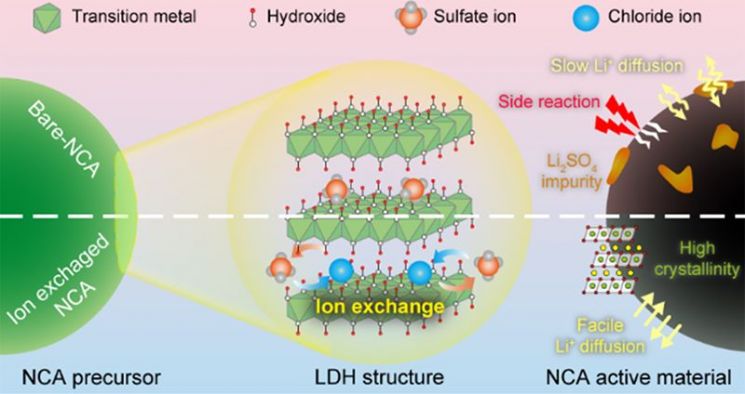 Schematic diagram of impurity control and structural stabilization through ion exchange strategy of Ni-rich NCA precursor.
This research was supported by the National Research Foundation of Korea (Priority Research Center Program) and the Korea Energy Technology Evaluation and Planning (Energy Human Resources Development Program).
© The Asia Business Daily(www.asiae.co.kr). All rights reserved.
![Clutching a Stolen Dior Bag, Saying "I Hate Being Poor but Real"... The Grotesque Con of a "Human Knockoff" [Slate]](https://cwcontent.asiae.co.kr/asiaresize/183/2026021902243444107_1771435474.jpg)
















