Confirmation of Positions Rather Than a Breakthrough... "Symbolic Agreement"
Preparatory Stage Before Summit... Will the US and China Meet at APEC?
The South China Morning Post (SCMP), a Hong Kong media outlet, reported on the 27th, citing sources from both countries, that the United States and China are expected to agree to extend the tariff truce for an additional 90 days during the high-level trade talks scheduled to be held in Stockholm, Sweden, from July 28 to 29 (local time). With the possibility of the US-China tariff truce being extended until November, there is speculation that US President Donald Trump and Chinese President Xi Jinping may directly engage in trade negotiations at the Asia-Pacific Economic Cooperation (APEC) summit to be held in Korea at the end of October.
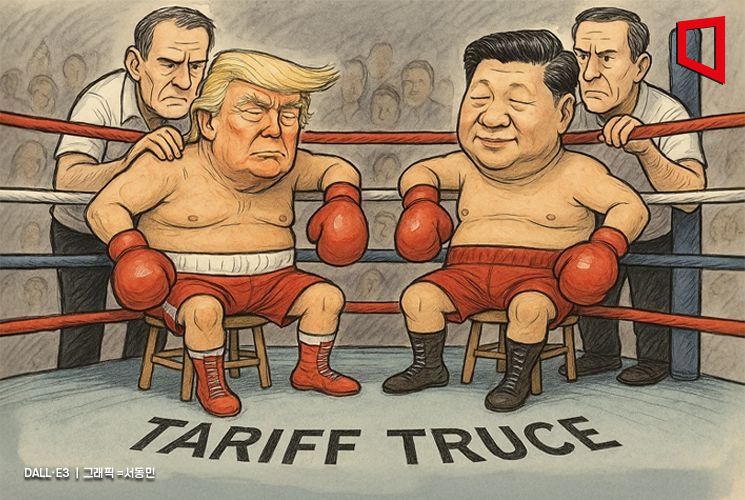
The two countries are expected to discuss extending the period of reduced super-high tariffs during this third round of high-level trade talks, which will be attended by US Treasury Secretary Scott Besant and Chinese Vice Premier He Lifeng.
According to SCMP, quoting sources, both countries are expected to merely state their positions rather than reach a concrete breakthrough on the main contentious issues at this meeting. One source stated that the two countries would agree not to impose additional tariffs on each other or escalate the trade war by other means during the additional 90-day grace period. The US and China, which had been engaged in a triple-digit tariff war, agreed at the Geneva talks in May to lower tariffs by 115 percentage points each for 90 days. This measure is set to expire on August 12. If the grace period is extended by another 90 days, the tariff truce will last until November.
Previously, on July 22, Secretary Besant suggested an extension of the super-high tariff suspension in an interview with Fox Business regarding the third round of high-level US-China trade talks, saying, "We will address what is likely an extension." On the evening of the same day, President Trump stated in Scotland, United Kingdom, ahead of a meeting with Ursula von der Leyen, President of the European Commission, "We are very close to an agreement with China."
Niklas Swanstr?m, director of the Swedish think tank Institute for Security and Development Policy, said, "It does not seem likely to be a breakthrough," but added, "If there is no outcome at all, it would be disappointing, so I believe there will be at least a symbolic agreement, even if it is small."
Given that President Trump prefers a 'top-down' approach to negotiations involving direct communication between leaders, there is analysis that this third round of high-level talks serves as a preparatory stage for a US-China summit. According to an SCMP report citing sources from the previous day, President Trump is highly likely to visit China before the APEC summit or hold a separate meeting with President Xi during the APEC summit.
Philippe Le Corre, head of the Asia Program at France's ESSEC Business School, analyzed that a trade agreement could be reached at the APEC summit to be held in Gyeongju, Korea, at the end of October between President Trump and President Xi. He said, "Through this third round of talks, people will be able to grasp the details of an agreement that is not yet well known, and the next step will be a meeting between the two leaders."
In addition, the issue of fentanyl tariffs is expected to be a key agenda item at this meeting. The first and second rounds of high-level talks previously focused on easing trade tensions. However, three sources indicated that at this meeting, China plans to raise the issue of fentanyl-related tariffs with the United States. President Trump imposed a 20% tariff on China in March, stating that China had not taken sufficient measures to prevent the inflow of fentanyl into the United States.
The Peterson Institute for International Economics (PIIE), a think tank, assessed that the current average US tariff rate on Chinese imports, with the grace measures applied, reaches 51.1%. This figure includes the basic tariff (10%), the fentanyl tariff (20%), and all tariffs imposed on China during President Trump's first term.
© The Asia Business Daily(www.asiae.co.kr). All rights reserved.
![Clutching a Stolen Dior Bag, Saying "I Hate Being Poor but Real"... The Grotesque Con of a "Human Knockoff" [Slate]](https://cwcontent.asiae.co.kr/asiaresize/183/2026021902243444107_1771435474.jpg)















