Number of Heat-Related Illnesses 2.5 Times Higher Than Last Year
Over 1 Million Livestock Deaths... 10 Times Increase
"It's Still July, the Heat Will Continue for Now"
Two high-pressure systems are currently covering the Korean Peninsula, resulting in a prolonged period of scorching weather. As various regions continue to break their own records for highest temperatures, the number of daily heat-related illness cases has more than doubled compared to the same period last year.
According to the Ministry of the Interior and Safety on July 28, heat wave advisories were issued for all 17 metropolitan cities and provinces across the country as of that morning. The Korea Meteorological Administration forecast that the sweltering heat, with maximum perceived temperatures nationwide hovering around 35 degrees Celsius, would continue for the time being. On this day, the minimum temperature in Yongsan, Seoul, and Gangneung was 30.4 degrees Celsius, far exceeding the 25-degree threshold that defines a tropical night. While some regions experienced brief showers that temporarily lowered temperatures, the heat is expected to return as daytime temperatures rise again in humid conditions after the rain stops.
In some areas, this period has been recorded as the hottest on record for the time of year. On the previous day, Daegwallyeong in Gangwon Province reached a high of 33.2 degrees Celsius, marking the hottest July day ever recorded there. Just one day earlier, on July 26, Daegwallyeong had already broken its previous record with 33.1 degrees Celsius, surpassing the 2018 record, and then broke it again the next day. In Seoul, the daytime high reached 38 degrees Celsius on the previous day, making it the fourth hottest July day on record for the city.
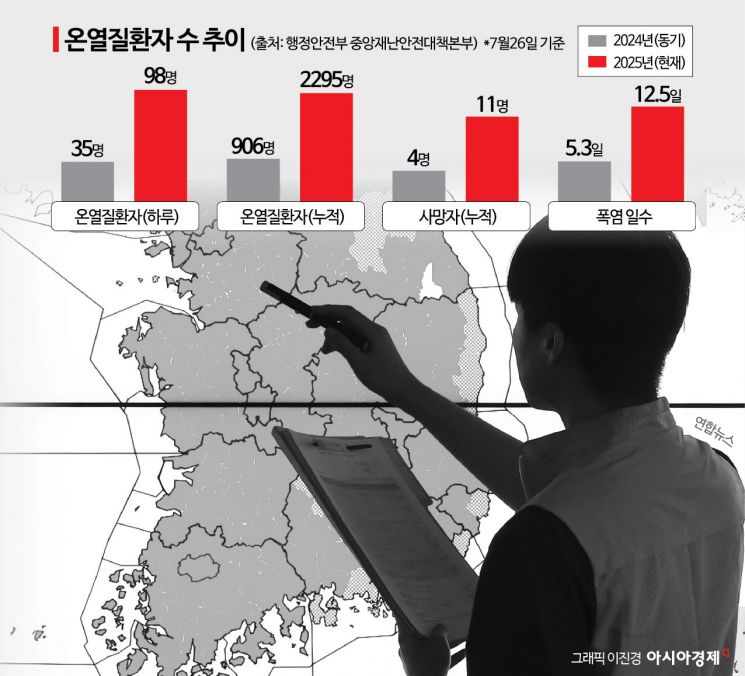
The ongoing heat wave has quickly led to an increase in both human casualties and property damage. The scale of the damage is particularly large compared to the same period last year. On July 26, there were 98 new cases of heat-related illness, more than double the 35 cases reported on the same day last year. The cumulative number of heat-related illness cases this year reached 2,295, which is 1,389 more than last year, and the death toll increased by seven to a total of 11. The number of livestock deaths due to the heat reached 1,011,243, which is 10.5 times higher than the 96,148 recorded last year. Damage to aquaculture was also reported, with 2,030 animals affected.
This heat wave was caused by two high-pressure systems covering the Korean Peninsula. The Tibetan High was present in the upper atmosphere, while the North Pacific High dominated the middle and lower layers, resulting in heat waves and tropical nights across the entire country. Additionally, the Foehn phenomenon, where southeastern winds cross over mountains and raise temperatures, caused the western side of the Baekdudaegan mountain range to become hotter than the eastern side.
The problem is that there is no clear end in sight for the heat wave. According to the Korea Meteorological Administration's mid-term forecast for August 1 to 7, daytime highs in most regions will rise to between 33 and 35 degrees Celsius. Minimum temperatures will also remain around 25 degrees, meaning tropical nights will continue. An official from the Korea Meteorological Administration stated, "We can forecast daily temperatures up to ten days in advance, and it will remain above 33 degrees throughout that period. Since August, typically the hottest month of the year, has not yet arrived, it is difficult to say when the heat will end." The official added, "The North Pacific High continues to cover Korea, and hot air is still flowing in from the southeast, so the heat wave is expected to persist throughout this week."
The government has operated the Central Disaster and Safety Countermeasures Headquarters since July 25 to respond to the heat wave. At a headquarters meeting on the morning of July 28, Yoon Ho-jung, head of the headquarters and Minister of the Interior and Safety, said, "Please make every effort to ensure that disaster victims affected by recent wildfires and heavy rains do not suffer secondary damage to their health due to the heat wave." He also requested, "Provide maximum support to ensure that those engaged in recovery and search operations for flood damage are not exposed to heat-related illnesses and can work without inconvenience."
© The Asia Business Daily(www.asiae.co.kr). All rights reserved.

















