3% Rule, Cumulative Voting, and Mandatory Treasury Share Retirement Under Discussion
Significant Impact on Spin-Offs and Mergers...Possibility of Recurrent Chaebol Family Disputes
Significant changes are expected in the capital market due to the so-called 'Stronger Commercial Act.' On July 28, DS Investment & Securities published a report titled 'Scenarios After the Amendment of the Commercial Act,' analyzing that, as seen in the Pharmaresearch division withdrawal case, the revised law will affect mergers and spin-offs of listed companies. The report also noted the possibility of renewed management disputes in companies with high second-largest shareholder stakes, such as Korea & Company.
Among the amendments, the 'Duty of Loyalty of Directors to the Company and Shareholders' took effect on July 15. However, the rule limiting the voting rights of the largest shareholders and related parties to 3% in the election of all audit committee members (including both inside and outside directors), the renaming of outside directors to 'independent directors,' and the increase of the mandatory proportion of independent directors from one-fourth to one-third of the total board members have been postponed for one year. The requirement for listed companies with assets of 2 trillion won or more to introduce on-site electronic general meetings of shareholders will take effect from January 2027.
Provisions currently under active discussion in the National Assembly include the prohibition of excluding cumulative voting in the articles of incorporation (mandatory cumulative voting), the expansion of separately elected audit committee members from at least one to two or more (expansion of separate election for audit committee members), and the mandatory retirement of treasury shares exceeding a certain ownership ratio (mandatory retirement of treasury shares).
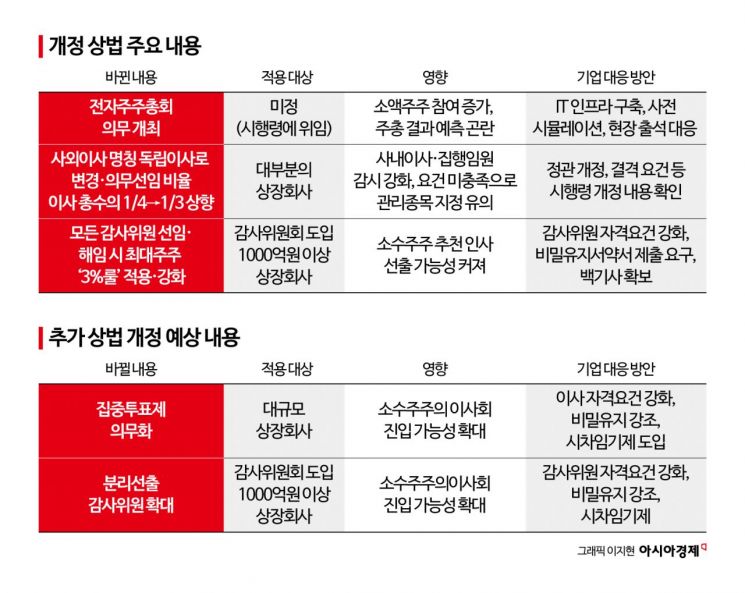
3% Rule, Cumulative Voting, and Mandatory Treasury Share Retirement Under Discussion
If the 3% rule is introduced, the largest shareholders and related parties will only be allowed to exercise up to 3% of their voting rights. DS Investment & Securities analyzed that the average stake held by the largest shareholders and related parties in 24 domestic holding companies is 43.9%, which is higher than the average of 40.2% in 206 general companies, suggesting a greater impact on holding companies.
However, from the perspective of the largest shareholders, cumulative voting can be neutralized by staggering the appointment of directors. For example, if the terms of six directors are set differently and only one director is replaced at each regular or extraordinary shareholders' meeting held every year or every six months, shareholders can focus their votes on only one candidate per meeting. In this case, minority shareholders will have limited options for concentrating their votes, effectively neutralizing the cumulative voting system.
For minority shareholders, expanding the separate election of audit committee members must be applied simultaneously. Previously, at least one audit committee member was elected separately at the shareholders' meeting. Now, two or more, or even all, audit committee members must be separately elected at the shareholders' meeting. In these cases, the largest shareholders and related parties can only exercise up to 3% of their voting rights.
The ruling Democratic Party of Korea plans to additionally amend the Commercial Act to mandate the retirement of not only newly acquired treasury shares but also existing treasury shares. Newly acquired treasury shares must be retired within six months to one year of acquisition, and if the amount is less than 3%, the deadline may be extended to two years. There is also a possibility that the People Power Party will propose a compromise.
Significant Impact on Spin-Offs and Mergers...Possibility of Recurrent Chaebol Family Disputes
When conflicts of interest arise between controlling and minority shareholders in cases such as spin-offs, mergers, or new share issuances, the 'duty of loyalty of directors to shareholders' is likely to apply. In the past, such actions in Korea were often used for the personal benefit of controlling shareholders, to the detriment of minority shareholders' influence. Now, to conduct spin-offs or mergers without violating the amended Commercial Act, controlling shareholders must ensure procedural legitimacy, unlike in the past. For example, to merge through a spin-off, all minority shareholders' shares must be acquired through a public tender offer, or the process must include 'independent decision-making' and 'majority approval by general shareholders' as in the United States.
DS Investment & Securities predicted that Hanwha may attempt a spin-off for the purpose of separating business groups among the three brothers in the medium to long term. After strengthening the three brothers' control over Hanwha, they may attempt to separate manufacturing, finance, and distribution divisions through a spin-off. As a result, there is a high possibility that Hanwha's minority shareholders will demand a 100% public tender offer or fair compensation before the group separation.
DS Investment & Securities also expects increased pressure to withdraw IPO plans for several LS Group subsidiaries. LS EV Korea, KOC Electric, LS E-Link, Essex Solutions, and Superior Essex had IPO plans, but KOC Electric's listing has been postponed. When the issue of dual listings arose at SK Group, the IPO of SK Enmove was withdrawn. Consequently, the IPO plans and progress for SK On and SK Ecoplant are also expected to face difficulties. Woori Financial Group, which is pursuing the acquisition of Tongyang Life, is likely to conduct a public tender offer at a premium to the market price.
Meanwhile, due to cumulative voting, the influence of the largest shareholders in director appointments will be reduced, while the influence of the second- or third-largest shareholders may increase if they ally with minority shareholders. DS Investment & Securities stated, "In companies where management disputes have occurred, the passage of these bills may lead to renewed disputes," adding, "In the case of Korea & Company, the opposing faction led by Cho Hyunshik and his allies have a high stake, and under any scenario, it is certain that Cho Hyunshik's side will secure at least one director." The report also projected that companies such as Hanjin KAL, LS, Hanmi Science, and Kumho Petrochemical may also see renewed disputes.
If the mandatory retirement of treasury shares is legislated, it is highly likely that major listed holding companies will retire their treasury shares. However, SK must be cautious about tax issues when retiring treasury shares. Of SK's 24.8% treasury shares, 15% were generated during the merger of SK and SK C&C, and treasury shares created during the post-spin-off merger process are subject to taxation upon retirement. DS Investment & Securities estimated that if SK retires 15% of its treasury shares, corporate taxes could exceed 500 billion won.
© The Asia Business Daily(www.asiae.co.kr). All rights reserved.
![Clutching a Stolen Dior Bag, Saying "I Hate Being Poor but Real"... The Grotesque Con of a "Human Knockoff" [Slate]](https://cwcontent.asiae.co.kr/asiaresize/183/2026021902243444107_1771435474.jpg)















