Frequent Corporate Exodus from Europe
EU-Wide, Long-Term Measures Prepared
Support from Startup to Global Expansion
Unified Bankruptcy, Tax, and Labor Regulations
The European Union (EU) is drawing attention as it embarks on institutional reforms to enable companies to address the "scale-up" stage?when startups begin to grow in earnest?within Europe itself. The EU recently announced its Startup·Scale-up Strategy, which weaves together the entire process from founding and technological advancement to overseas expansion into a single approach. This strategy includes comprehensive measures such as regulatory easing, capital inflow, and talent attraction.
This move comes as an increasing number of startups are leaving Europe in search of better business environments, prompting the EU to develop a continent-wide, long-term response. Experts note that this is highly relevant for countries like South Korea, where the startup and scale-up environment is deteriorating due to increased regulations and costs, and where investment in early-stage startups is shrinking.
According to the global startup community on July 28, the European Commission unveiled a joint response strategy in May titled "Choose Europe to Start and Scale," aimed at retaining European tech startups that are being lost to overseas markets. The goal of this strategy is to transform Europe into a "scale-up-friendly continent" through institutional reforms, capital procurement, and talent attraction at the EU level.
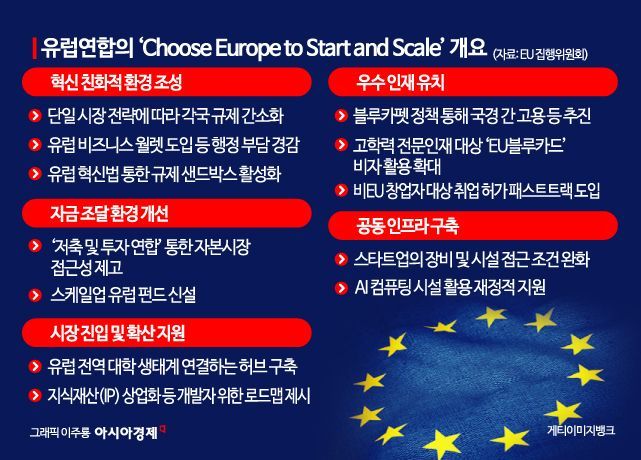
The European Commission has begun institutional improvements across five key areas to ensure that companies can grow and settle in Europe after their founding: ▲creating an innovation-friendly environment ▲improving funding conditions ▲supporting market entry and expansion ▲attracting top talent ▲building shared infrastructure. The EU will unify previously separate national regulations on bankruptcy, taxation, and labor, and will establish the "Scale-up Europe Fund" and a dedicated deep tech investment vehicle to attract private capital, including pension funds.
The EU will also streamline technology transfer procedures to ensure that technologies from universities and research institutes quickly reach the market, and will expand incentives for founders. The "Blue Carpet" policy will expedite visa issuance for foreign founders, while improvements to stock option taxation and integration of demonstration infrastructure are also planned.
This strategy stems from a sense of crisis within the European startup ecosystem. As of this year, there are only 110 unicorn companies originating from Europe, which is just one-sixth the number in the United States (687). Of the European unicorns founded between 2008 and 2021, 30% have relocated outside the EU in search of better investment environments. Currently, only 8% of global scale-up companies are headquartered in Europe. The European Commission explained, "European startups often stall at the research lab stage," and emphasized, "There is a need for institutional advancement in the post-founding stage."
South Korea also operates numerous support programs for each stage of startup and growth. There are efforts to discover technologically capable companies and link them to scale-up opportunities through programs such as TIPS (Tech Incubator Program for Startup), the Pre-Unicorn Support Program, and various startup packages, all of which are led by private investment. However, these programs remain fragmented, and there is criticism that the country lacks the institutional capacity to enhance policy connectivity and develop a comprehensive strategy.
The Lee Jaemyung administration has recognized these limitations and has made full-cycle startup support a national agenda. To establish a virtuous cycle of "startup→growth→exit→global expansion," the government is promoting measures such as encouraging pension fund investment, supporting technology spin-offs, and establishing regulatory relief mechanisms. While these efforts align with the EU's strategic direction, the challenge remains to achieve the strategic coordination and execution necessary for global expansion.
The "K-Startup Grand Challenge," a representative program for attracting foreign founders, reduced its selection size from the originally planned 60 to 40 last year due to issues such as visa delays and mismatches in the timing of grant disbursement. A venture industry official stated, "It is time for the country to concretize a 'strategic big picture' that not only supports startups but also connects them to global expansion."
© The Asia Business Daily(www.asiae.co.kr). All rights reserved.
![Clutching a Stolen Dior Bag, Saying "I Hate Being Poor but Real"... The Grotesque Con of a "Human Knockoff" [Slate]](https://cwcontent.asiae.co.kr/asiaresize/183/2026021902243444107_1771435474.jpg)















