Naming a Racehorse Is More Complicated Than You Think...
Horse Name Registration Rules Take Priority Over Creativity
The French Landmark "Eiffel Tower":
A Racehorse Bearing the Name Runs on the Track
There is an old saying: "Hosa yupi, insa yumyeong."
This classic proverb, which translates to "A tiger leaves its skin after death, and a person leaves their name," reminds us that a name is not just a simple label for identification, but a trace of life and a mark of honor.
But is this proverb only true for people? Not at all. Racehorses that run on the track are also remembered, recorded, and sometimes even become legends?like Reckless?through their names.
In just about two minutes of a race, a racehorse captures the attention of the audience and engraves its name in the minds of fans. Even after retirement, what remains in records and memories is ultimately the "name." So, how are racehorses named?
While people usually receive their names within a month of birth, the process is a bit different for racehorses. Until they are one year old, they are referred to by their lineage, such as "offspring of OOO." Only after that do they become eligible for their own unique name. The "horse name" is usually chosen by the owner, but it must go through a strict review process according to the "Horse Name Registration Regulations." This process is far more complex and demanding than naming a person.
There are several restrictions on naming racehorses. Names of well-known public figures or politicians (including nicknames), as well as company names, product names, or anything that could be interpreted as commercial advertising or that violates public order or good morals, are not allowed for racehorses.
In fact, these standards are similarly applied not only in Korea but also abroad. For example, in South Africa, a racehorse named "President Trump" was not only causing repeated behavioral issues but also had the potential to spark political controversy, so the regulatory authorities requested a name change.
There are also limits on the number of characters. For Korean names, two to six characters are allowed, and for foreign-bred horses, up to eight Korean characters are permitted. For instance, a foreign-bred horse named "Buum" became well-known after winning consecutive titles in the 2002·2003 Owners' Association Cup. Originally imported as "BOOM," the horse was registered as "Buum" instead of "Boom" because regulations prohibit single-character names in Korean.
While it is common for people to have the same name, in the world of racehorses, duplicate names are nearly impossible. This is because names that have already been used, or those that are famous or could cause confusion, are restricted. Additionally, for broodmares, the same name cannot be used for ten years after death or retirement, and for stallions, the restriction lasts fifteen years. Thus, for racehorses, a name is a unique history and remains a singular record that is never duplicated.
People can relatively freely change their names for reasons of inconvenience, teasing, or psychological reasons, but for racehorses, it is different. A racehorse's name cannot be changed in principle, and even if an exception is granted, it can only be changed once before the horse's first race, and only after passing a rigorous review.
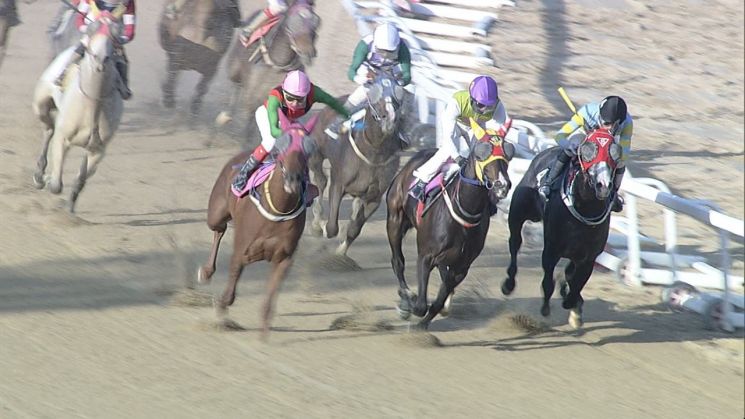
Looking at a race card, sometimes a name catches your eye?like "Eiffel Tower." The name alone brings to mind the iconic French landmark loved around the world. But at Let's Run Park Seoul, "Eiffel Tower" is not just a symbol; it is the name of a racehorse actually running on the track.
This "Eiffel Tower" is not just notable for its size. Weighing nearly 500kg, with a physique larger than a human, solid muscles, and the ability to earn prize money 24 times its debut value, it is a true premium racehorse that lives up to its name and more.
The name of a racehorse is not just a play on words. It embodies the owner's philosophy, marketing sense, and serves as an important element that can set the mood for a race. For example, the name "Eiffel Tower" excites the audience and heightens the tension of the race. When the announcer shouts, "Eiffel Tower takes the lead!" during a race broadcast, that moment adds excitement and creates a memorable highlight.
Indeed, on April 27, 2024, in Race 10, "Eiffel Tower" lived up to its name by dominating the field and crossing the finish line first to claim victory. This win also gave jockey Lee Dongha his 200th career victory, marking a significant milestone.
Racehorses with such unique and delightful names remain in the memories of spectators long after the race is over. Even if it is just one horse standing on the track, the imagination contained in its name can run far beyond the racetrack itself. Someday, we may even hear news from Paris that "Eiffel Tower is running."
© The Asia Business Daily(www.asiae.co.kr). All rights reserved.

















