Temporary Opening of Humanitarian Corridors
UAE and UK Join in Airdropping Relief Supplies
Israel, which had enforced a humanitarian blockade on the Gaza Strip?limiting access to medical supplies, food, and other essentials?took a step back on the 26th (local time) by beginning airdrops of relief supplies. However, as international criticism over the outbreak of famine and disease in Gaza intensified, Israel's reluctant response has raised significant doubts about the effectiveness of these measures.
According to AFP and other sources, the Israeli military began airdropping humanitarian aid, including food, over northern Gaza on the 26th (local time). In a statement, the Israeli military said, "We are launching a series of operations to improve the humanitarian situation in Gaza and to refute the false claim of a 'deliberate famine,'" adding, "As part of our efforts to facilitate and allow the entry of aid, we are resuming airdrops tonight."
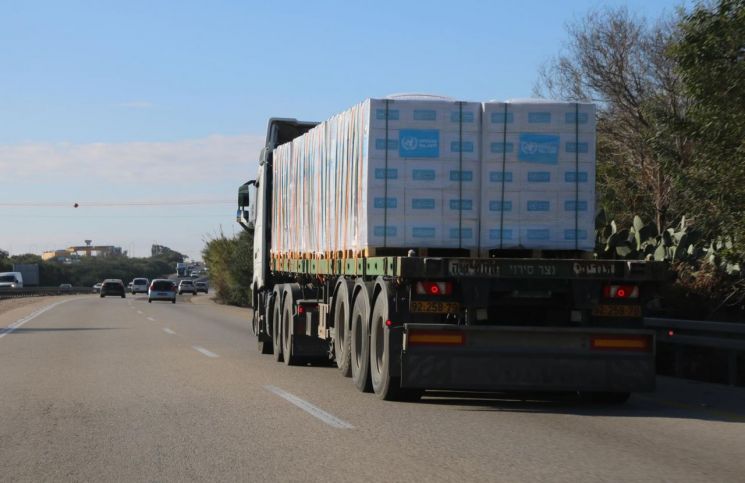
Previously, the Israeli military announced plans to drop seven pallets of food supplies?including flour, sugar, and canned goods?in cooperation with the Coordination of Government Activities in the Territories (COGAT), which is under the Ministry of Defense, as well as international organizations. The military also explained that it would establish designated routes to ensure the safe passage of UN convoys delivering food and medicine to residents.
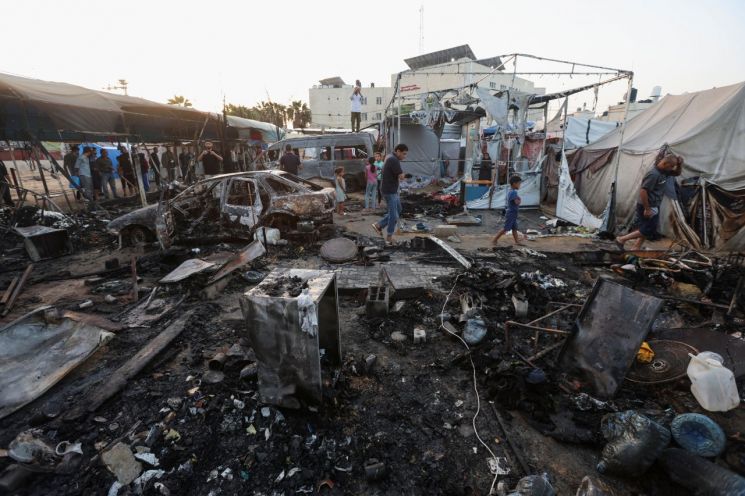
The Israeli military stated, "More than 250 truckloads of aid have been unloaded at border checkpoints just this week," and explained that it plans to cooperate with international organizations to transport the remaining aid supplies. Additionally, Israel emphasized that, in cooperation with the Israel Electric Corporation, it has connected power lines to a seawater desalination facility in Gaza, increasing its daily water supply from 2,000 cubic meters to approximately 20,000 cubic meters?enough to provide for about 900,000 residents.
According to Israeli media, Prime Minister Benjamin Netanyahu, Defense Minister Israel Katz, and Foreign Minister Gideon Saar decided after a meeting to suspend combat operations in Gaza for one day on the 27th. This move appears to be intended to allow for the distribution of aid, following international criticism that the survival of civilians has reached a critical point.
After the outbreak of the Israel-Hamas war in October 2023, Israel imposed a blockade on Gaza and has recently intensified these restrictions. The recent cutoff of water, food, and electricity has led to a surge in deaths from starvation, and the healthcare system has effectively collapsed. While Israel claims that Hamas is responsible for provoking this crisis, it has shown signs of easing its stance in response to mounting international criticism. The Israeli military insisted, "There is no famine in Gaza; this is merely false propaganda promoted by Hamas," and added, "The UN and international organizations must improve the efficiency of aid distribution and ensure that aid does not reach Hamas."
According to Gaza health authorities, since the start of the Israel-Palestine war, 127 people have died from malnutrition, including 85 children. The World Food Programme (WFP), a UN agency, reported that one-third of the population in Gaza has gone several days without food, and 470,000 people are experiencing hunger levels equivalent to Phase 5?'catastrophe'?the highest level on the Integrated Food Security Phase Classification (IPC) scale.
Along with the easing of the blockade and the suspension of hostilities by the Israeli military, other countries have also decided to join in airdropping relief supplies. According to AFP, before Israel announced its airdrop plans, the United Arab Emirates (UAE) stated it would "immediately" resume airdrops. Abdullah bin Zayed Al Nahyan, the UAE's Minister of Foreign Affairs, said on X (formerly Twitter), "The humanitarian situation in Gaza is severe and unprecedented," and "Airdrops will once again resume immediately."
The United Kingdom also plans to participate in airdropping aid in cooperation with Jordan and other partners. The UK Prime Minister's Office reported that Prime Minister Keir Starmer, in calls with the leaders of France and Germany, explained, "We are working with partners such as Jordan to airdrop aid and to evacuate children in need of medical assistance."
However, there are doubts about whether airdropped supplies can provide sufficient relief to Gaza residents. Last year, Western and some Middle Eastern countries conducted airdrops of aid to Gaza, but the quantity was limited, and there were civilian casualties caused by falling aid packages. Philippe Lazzarini, Commissioner-General of the United Nations Relief and Works Agency for Palestine Refugees (UNRWA), criticized on X, "Airdrops will not reverse the deepening famine," adding, "They are costly, inefficient, and can kill starving civilians."
Humanitarian organizations have pointed out that Israel's centralization of aid distribution in Gaza through the Gaza Humanitarian Foundation (GHF) and its control over UN and international organizations' activities have exacerbated the hunger crisis in Gaza. However, the Israeli military maintains that it does not block the entry of aid trucks into Gaza and that it will not cooperate with the UN and international organizations in moving aid to GHF distribution centers.
© The Asia Business Daily(www.asiae.co.kr). All rights reserved.
![Clutching a Stolen Dior Bag, Saying "I Hate Being Poor but Real"... The Grotesque Con of a "Human Knockoff" [Slate]](https://cwcontent.asiae.co.kr/asiaresize/183/2026021902243444107_1771435474.jpg)
















