Signing of Friendship City Agreement with Kuala Lumpur
Discussion on Global Talent Development with Tashkent
Policy-Sharing Forum Held in Bishkek
The Seoul Metropolitan Government is initiating urban cooperation with Kuala Lumpur, Malaysia, and Tashkent, Uzbekistan. The cities have agreed to expand exchanges in digital technology, culture, and human resources, as well as to share smart policy initiatives.
Kim Taekyun, Seoul’s First Vice Mayor for Administrative Affairs, visited Kuala Lumpur from July 22 to 27, where he signed a friendship city agreement and commemorated the 15th anniversary of the friendship agreement with Tashkent through the "Seoul Day" event, providing an opportunity to expand global cooperation between the cities.
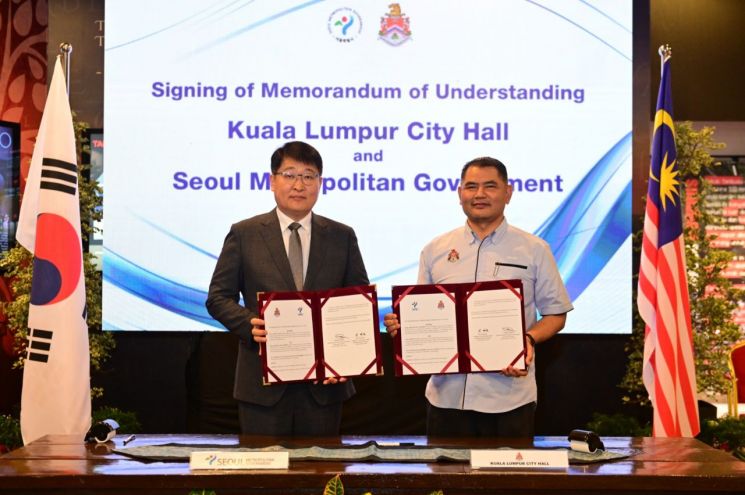 Kim Taekyun, Administrative Deputy Mayor 1 (right), signed a sister city agreement (MOU) with Ismadi Bin Sakirin, Deputy Mayor of Kuala Lumpur, on the 23rd in Kuala Lumpur. Seoul City
On July 23 in Kuala Lumpur, Vice Mayor Kim signed a memorandum of understanding (MOU) for friendship cities with Ismadi bin Sakirin, Vice Mayor of Kuala Lumpur. The agreement aims to expand practical cooperation in various fields, including sustainable urban development, smart city policy, and human resource exchange. Prior to the signing ceremony, the two cities held a commemorative tree-planting event at Perdana Botanical Garden, symbolizing their friendship. Kim also met with Kuala Lumpur Mayor Maimunah Mohd Sharif to discuss directions for cooperation in areas of mutual interest, such as improving urban transportation and advancing digital transformation.
Kuala Lumpur, the capital of Malaysia, is a city of approximately 2.07 million residents across 11 districts, located in the foothills of the central west coast of the Malay Peninsula. The city has maintained exchanges with Seoul through projects such as the establishment of a bus payment system, an integrated public transportation settlement system, and a master's program for foreign public officials at Seoul Metropolitan University.
In Tashkent, Kim met with Sharipov Kongratbay Abedzhimbetovich, Uzbekistan’s Minister of Higher Education, to introduce Seoul’s policies for attracting international students and global talent. He then held an official meeting with Rahimova Durdona, Deputy Mayor of Tashkent, to celebrate the 15th anniversary of the friendship city relationship and explored ways to deepen cooperation between the cities, including tourism, cultural collaboration, and talent exchange for future generations.
Tashkent, the largest industrial city in Central Asia, is home to about 2.47 million people and generates around 19% of the national GDP. Since signing a friendship city agreement with Seoul in 2006, and elevating the relationship to a friendship city in 2010, the two cities have maintained practical cooperation in various fields, including policy and human resource exchanges, for the past 15 years.
The Seoul delegation also visited Bishkek, the capital and largest city of Kyrgyzstan, to hold a policy-sharing forum. The forum, scheduled to be held online on July 29, will explore directions for cooperation in future transportation policy, including smart traffic information systems, measures to strengthen traffic safety, and carbon-neutral transportation systems. Attendees will include the Vice Mayor of Bishkek, the Head of the Information Technology Department of the Ministry of Internal Affairs of the Kyrgyz Republic, the Deputy Director of the Road Traffic Safety Department, and the Inspector of the International Cooperation Department, who will share the current status and vision for transportation in Kyrgyzstan. From Seoul, the Director of International Cooperation, the Head of Future Advanced Transportation, and the Head of Transportation Operations will attend to present Seoul’s smart transportation and traffic safety policies and best practices.
Vice Mayor Kim stated, "This visit to three cities has provided an opportunity to establish a cooperative framework with leading cities in ASEAN and Central Asia in the fields of digital technology, culture, and human resource exchange," adding, "We will continue to expand cooperation between Seoul and global cities in even more diverse areas in the future."
© The Asia Business Daily(www.asiae.co.kr). All rights reserved.
![Clutching a Stolen Dior Bag, Saying "I Hate Being Poor but Real"... The Grotesque Con of a "Human Knockoff" [Slate]](https://cwcontent.asiae.co.kr/asiaresize/183/2026021902243444107_1771435474.jpg)















