Seventeen Representative Works in Black, White, and Gray Unveiled
Showcasing Masterpieces such as "Two Swallows" and "Jiangnan Reminiscence"
First Solo Exhibition in Korea
The world of art created by Wu Guanzhong (1919?2010), a master of modern Chinese art, was largely composed of black, white, and gray. His work is divided into gray and white, with the Cultural Revolution?when artistic freedom was lost?serving as a turning point. Black, in his art, represents a transcendence of all these elements. An exhibition embodying these meanings, "Wu Guanzhong: Between Black and White," has opened at the Seoul Calligraphy Art Museum in the Seoul Arts Center, Seocho-gu, Seoul. This is Wu Guanzhong's first solo exhibition in Korea.
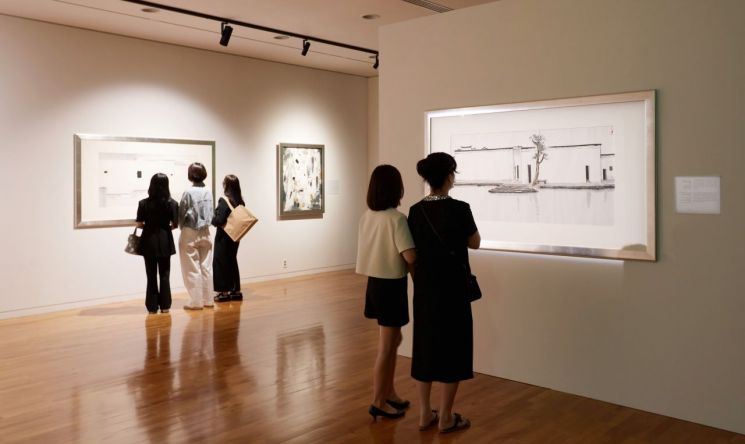
This exhibition is co-hosted by the Seoul Arts Center and the Hong Kong Museum of Art. It is part of an overseas exhibition series planned by the Hong Kong Museum of Art, under the Leisure and Cultural Services Department of the Hong Kong Special Administrative Region Government, as a pre-event for "Hong Kong Week 2025@Seoul." For the first time in Korea, 17 representative works by Wu Guanzhong from the Hong Kong Museum of Art's collection are being introduced.
Wu Guanzhong is considered one of the most important Chinese artists of the 20th century. During his school years, he entered the National Art Academy in Hangzhou, where he was taught by Chinese art masters such as Fengmian (1900?1991) and Pantian Shou (1897?1971). In 1947, he studied in Paris, France, for about three years as a government-sponsored scholarship student. After returning to China, he established his own unique artistic world and dedicated himself to teaching younger artists. However, with the onset of the Cultural Revolution in 1966, he went through a dark period during which he destroyed his own work.
The color reflected in his works during this time is gray. Dr. Nadia Lau, curator of this exhibition from the Hong Kong Museum of Art, explained, "He used a lot of white, gray, and black as he tried to integrate Eastern ink painting with Western oil painting. Chronologically, gray corresponds to the Cultural Revolution period?when he could not paint, but still had hope."
She added, "White represents the period after the Cultural Revolution, when he could freely express himself, working as if he were splashing ink onto the white rice paper of the world. Black signifies a stage where both the era and his skills had matured, reaching a certain artistic height."
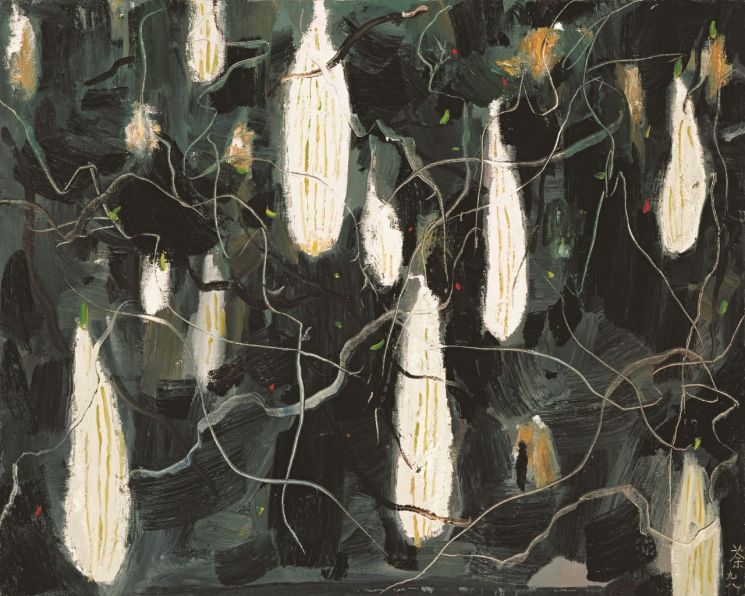
Among his black works is "Bitter Melon: Hometown" (1998), an oil painting of bitter melon, a fruit from the Jiangnan region of China. The bitterness of the fruit is linked to the artist's own suffering. Dr. Nadia Lau explained, "Having experienced the bitterness of life during the Cultural Revolution, Wu Guanzhong frequently painted bitter melon, which carries the strong bitterness of his own experience. The artist's philosophy is reflected in the belief that a fruit that has tasted bitterness once will not taste bitter again when eaten."
Other representative works on display include "Two Swallows" (1981), "Waterway" (1997), and "Jiangnan Reminiscence" (1996). "Two Swallows," a representative white work, is an ink painting that applies the techniques of Piet Mondrian, dividing the painting with horizontal and vertical lines drawn in ink. Dr. Nadia Lau described it as "a work that combines the composition of Western painting with traditional Chinese ink painting techniques."
The representative gray work is "Encounter" (1999), an oil painting depicting willow branches sprouting new buds. Unlike his other works, this piece abandons simplicity in favor of dynamic complexity, using intricate lines and dots.
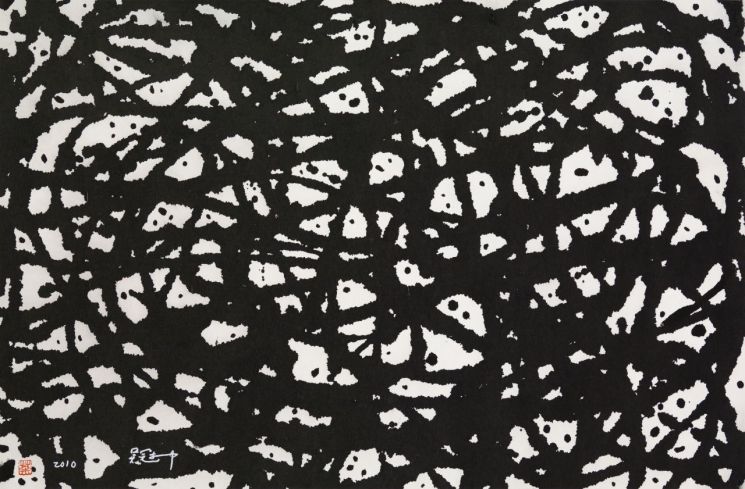
Wu Guanzhong never put down his brush until just before his death. Despite his family's objections, he held a brush even from his sickbed, and the last work he left behind was "Nest" (2010). In this piece, dots, lines, and planes intertwine with emotion, creating both gentle entanglement and intense struggle. Wu Guanzhong expressed his intention to donate this work to the Hong Kong Museum of Art and passed away on June 25, 2010, the very day he held a press conference. Most of his works have been donated to institutions around the world. Wu Guanzhong believed that his art was not a personal possession but something to be shared with the public.
This exhibition was made possible with the support of the "Wu Guanzhong Art Endowment," established with a donation of 100 million Hong Kong dollars (approximately 17.5 billion won) to the Hong Kong Museum of Art by his son Wu Keyu, in honor of the artist's wishes. Within the exhibition hall, visitors can also experience an immersive installation titled "Pond of Emotions ? Seoul Edition," created with support from the Wu Guanzhong Art Endowment. This interactive work by Hong Kong artist Zhang Hanqian allows visitors to draw on a tablet, and their drawings are transformed into Wu Guanzhong's artistic style and projected into the exhibition space. The exhibition runs until October 19.
Meanwhile, "Hong Kong Week 2025," which begins with Wu Guanzhong's solo exhibition, will officially launch on September 26. Hosted by the Leisure and Cultural Services Department of the Hong Kong Special Administrative Region Government, it will introduce the artistic excellence and cultural diversity of Hong Kong to Korea through a total of 14 programs, including dance, music, film, comics, visual arts, and fashion.
© The Asia Business Daily(www.asiae.co.kr). All rights reserved.



















