Completion of UK-France-Germany Trilateral Alliance
US Likely to Intensify Pressure for Korea-Japan Defense Pact
The United Kingdom and Germany have signed a mutual defense treaty for the first time since World War II, marking a groundbreaking shift in the security landscape of Europe. With this agreement, a trilateral defense system among the UK, France, and Germany has been completed, significantly strengthening Europe’s independent defense capabilities in response to the threat posed by Russia.
What is particularly noteworthy is that this agreement goes beyond simple military cooperation and includes the sharing of nuclear deterrence. The treaty explicitly states that "both countries will maintain close dialogue on defense issues of mutual interest, including nuclear matters," thereby laying the groundwork for the possible deployment of British tactical nuclear weapons on German territory or their deployment to other European countries via German soil in times of crisis.
This follows the previous nuclear deterrence cooperation agreement between the UK and France, and with Germany’s participation, the three major European powers have effectively established a "European nuclear umbrella" independent of the United States. This development is seen as a reflection of Europe’s realistic assessment that it can no longer rely solely on the US for its security.
The background to the establishment of this trilateral alliance lies in the protracted war in Ukraine and the ongoing threat from Russia. Western intelligence agencies, including those of the United States, project that Russia could fully restore its conventional military capabilities lost in the Ukraine war and even begin expanding them further by around 2029. Russia has already begun forward-deploying troops to the borders of NATO member states, including Poland, and it is expected that tensions will remain high even after the war in Ukraine ends. Under these threat perceptions, Europe is under increasing pressure to establish its own defense system before such a scenario unfolds.
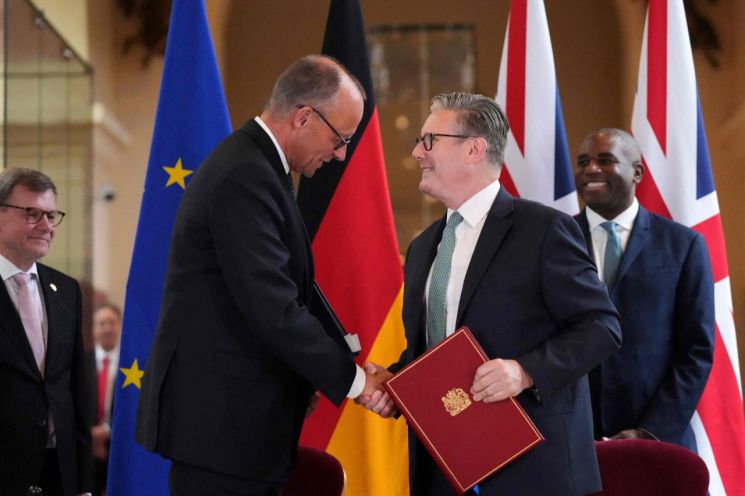 On the 17th (local time), at the signing ceremony of the mutual defense agreement between the United Kingdom and Germany held in London, UK, British Prime Minister Keir Starmer (right) and German Chancellor Friedrich Merz (left) shook hands. Photo by AFP
In particular, the issue of Kaliningrad, Russia’s exclave, is emerging as a new flashpoint. Located in northeastern Poland, this region was formerly German territory before being occupied by the Soviet Union after World War II and remains under Russian control to this day. Russia has stationed various military assets there, including supersonic missiles. Given its proximity, Kaliningrad is within missile strike range of mainland Germany, and Russia’s opposition to the UK-Germany nuclear sharing agreement is expected to intensify further.
The fact that the UK and Germany are now engaging in such close defense cooperation also signifies that they have fully overcome historical issues. Germany, as the country that initiated both World Wars, was viewed with lingering resentment by other European nations even during the Cold War. Germany, for its part, has focused on proving that it is no longer a nation that would start another war in Europe.
Moreover, during the East-West Cold War, both West Germany and East Germany were frontline states, so any moves to increase armaments or enter into nuclear defense agreements with other countries were approached with extreme caution. Notably, since the 1960s, Germany pursued the "Ostpolitik" policy, maintaining significant cooperation with the Soviet Union. In fact, the pipelines connecting Russia and Europe were constructed through German loans and technology transfers to the Soviet Union.
This pro-Russian orientation in German policy raised concerns in the US, UK, and France right up until just before the outbreak of the Ukraine war. However, the war has dramatically shifted the situation, leading Germany to actively pursue defense cooperation.
Russia’s strong opposition and the possibility of new conflicts: Russia has strongly objected to the UK-Germany defense agreement. Among the Russian public, resentment has grown over the continued supply of weapons to Ukraine by Germany and the UK, and the nuclear umbrella agreement has further intensified this backlash.
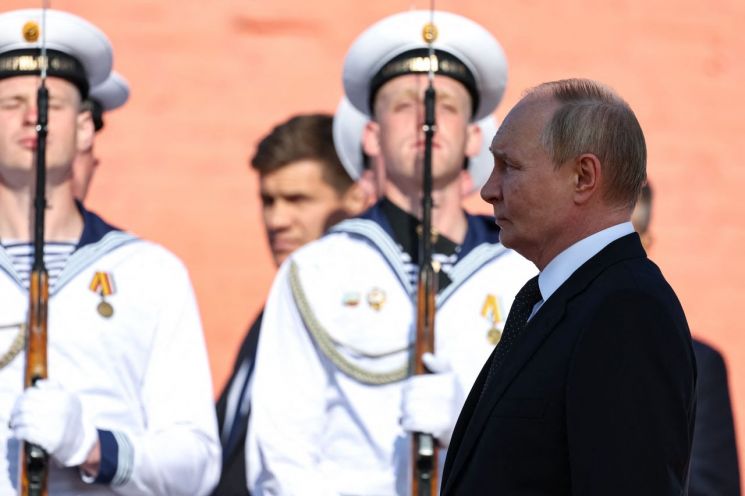 On the 24th (local time), Russian President Vladimir Putin attended the launching ceremony of a new nuclear submarine held at the Severodvinsk port. Photo by AFP
In particular, Russia has expressed its dissatisfaction with the agreement by threatening to deploy nuclear weapons in the Kaliningrad region. Recently, US European Command Commander General Chris Cavoli remarked that "NATO could militarily seize Kaliningrad if necessary in an emergency," further escalating tensions. There are also reports that Russian troops are moving near the Poland-Belarus border, raising the possibility that this area could become a new conflict zone. Belarus, effectively a satellite state of Russia, has prompted Poland to completely seal its border due to concerns over possible Russian military provocations through Belarusian territory.
The completion of Europe’s trilateral alliance is expected to have a significant impact on Northeast Asia, particularly on the US-South Korea-Japan cooperation framework. The United States has consistently pushed for a trilateral security arrangement among South Korea, the US, and Japan, but historical issues and territorial disputes such as those over Dokdo have kept South Korea and Japan at arm’s length regarding a mutual defense treaty. However, with the UK and Germany?two countries with deeply intertwined historical grievances?setting aside the past in the face of real threats and moving toward military cooperation, the US is likely to intensify its pressure for a swift establishment of a trilateral framework in Northeast Asia, especially in light of the threat posed by China.
According to US analysis, the situation in which South Korea, the US, and Japan could be drawn into a Taiwan Strait conflict in some form is very similar to Europe’s need to collectively contain Russia. The US has already established the "Quad" (a military consultative body of India, Japan, Australia, and the US) and the "AUKUS" security pact (among the US, UK, and Australia), and now seeks to create a "Northeast Asia NATO" framework including South Korea, Japan, and the US.
For the South Korean government, diplomatic coordination on this issue is expected to become increasingly challenging. This is because South Korea’s diplomatic and economic ties with China are substantial, and strengthening military cooperation in the direction the US desires could lead to a deterioration in relations with China.
Europe’s example demonstrates that it is possible to overcome historical issues in the face of present-day threats, but in Northeast Asia, the presence of China as a major economic partner makes the situation far more complex. South Korea faces the dilemma of needing security cooperation with the US and Japan, while also having to maintain economic relations with China. Going forward, the South Korean government will need to pursue a balanced diplomacy that maximizes national interests amid these geopolitical changes. It is time to closely analyze the ripple effects of Europe’s transformation on Northeast Asia and seek the optimal strategy to ensure peace and stability on the Korean Peninsula.
© The Asia Business Daily(www.asiae.co.kr). All rights reserved.


















