34 Billion KRW Invested...
3.4 Hectares of Urban Forest Created
Wando County in South Jeolla Province has created a large-scale urban forest by investing a total project cost of 3.4 billion KRW to respond to the climate crisis and reduce fine dust.
On July 25, the county announced that it had completed the "Climate Response Urban Forest Creation Project" on a 3.4-hectare site around the Wondong Intersection in Gunoe-myeon. This project was promoted to proactively respond to climate change by transforming idle spaces into green areas and to provide residents with a pleasant living environment.
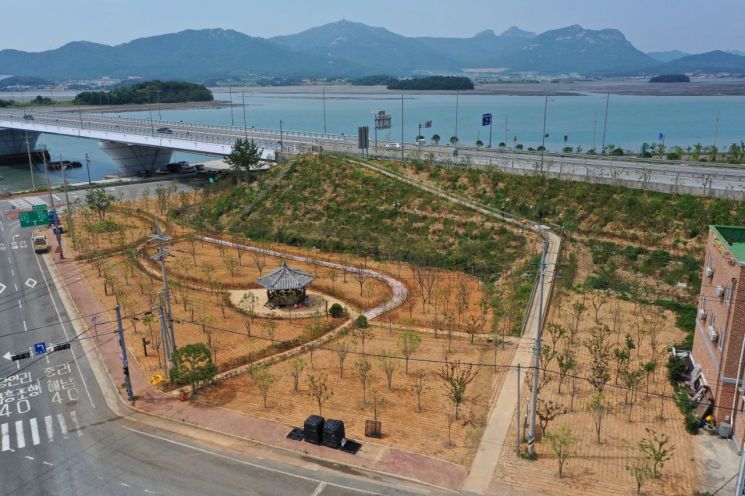 Wando County has completed the "Climate Response Urban Forest Creation Project" by investing 3.4 billion KRW in a 3.4-hectare site around Wondong Intersection in Gunoe-myeon. Provided by Wando County
The project site, Wondong Intersection, is the gateway to Wando and an area with heavy vehicle traffic, where not only buses and trucks but also ships frequently pass through, resulting in frequent emissions and dust. The county continued to propose the necessity of the project and eventually secured a total budget of 3.4 billion KRW from the Korea Forest Service and South Jeolla Province, starting full-scale development last year.
For this urban forest, mainly broad-leaved evergreen trees reflecting the characteristics of the Wando region were planted. Representative species include Wando holly, camellia, Dendropanax morbifera, and Elaeocarpus sylvestris, arranged in a way that symbolizes the largest warm-temperate forest in Korea, located in Wando. In addition, the county planted a total of 106,190 trees, including shrubs such as red-leaved photinia and golden euonymus, and flowering plants along the walking paths. Convenience facilities such as pergolas and benches were also installed to create resting spaces for residents and visitors.
Park Eunjae, head of the Forest Recreation Department, said, "An urban forest, with each tree coming together, becomes an important green infrastructure to address the climate crisis," and added, "We will continue to expand and create high-quality urban forests in the future."
Meanwhile, according to the Korea Forest Research Institute, urban forests lower the average daytime temperature in summer by 3.7 degrees Celsius and increase humidity by 923%. Forty-seven trees absorb the amount of fine dust emitted by one diesel vehicle in a year, and one hectare of urban forest filters out 168 kilograms of pollutants annually.
© The Asia Business Daily(www.asiae.co.kr). All rights reserved.
![Clutching a Stolen Dior Bag, Saying "I Hate Being Poor but Real"... The Grotesque Con of a "Human Knockoff" [Slate]](https://cwcontent.asiae.co.kr/asiaresize/183/2026021902243444107_1771435474.jpg)















