Unstable Harvests Due to Extreme Weather... Rice Supply Declines
Japan Sees Soaring Rice Prices from Production Cuts and Poor Harvests
"Korea Also Moving Toward Production Reduction Like Japan"
"Simultaneous Drop in Farms and Yields Threatens Food Security"
Could the "rice price surge crisis" that troubled Japan earlier this year also occur in Korea? Due to ongoing abnormal high temperatures, heavy rainfall, and other climate changes, poor harvests are causing domestic rice retail prices to soar. Farmers are warning that without proactive agricultural policies from the government, Korea could face a rice price shock similar to Japan's.
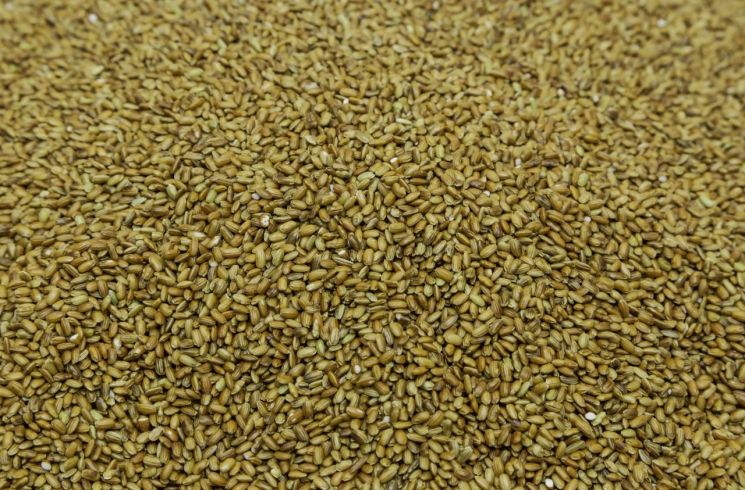 Due to successive abnormal high temperatures, heavy rains, and other climate changes causing poor crop yields, domestic retail rice prices are soaring. Getty Images
Rice Prices Rise... Surpass 60,000 Won for the First Time This Year
According to the Agricultural Products Distribution Comprehensive Information System (Nongnet), as of July 24, the domestic retail price of rice (20kg) reached 60,112 won, surpassing the 60,000 won mark. This represents a 14% increase compared to the previous year and a 16% rise compared to the annual average price. This is the first time this year that the retail price of rice has exceeded 60,000 won.
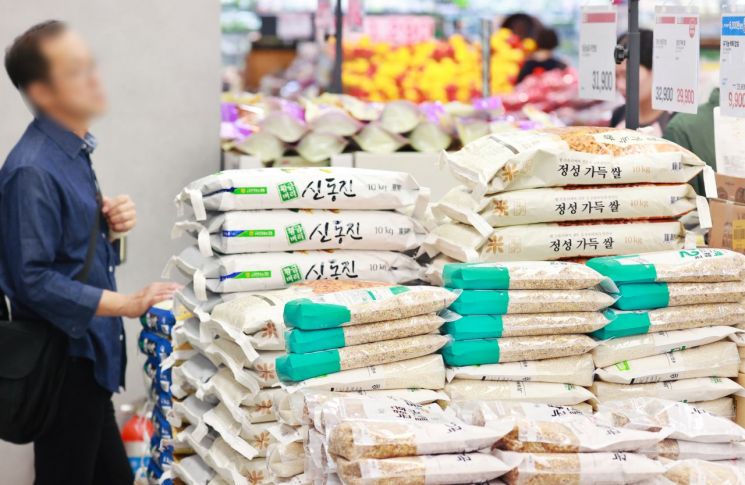
The decrease in domestic rice production is believed to have driven up prices. According to the Agricultural Outlook Center at the Korea Rural Economic Institute (KREI), from January to April this year, rice distributors purchased 157,000 tons of rice, a decrease of about 16,000 tons compared to the previous year. As rice supply decreased, inventories also fell. As of April, rice stockpiles stood at 712,000 tons, down 210,000 tons from a year earlier. The National Agricultural Cooperative Federation (Nonghyup) held 635,000 tons in stock, a 20.4% decrease year-on-year, while private sector stocks plunged 39.6% to 77,000 tons.
Sudden Downpours, Abnormal Heat... All Threaten Rice Farming
Behind the decline in rice production are worsening weather anomalies in recent years. According to data from the Ministry of Agriculture, Food and Rural Affairs, mid-July heavy rains caused flooding damage to 25,065 hectares of rice paddies, which accounts for 3.6% of the total rice cultivation area.
Cases of rice farming failures are increasing from the cultivation stage due to higher-than-average temperatures and sudden heavy rains. Regarding this, Kim Jungryong, Secretary-General of the National Rice Producers Association, told Asia Economy, "For two consecutive years, abnormal weather events have disrupted rice farming. Many farms suffered damage this month as seedbeds (nurseries set up in paddies or fields to grow rice seedlings) were washed away by heavy rain."
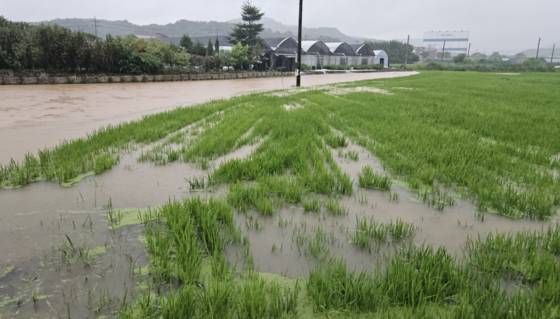 On the morning of the 17th, when heavy rain poured down, the stream in Wonseongri, Jeonui-myeon, Sejong City overflowed, flooding nearby farmland. Photo by Yonhap News
Kim also said, "Last year, abnormal high temperatures made rice farming difficult. The late heat wave persisted until September, preventing rice planthoppers from dying off naturally and allowing them to multiply further. Planthoppers suck the sap from rice stalks, killing the plants, and farmers refer to this phenomenon as 'getting bombed.' Last year, the explosion of planthopper infestations left many rice paddies in a bombed-out state."
"A Rice Crisis Like Japan's Could Happen Here Too"
Earlier this year, Japan experienced the "Reiwa Rice Crisis," in which rice prices soared by 99.3% year-on-year due to a combination of factors that sharply reduced rice production. First, the number of farms that failed at rice cultivation increased due to abnormal heat. In addition, the government's "gentan policy"?a rice reduction policy in place since 1971?also played a role. Since the 1970s, as Japan entered a period of rapid economic growth, rice was overproduced and dietary habits began to Westernize. In response, the government began providing subsidies to farms that reduced rice cultivation.
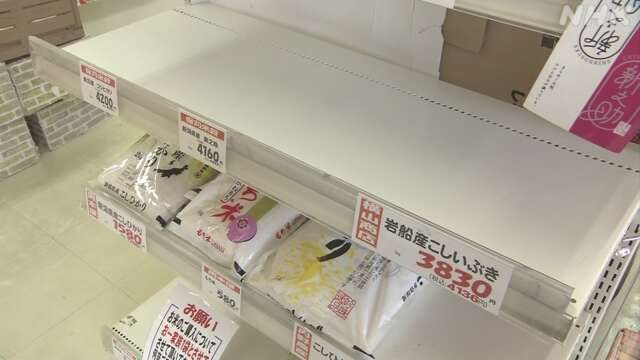
Kim explained, "The rice supply crisis Japan experienced from last year to this year was caused by a combination of the government's gentan policy and crop failures due to abnormal weather. When rice consumption was declining, the problem may not have been noticeable, but now, with both a decrease in the number of farms and a drop in harvests occurring simultaneously, all the conditions for food supply instability have come together." He also warned, "Korea's rice policy has also been moving toward supply reduction, just like Japan, albeit with a lag of about 10 to 20 years. If the reduction trend and abnormal weather combine, we cannot guarantee that a crisis like Japan's will not happen here."
So far, the government has managed grain supply plans through the Grain Management Act. On July 26, the National Assembly's Agriculture, Food, Rural Affairs, Oceans and Fisheries Committee's subcommittee passed an amendment to the Grain Management Act with bipartisan agreement. The amendment includes measures such as: ▲ the government purchasing surplus rice to stabilize prices, and ▲ strengthening compensation when rice farmers switch to cultivating other crops.
Regarding this, Um Cheongna, Policy Director of the National Rice Producers Association, said, "The key is how price policies to prevent a rice price collapse are formulated, and we are monitoring the specifics of these policy measures." He added, "The bill that provides compensation when rice farmers switch crops should be implemented through the voluntary participation of farmers, not by government coercion. If there is coercion, there will be strong backlash from the farming community."
On this point, Kim also noted, "Currently, the government is studying ways to diversify crops, such as planting tropical fruits, to adapt to Korea's subtropical climate. However, no matter how much the average temperature rises, Korea still experiences sudden cold snaps every February and March that wilt fruit blossoms. In such an environment, it will be difficult to replace rice, sweet potatoes, chili peppers, and garlic with crops like papaya or mango."
© The Asia Business Daily(www.asiae.co.kr). All rights reserved.
![Clutching a Stolen Dior Bag, Saying "I Hate Being Poor but Real"... The Grotesque Con of a "Human Knockoff" [Slate]](https://cwcontent.asiae.co.kr/asiaresize/183/2026021902243444107_1771435474.jpg)

















