US Adjusts Pace of Electrification Due to Tax Bill
Sales Growth Momentum to Remain Weak for the Time Being
Impact of New PFE System Expected to Be Limited
ESS Market Projected to Grow 60% Next Year
North American ESS Production Capacity to Expand to 36GW
All New Expansion Plans to Be Fully Readjusted
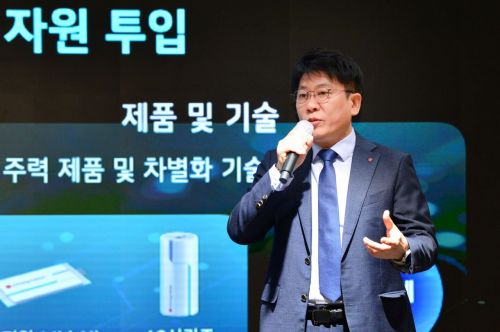 Kim Dongmyung, CEO of LG Energy Solution, is speaking at the regular shareholders' meeting held at LG Twin Towers in Yeouido, Seoul on the 20th. 2025.3.20. Photo by LG Energy Solution Yonhap News
LG Energy Solution has projected that the U.S. electric vehicle (EV) market will slow down until the first half of next year, following the elimination of EV subsidies after the end of September under the recently passed U.S. Omnibus Budget Reconciliation Act (OBBBA). In response, LG Energy Solution plans to focus on the rapidly growing energy storage system (ESS) market to fill the gap. The company also intends to fully readjust its new expansion plans in light of the slowdown in EV demand.
On July 25, Changsil Lee, Chief Financial Officer (CFO) and Executive Vice President of LG Energy Solution, stated during the second quarter earnings conference call, "With the early termination of EV subsidies after September, major EV manufacturers are expected to adjust the pace of electrification and conservatively manage their inventories. As a result, momentum for sales growth will inevitably be limited for the time being."
CFO Lee emphasized, "Customer demand for North American ESS is much stronger than previously forecast, and since we are the only company with local ESS production capabilities, we see this as an excellent opportunity. We plan to fill the vacant capacity in automotive batteries with ESS production."
The OBBBA, recently signed by U.S. President Donald Trump, stipulates that the EV subsidy of up to $7,500 for consumers under the Inflation Reduction Act (IRA) will only be maintained until September. Regarding this, LG Energy Solution commented, "With the elimination of subsidy benefits, manufacturers are adjusting the pace of their EV businesses. We expect overall demand to slow down until the first half of next year."
However, LG Energy Solution noted that its customers are expanding their lineups of low-priced EVs, stating, "We plan to continuously strengthen our competitiveness through prismatic batteries, lithium iron phosphate (LFP), and lithium manganese rich (LMR) batteries with our strategic customer (GM)."
LG Energy Solution explained, "The existing nickel cobalt manganese (NCM) pouch batteries will continue to be produced at the first joint plant in Ohio, which is currently operating stably. Meanwhile, new products such as LMR and LFP are being considered for flexible production at the second plant in Tennessee, where capacity expansion is planned."
The LMR battery offers a similar price to LFP but improves energy density by 30%. LG Energy Solution expects to be able to supply LMR batteries to customers by 2028.
LG Energy Solution believes the impact of the newly introduced Prohibited Foreign Entity (PFE) system under the OBBBA will be limited. The OBBBA maintains the advanced manufacturing production credit (AMPC) provision under the IRA until 2032 as before, but excludes materials sourced at a certain rate from PFEs from tax credit eligibility.
LG Energy Solution stated, "The newly established PFE is somewhat less stringent than the previous Foreign Entity of Concern (FEOC), and we believe we can optimize our supply chain by utilizing this. As the PFE designation is limited to direct material costs, we can now use lower-cost supply chains for some materials."
With the elimination of EV subsidies, the obligations for local sourcing of battery components in North America and sourcing of critical minerals from Free Trade Agreement (FTA) countries have disappeared, which, according to LG Energy Solution, has actually increased flexibility in supply chain operations.
LG Energy Solution continues to struggle in the European EV market. The company explained, "In addition to the conservative inventory management by European customers, we are being affected by the increase in Chinese battery installations following the entry of Chinese EVs into the European market." LG Energy Solution added, "In the second half of the year, major customers are preparing for mass production of new mid- to low-priced batteries in line with new vehicle launches. However, we plan to convert some EV lines to ESS within the year to improve the operation rate and profitability of our Poland plant."
LG Energy Solution's strategy is to fill the gap left by EVs with ESS. The company stated, "As of the end of June, we have secured an ESS order backlog of 50GW. We expect U.S. ESS grid demand next year to exceed this year’s level by over 60%."
Accordingly, LG Energy Solution is actively expanding capacity, including converting North American EV battery production lines to ESS lines. CFO Lee stated, "To respond to the North American trend of decoupling from China, we plan to expand ESS production capacity in North America from 17GW at the end of this year to 36GW by the end of 2026." The company also plans to convert some joint venture production lines to ESS through discussions with customers.
New expansions are expected to be minimized. CFO Lee stated, "To reduce the burden of fixed costs, we will fully readjust our new capacity expansion plans and adjust the production timelines of ongoing projects." He also mentioned that the company is currently redeploying personnel to appropriate positions as needed.
Innovation in technology development will continue. The company plans to apply new processes such as dry electrodes to LFP batteries for EVs, and to secure cost competitiveness for ESS-use LFP batteries through high-density and high-integration designs. In addition, LG Energy Solution aims to introduce 10-minute charging technology to its products by 2028. The company also plans to secure mass production capability for dry electrodes at the Ochang Energy Plant within this year.
Meanwhile, LG Energy Solution announced that it achieved sales of 5.5654 trillion KRW and operating profit of 492.2 billion KRW in the second quarter of 2025. Sales decreased by 9.7% compared to the same period last year (6.1619 trillion KRW) and by 11.2% compared to the previous quarter (6.265 trillion KRW). Operating profit increased by 152.0% compared to the same period last year (195.3 billion KRW) and by 31.4% compared to the previous quarter (374.7 billion KRW).
The amount reflected in the second quarter’s operating profit from IRA tax credits (AMPC) and similar items was 490.8 billion KRW. Excluding this, the second quarter operating profit was 1.4 billion KRW, marking a return to profitability after six quarters.
© The Asia Business Daily(www.asiae.co.kr). All rights reserved.

















