Concessions Made on the Grain Management Act and Commercial Act Amendment Within Feasible Limits
Opposition Struggles with Fewer Seats... Ruling Party Burdened by "Legislative Overreach" Frame
Since the inauguration of the Lee Jaemyung administration, the handling of key contentious bills such as the Grain Management Act and the Commercial Act amendment has unfolded differently compared to the previous administration. Unlike the previous extreme confrontations over major bills, the process has shifted toward mutual concessions and agreement-based resolutions within feasible limits. This change is not unrelated to the reality faced by the opposition party, which, due to its limited number of seats, finds it difficult to secure political momentum against the overwhelmingly dominant ruling party.
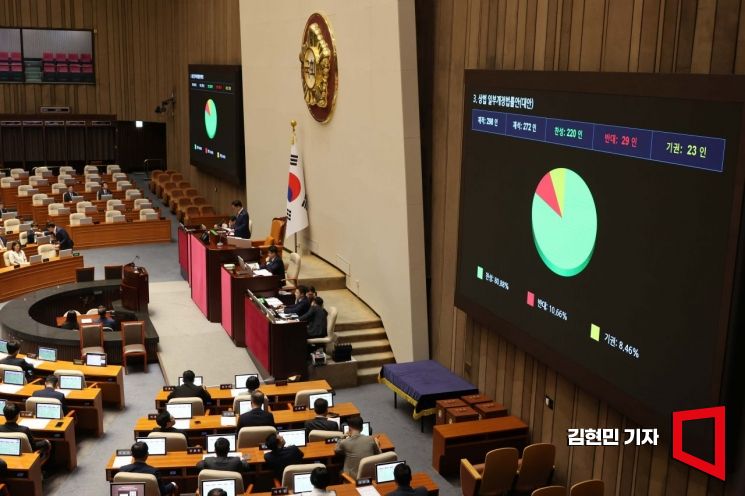 On July 3, the partial amendment to the Commercial Act was passed at the plenary session of the National Assembly. 2025.7.3 Photo by Kim Hyunmin
The reason the People Power Party is taking a more forward-looking stance is that, if the dominant ruling Democratic Party of Korea pushes through a bill, there are virtually no effective means to block it except for a filibuster (unlimited debate). Unless there are exceptional circumstances, a bill is passed in a plenary session with the attendance of a majority of all members and the approval of a majority of those present. Currently, the Democratic Party holds 167 seats, already more than half of the total number of lawmakers. Including friendly seats from parties such as the Cho Kuk Innovation Party, the pro-ruling bloc commands over 190 seats. The Democratic Party, now in the ruling position, also feels burdened by the prospect of pushing legislation solely by relying on its majority. There is a risk of being criticized for "legislative overreach."
Amid each party's interests, bills that were previously sources of conflict during the last administration are now being passed at the committee stage through bipartisan agreement. The Grain Management Act passed the National Assembly's Agriculture, Food, Rural Affairs, Oceans and Fisheries Committee's Legislation Review Subcommittee on July 24 after bipartisan negotiations. The core of the Grain Management Act is that, when rice production exceeds demand, the government purchases the surplus to guarantee farmers' income. This bill was previously scrapped after former President Yoon Sukyeol exercised his right to request reconsideration (veto) due to concerns over fiscal burden.
The ruling and opposition parties on the Agriculture and Fisheries Committee reached an agreement to balance rice supply and demand by pre-adjusting rice cultivation areas and proactively managing the supply of rice produced in the current year. Additional provisions include sufficient financial support for farmers who participate in cultivating alternative crops, strengthening the government's discretionary power and clarifying the criteria for mandatory government purchases. The price stabilization system (supporting the difference when the price of grain falls below the reference price) will be reviewed collectively under the Act on Distribution and Price Stabilization of Agricultural and Fishery Products (the Agricultural Products Act).
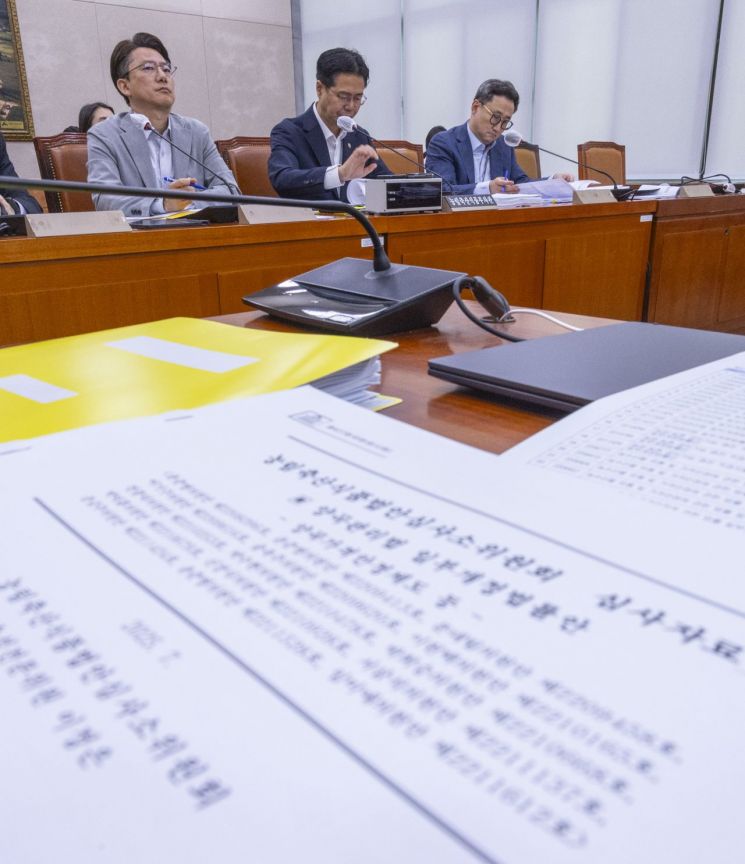
The People Power Party members on the Agriculture and Fisheries Committee's Legislation Subcommittee stated, "We proposed alternatives to reduce side effects such as overproduction and fiscal burden," and added, "While it is fortunate that the Democratic Party has finally taken a step back compared to previous bills, we regret that their unreasonable demands over a long period have caused confusion and conflict." Lee Wontak, the Democratic Party's Legislation Subcommittee Chair, drew a line by saying, "This is not a step back," but there are indeed differences in the content compared to previous bills.
The amendment to the Commercial Act was also agreed upon by both parties as the People Power Party adopted a more forward-looking attitude. The ruling party only passed those elements of the bill that were not contentious, leaving out disputed issues such as the cumulative voting system and the expansion of the number of separately elected audit committee members, which will be discussed further through public hearings. The People Power Party also left open the possibility of discussing the relaxation of criminal breach of trust charges, which it had requested.
However, some contentious issues remain. Notably, the so-called "Broadcasting Three Laws" and the amendment to the Trade Union and Labor Relations Adjustment Act (the "Yellow Envelope Act"), which are being reintroduced after having been vetoed by the Yoon Sukyeol administration, are at the center of the debate. The Broadcasting Three Laws amendment aims to increase the number of board members at public broadcasters such as KBS, MBC, and SBS and to expand the entities eligible to recommend board members. The Democratic Party plans to handle these bills at the National Assembly plenary session on August 4. However, the People Power Party has stated that if the Democratic Party pushes through the broadcasting law, it will respond with a filibuster.
Tensions are also rising over the Yellow Envelope Act. The core of the Yellow Envelope Act is to restrict companies from claiming damages against striking workers. The government is said to have prepared a more conciliatory version of the bill, doubling the grace period of the existing bill to include a "one-year grace period." The Democratic Party plans to convene a Legislation Review Subcommittee as early as next week to begin full-scale discussions.
© The Asia Business Daily(www.asiae.co.kr). All rights reserved.


















