Attempting a 'Investment + Tariff Deal' Similar to Japan
Aiming for Agreement Before August 1
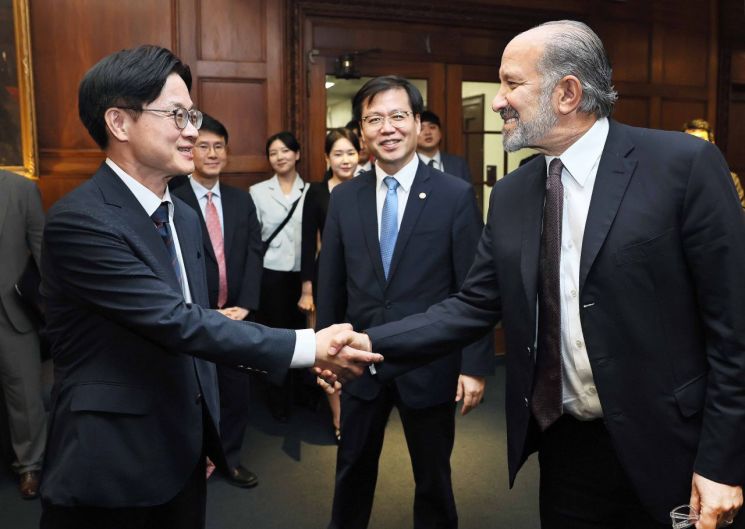 Kim Jungkwan, Minister of Trade, Industry and Energy, is greeting Howard Lutnick, U.S. Secretary of Commerce, on the 24th (local time) at the U.S. Department of Commerce conference room in Washington D.C. Ministry of Trade, Industry and Energy
With the deadline for tariff negotiations between South Korea and the United States approaching, the Korean government has begun efforts to persuade the U.S. side by highlighting strategic manufacturing cooperation and a large-scale investment package as its main cards. Minister of Trade, Industry and Energy Kim Jungkwan and Trade Minister Yeo Hankoo visited Washington, D.C. on the 24th (local time), holding a series of meetings with senior U.S. government officials to launch full-scale diplomatic efforts to prevent the imposition of a 25% tariff scheduled for August 1.
Tariff Reduction Linked to Large-Scale Investment
On the morning of the same day, Minister Kim and Minister Yeo held an approximately 80-minute meeting with U.S. Secretary of Commerce Howard Lutnick at the Department of Commerce. During this meeting, Minister Kim proposed expanding bilateral cooperation in strategic manufacturing sectors such as shipbuilding, semiconductors, and batteries, and in return, requested tariff relief for major export items such as automobiles.
The previous day, Minister Kim also met with Secretary of Energy Chris Wright to discuss expanding cooperation in the energy sector and officially invited him to attend the 'Energy Super Week' to be held in Busan at the end of August.
The Korean government is known to have proposed a $100 billion investment package in the U.S. This investment plan, which involves major conglomerates such as Samsung Electronics, Hyundai Motor, and LG, is a response to the $550 billion investment commitment made by Japan to the U.S. and the subsequent 15% tariff reduction. An official from the Ministry of Trade, Industry and Energy stated, "We made it clear that Korea is prepared to make a tangible contribution to stabilizing the U.S. supply chain and therefore deserves reciprocal treatment."
In fact, the U.S. previously reached a 'package deal' with Japan, reducing tariffs from 25% to 15% in exchange for investment, technology transfer, and job creation. This trend is now being applied to Korea as well. However, the U.S. side maintains that the key is not simply the promise of investment, but how much employment and regional investment can be generated.
Contributing to U.S. Manufacturing Revival through Shipbuilding... Agricultural Market Opening Remains a Challenge
Another key card presented by the Korean government is cooperation in the shipbuilding industry. In line with the Trump administration's policy of rebuilding domestic manufacturing, Korea's two major shipbuilders, Hanwha Ocean and HD Hyundai, are emphasizing their potential contributions to U.S. Navy maintenance and commercial ship construction. It is also reported that expanding technological cooperation with the U.S. Navy is on the table.
This goes beyond simple industrial cooperation and carries political and strategic significance. By mitigating supply chain risks and creating jobs in the U.S., it aligns with President Donald Trump's 'Made in USA' policy. The government has formalized the concept of a 'Korea-U.S. Manufacturing Renaissance Partnership' and positioned shipbuilding cooperation as a key lever to exchange for tariff reductions.
On the other hand, the issue of opening the market to U.S. agricultural products remains a 'minefield' in the negotiations. In particular, there is strong opposition from the Korean agricultural sector. Domestic lawmakers and farmers' organizations are raising concerns that the influx of high-quality U.S. fruits could directly impact local farmers, insisting that agricultural items should be excluded from the negotiation table.
The Korean government has also made it clear that sensitive items such as rice and beef will be excluded from the negotiations. Meanwhile, the U.S. side is requesting some degree of market opening for certain products, including corn for bioethanol, some fruits, and nuts. Regarding this, a Ministry of Trade, Industry and Energy official said, "Given our domestic political situation and potential industrial damage, this is an area where we cannot easily make concessions," adding, "We are responding with precision according to the sensitivity of each negotiation scenario."
One Week Until Deadline: Agreement or Extension?
The remaining variable is time. The tariff implementation deadline is August 1. With less than a week left, if negotiations are not concluded, tariffs will be automatically imposed. However, since the U.S. side has not declared the negotiations closed, the possibility of a partial agreement or deadline extension cannot be completely ruled out.
The government plans to make a final push by combining working-level negotiations and high-level diplomacy. Minister Kim will hold individual meetings with Doug Burgum, Chair of the National Energy Commission, while Minister Yeo will meet with USTR Representative Greer and Texas Governor Greg Abbott to further discuss progress in tariff negotiations and cooperation in the energy sector.
An official from the Ministry of Trade, Industry and Energy stated, "It is now time for practical negotiations to maximize national interests," adding, "We will mobilize all diplomatic means until the end to achieve a balanced agreement."
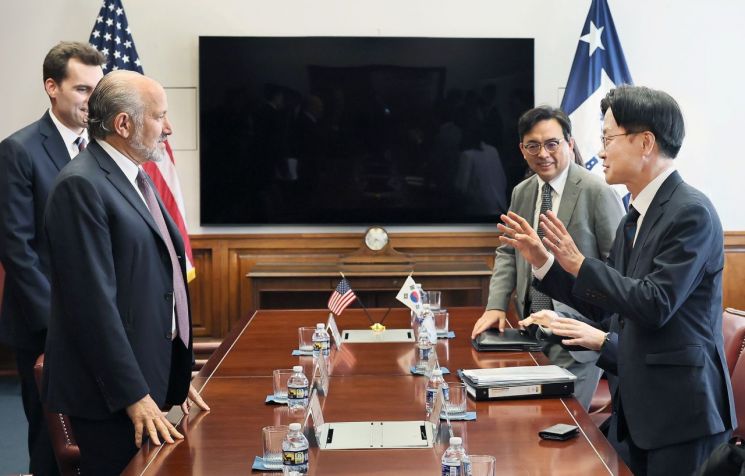 Kim Jungkwan, Minister of Trade, Industry and Energy, met with Howard Lutnick, U.S. Secretary of Commerce, on the 24th (local time) in the Commerce Department conference room in Washington D.C. to have a preliminary discussion before negotiations. Ministry of Trade, Industry and Energy
© The Asia Business Daily(www.asiae.co.kr). All rights reserved.


















