The Gyeonggi-do Out-of-Home Youth Support Center, which will provide integrated support for the protection and self-reliance of out-of-home youth, opened on July 24.
The Gyeonggi-do Out-of-Home Youth Support Center will oversee and support 38 youth welfare facilities in the province. It will be responsible for policy research for out-of-home youth, program development, and integrated case management for high-risk youth. The center will also actively identify and support out-of-home youth in 13 cities and counties where youth welfare facilities have not been established.
In addition, the center will enhance the practical capabilities of more than 340 youth welfare facility workers by providing job training and burnout prevention education. It will also offer customized support to address regional disparities in welfare services.
With the launch of the center, Gyeonggi-do plans to establish a step-by-step support system that goes beyond simple protection to take responsibility for self-reliance. The province aims to create a balanced youth welfare infrastructure across all regions, leaving no blind spots.
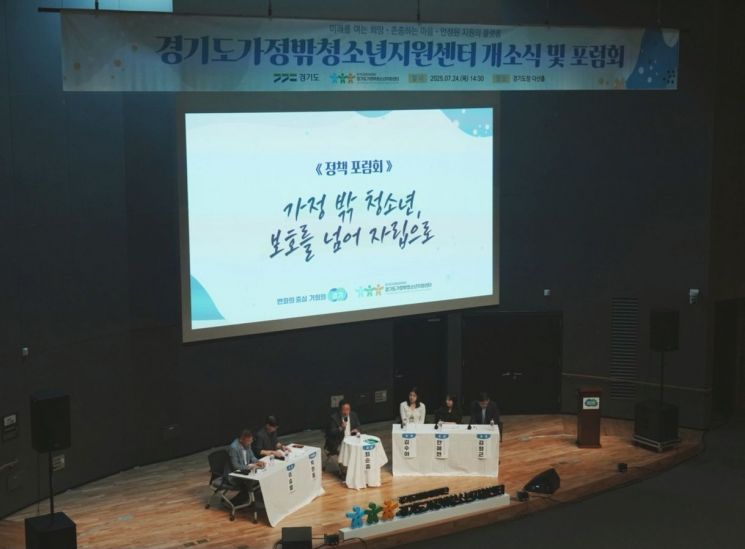
Oh Gwangseok, Director of the Gyeonggi-do Bureau of Future Lifelong Education, stated, "As the only dedicated center at the metropolitan level in the country has been established in Gyeonggi-do, we will build a seamless support system from crisis response to self-reliance. With the determination not to overlook even a single youth, we will become a warm safety net for out-of-home youth."
As of the end of last month, 2,831 youth were residing in youth welfare facilities in the province. Including missing and runaway youth, the number of out-of-home youth is estimated to be more than double that figure.
Gyeonggi-do has specialized the functions of youth welfare facilities into three types: high-risk support, self-reliance support, and recovery support. The province provides tailored assistance such as psychological counseling, academic reintegration, and work experience.
Furthermore, Gyeonggi-do is helping out-of-home youth build an economic foundation for independence through programs such as the 'Self-Reliance Double Savings Account,' which matches youth savings of 100,000 to 1,000,000 KRW per month at a 2:1 ratio, and the 'Self-Reliance Settlement Fund,' which provides a total of 10,000,000 KRW over two years to youth leaving welfare facilities.
© The Asia Business Daily(www.asiae.co.kr). All rights reserved.
![Clutching a Stolen Dior Bag, Saying "I Hate Being Poor but Real"... The Grotesque Con of a "Human Knockoff" [Slate]](https://cwcontent.asiae.co.kr/asiaresize/183/2026021902243444107_1771435474.jpg)















