Electromagnetic Wave Levels in Everyday Products and Environments
All Measurements Meet WHO Human Protection Standards
Induction Cooktops, AI Speakers, and Power Lines Near Schools Found to Be Safe
Detailed Results Available on Official Websites
The results of electromagnetic wave measurements for 81 information and communication technology (ICT) products across 32 categories distributed in Korea, as well as for major facilities in 3,038 living spaces, all met the World Health Organization (WHO) human protection standards.
On July 24, the Ministry of Science and ICT announced that measurements of electromagnetic wave exposure from 81 living products across 32 categories?including electric induction cooktops and artificial intelligence (AI) speakers?as well as from living environments such as educational, residential, and public facilities (3,038 locations), all satisfied human protection standards.
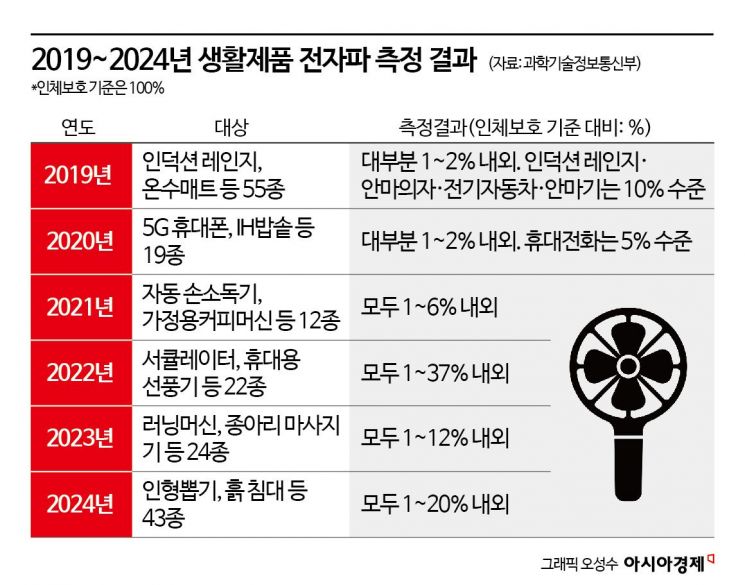
According to the electromagnetic wave measurements, electric induction cooktops and carbon mats emitted electromagnetic waves at or below 20.22% of the human protection standard. Seasonal products for summer, such as portable fans and ice makers, emitted electromagnetic waves at or below 12.05% of the standard, while electric shavers and electric toothbrushes measured at or below 4.74% of the standard.
In educational facilities such as schools and kindergartens, and in living facilities such as hospitals and government offices, electromagnetic wave exposure was measured at or below 3.26% of the human protection standard. Even in converged facilities such as smart factories and campuses based on IoT technologies like Eum 5G, electromagnetic wave exposure was at or below 3.74% of the standard, a level similar to that of other facilities, despite the operation of various wireless devices.
Power lines near kindergartens and schools were also found to be safe, with measurements at or below 0.05% of the human protection standard.
Domestic human protection standards for electromagnetic waves are based on the International Commission on Non-Ionizing Radiation Protection (ICNIRP) guidelines recommended by the WHO. For a frequency band of 30 Hz, the standard is set at 1,666 mG or less; for 60 Hz, 833 mG or less; and for 200 Hz, 250 mG or less.
Since 2019, the Ministry of Science and ICT has annually selected ICT products and major living space facilities for measurement based on public and social interest, and has disclosed the results of electromagnetic wave measurements. From 2019 through the first half of this year, a total of 506 products across 166 categories and 22,932 major living space facilities have been measured for electromagnetic waves.
In the first half of this year, through the 'Everyday Electromagnetic Waves Committee' operated by the Ministry of Science and ICT, six products requested by the public, five seasonal (summer) products, and 21 products selected by the ministry itself?a total of 32 categories?were selected. The National Radio Research Agency conducted precise measurements and analyses of electromagnetic wave intensity for about two months according to measurement standards.
The results of this electromagnetic wave exposure measurement can be found on the National Radio Research Agency's 'Everyday Electromagnetic Waves' website (for living products) and the Korea Communications Agency's 'Electromagnetic Wave Safety Information' website (for living spaces).
© The Asia Business Daily(www.asiae.co.kr). All rights reserved.
![Clutching a Stolen Dior Bag, Saying "I Hate Being Poor but Real"... The Grotesque Con of a "Human Knockoff" [Slate]](https://cwcontent.asiae.co.kr/asiaresize/183/2026021902243444107_1771435474.jpg)















