"Trump Personally Intervenes to Finalize 100-Day U.S.-Japan Trade Deal"
Japanese Investment in the U.S. Raised to $550 Billion, Focused on Strategic Industries such as Semiconductors, Automobiles, and Aviation
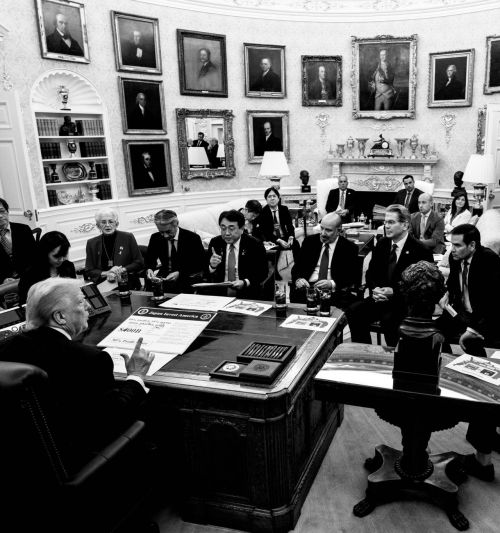 A photo posted on social media platform X by Dan Scavino, White House Deputy Chief of Staff, on the 22nd (local time). U.S. President Donald Trump is seen spreading a large board with Japan's proposal on his desk, directly negotiating with Ryosei Akazawa, Japan's Minister for Economic Revitalization and the lead representative for tariff negotiations. Scavino X
The driving force behind the rapid conclusion of the 100-day trade negotiations between the United States and Japan was U.S. President Donald Trump. President Trump personally intervened in the final stage of the talks, successfully increasing Japan's investment in the U.S. to a total of $550 billion (approximately 759 trillion won). This amount is 1.4 times higher than the $400 billion initially discussed at the start of the negotiations. The Trump administration is expected to use the outcome of the negotiations with Japan to pressure other key negotiating partners, including the European Union (EU), which is the second-largest country in terms of trade surplus with the U.S., as well as South Korea.
"Trump Stepped In Despite No Initial Plans for Face-to-Face Negotiations"
According to Japan’s Nikkei newspaper on the 24th, on the afternoon of the 22nd (local time), President Trump spread out a large board containing Japan's proposals on his desk at the White House and fired off questions at Ryosei Akazawa, Japan’s Minister for Economic Revitalization and the chief representative for tariff negotiations.
When Minister Akazawa departed from Haneda Airport, there were no plans for a face-to-face meeting with President Trump. However, with Trump, the ultimate decision-maker, personally stepping in, the negotiations between the two countries were swiftly concluded. U.S. Treasury Secretary Scott Besant and Commerce Secretary Howard Rutnick were also present at the meeting.
It is reported that President Trump focused on expanding Japanese investment in the U.S. during the meeting. He asked, "Will you purchase from Boeing?" and the Japanese government agreed. Boeing is an American aircraft manufacturer. As a result, the negotiations included Japan’s purchase of 100 Boeing aircraft. President Trump personally amended the investment support figure from Japan written on the board, changing it from "$400 billion" to "$500 billion" with a pen, and subsequently, both sides added another $50 billion, ultimately agreeing on a final total of $550 billion.
Afterwards, the Trump administration highlighted the $550 billion in Japanese investment in the U.S. as a core achievement of the negotiations. In an interview with Bloomberg TV the previous day, Secretary Besant stated, "Japan brought forth a U.S.-Japan cooperation initiative that includes equity investment, credit guarantees, and funding support for major projects in the U.S.," emphasizing that all foreign direct investment (FDI) commitments are new capital. On the same day, Secretary Rutnick said in an interview, "Japan’s investment pledge in the U.S. could serve as a model for the EU. The negotiations now depend on the EU," thereby increasing the pressure on other negotiating countries.
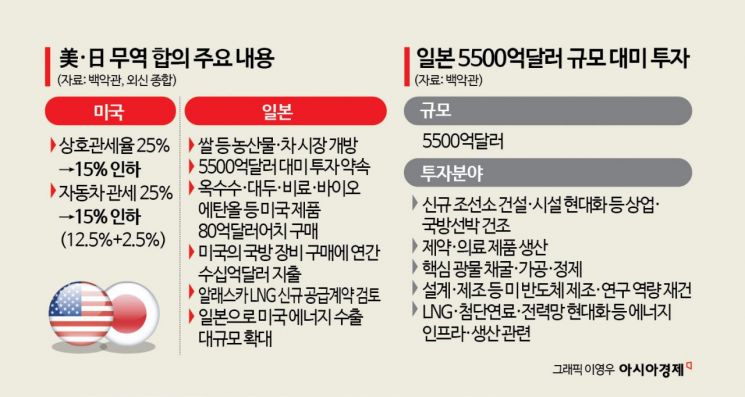
Japanese Investment in the U.S. Focused on Semiconductors, Automobiles, Aviation, Biotech, and Energy
According to explanatory materials released by the White House, Japan’s investment in the U.S. is concentrated in strategic industries such as semiconductors, automobiles, aviation, biotechnology, and energy. Among these, shipbuilding and semiconductors are areas where South Korea holds global core capabilities, and it is known that the Korean government has used these as leverage in its negotiations with the U.S.
In addition, Japan will purchase $8 billion (approximately 11 trillion won) worth of corn, soybeans, and bioethanol, and plans to increase imports of U.S. rice by 75%. Japan also offered a package of concessions, including expanded purchases of defense equipment, participation in the Alaska LNG (liquefied natural gas) project, and the lifting of long-term import restrictions on U.S. cars and trucks.
Despite the results of the negotiations appearing to be heavily in favor of the U.S., the Japanese public responded more positively to the fact that a "15% automobile tariff rate" was secured. The Japanese automobile tariff was reduced from 25% to 12.5%, and with the existing 2.5% added, the final rate became 15%. Previously, the U.S. government had repeatedly stated during reciprocal tariff talks that item-specific tariffs, such as those on automobiles, were not subject to negotiation. Only the UK and Japan have succeeded in lowering automobile tariffs.
The evaluation of Minister Akazawa, who led the negotiations with the U.S. to "success," has also changed. He was previously heavily criticized in Japan for wearing a Trump campaign hat emblazoned with the slogan "Make America Great Again (MAGA)" and giving a thumbs-up during his first meeting with President Trump.
The next step for the Trump administration, after concluding negotiations with Japan, is talks with the EU. Nikkei noted that the U.S. government appeared to have accelerated trade negotiations with Japan with the EU in mind. The EU, which is the second-largest country in terms of trade surplus with the U.S. after China, is making demands similar to those of Japan, such as a review of automobile tariffs. According to the UK’s Financial Times (FT), the EU negotiating team resumed talks with the U.S. on the 23rd and is aiming for the same "15% tariff rate" as Japan.
As of this date, the countries that have concluded trade agreements with the U.S. are the UK, Vietnam, Indonesia, the Philippines, and Japan. Foreign media reported that negotiations with India and China are also in their final stages.
© The Asia Business Daily(www.asiae.co.kr). All rights reserved.


















