Park Chandae Urges "Make a Decision," Kang Steps Down 17 Minutes Later
Speculation Over Coordination With Presidential Office vs. Spirit of Solidarity
Sharp Contrast With Jung Chungrae... Party Sentiment Begins to Shift
Kang Sunwoo, a lawmaker from the Democratic Party of Korea, has announced her voluntary withdrawal as the nominee for Minister of Gender Equality and Family. The so-called "aide mistreatment controversy" has erupted into a major issue, leaving the ruling bloc unable to avoid political damage. During Kang's resignation process, candidates for the party leadership took contrasting stances, making the impact on the upcoming party convention a matter of keen interest.
According to political circles on July 24, Kang Sunwoo herself has suffered the most significant political damage from this incident. As a two-term lawmaker who had previously secured a sole nomination in Seoul's Gangseo-gu Gap district during the last general election, Kang had been on a winning streak. However, controversies have arisen not only during her time as a lawmaker but also from her past academic career, leaving her wounded. Both the presidential office and the Democratic Party delayed making a decisive move regarding Kang, out of concern that forcing her resignation could inflict irreversible political harm. While some of the party's core supporters have expressed sympathy for Kang, public opinion, as reflected in polls, has continued to turn against her. For Kang, who had hoped for a ministerial promotion, addressing her political wounds has become unavoidable.
The Democratic Party's parliamentary leadership, which had initially considered pushing through with her nomination, and the presidential office, which cannot escape criticism for its failure in personnel vetting, both now face political burdens. Despite worsening public sentiment, the Democratic Party's parliamentary leadership supported pushing ahead with her nomination until early in the week, taking on the "villain" role. The presidential office, for its part, tried to shift responsibility by claiming it was acting at the party leadership's request, and even requested the submission of a confirmation hearing report, signaling its intent to proceed with the appointment. Problems became apparent not only in the personnel vetting process but also in the subsequent management of the situation.
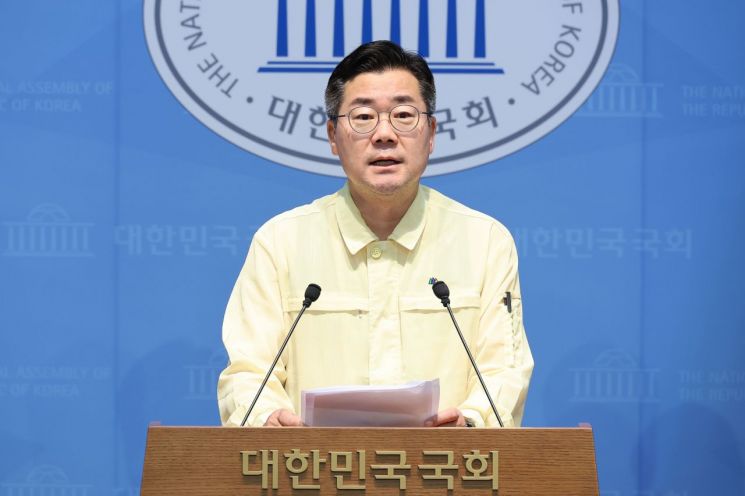 Park Chandae, a candidate for the Democratic Party of Korea leadership, is holding a press conference on current issues including prosecution reform at the National Assembly Communication Office in Yeouido, Seoul on the 24th. Photo by Yonhap News
Aftermath of Kang Sunwoo's Resignation Unavoidably Impacts Party Convention
The impact on the Democratic Party convention, scheduled for August 2, has become inevitable. Initially, regarding the issue with Kang, party leadership candidate Jung Chungrae voiced his support, which aligned with the sentiments of the party’s core supporters. In contrast, leadership candidate Park Chandae called for caution and careful consideration.
Ultimately, Park, through social media the previous day, stated, "It is difficult and painful, but a decision must be made," urging Kang to step down. Coincidentally, Kang announced her voluntary resignation 17 minutes later, leading to speculation that Park’s message played a role in the decision. Within and outside the party, this has prompted the view that Park is representing the presidential office, in contrast to Jung Chungrae, who is seen as representing the party’s base.
Their subsequent responses also differed. Jung focused on consoling supporters who were upset by the controversy, stating on social media, "What is a comrade? Winning together when we win, losing together when we lose. Standing together in the rain. I offer human comfort to Kang Sunwoo as a person." On the other hand, Park, when asked in a YTN radio interview about his alleged coordination with the presidential office, avoided a direct answer, saying, "I believe we were united in our determination to do whatever it takes for the success of the Lee Jaemyung administration," and "Rather than placing all the responsibility on the appointing authority, I think there was some mutual understanding among our party, lawmakers, and the public for the administration's success." This suggests that Park willingly took on the "villain" role to lessen the political burden on President Lee. For Park, who has emphasized his alignment with President Lee, this move represents a bold gambit. He appears to hope that party members will recognize the deliberation behind his decision.
Regarding criticism from some quarters that he lacks a sense of camaraderie, Park reacted strongly. Meeting with reporters that day, he said, "That is a misinterpretation by someone," and explained, "My remarks were made to help overcome the personnel challenges faced by the Lee Jaemyung administration."
© The Asia Business Daily(www.asiae.co.kr). All rights reserved.
![Clutching a Stolen Dior Bag, Saying "I Hate Being Poor but Real"... The Grotesque Con of a "Human Knockoff" [Slate]](https://cwcontent.asiae.co.kr/asiaresize/183/2026021902243444107_1771435474.jpg)















