Pre-Ship Review Held
Scheduled to Move to Guiana Space Center in South America in September
Arirang 7 (Multipurpose Practical Satellite 7) will be transported to the Guiana Space Center in South America in mid-September for launch preparations and is scheduled to be launched aboard Arianespace's Vega-C launch vehicle in November.
The Korea Aerospace Administration and the Korea Aerospace Research Institute held a Pre-Ship Review meeting for Arirang 7 on July 23. Arirang 7 is a world-class high-resolution (resolution of 0.3 meters or less) optical observation satellite developed entirely with domestic technology.
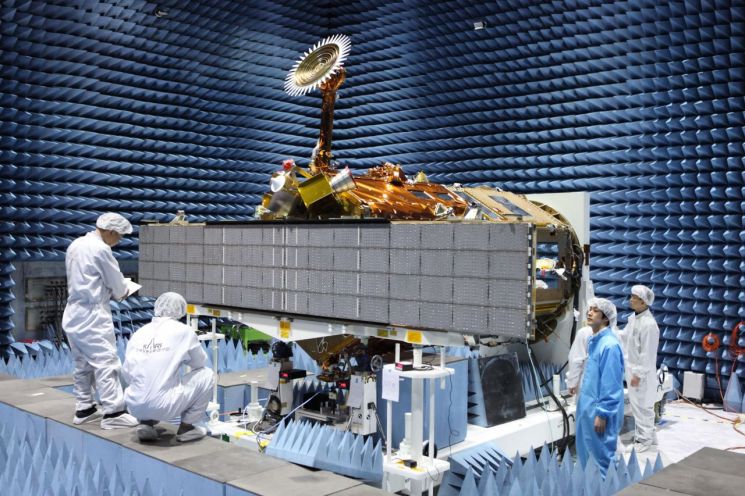
The Arirang 7 project began in August 2016. Detailed design was completed in April 2019, and the assembly of the satellite body and space environment testing were finished in December 2023. The satellite has now been placed in storage mode and is awaiting launch.
During the Pre-Ship Review, participants examined the results of satellite assembly and testing, checked the satellite's status, reviewed launch preparations, ground station readiness, and initial operation plans. They finalized the satellite development and confirmed its readiness for launch.
Following this, Arirang 7 will be transported to the Guiana Space Center, the launch site, in mid-September. After arrival, the satellite will undergo status checks, fueling, and integration with the launch vehicle. These launch preparations are expected to take about a month, with launch scheduled for November aboard Arianespace's Vega-C launch vehicle. Vega-C is a four-stage launch vehicle, with the first to third stages using solid fuel and the fourth stage using liquid fuel. It is capable of launching approximately 2.3 tons into a 700 km orbit.
After launch, once the satellite is placed into its target orbit, it will undergo about six months of initial operation and calibration. Full-scale satellite operations are expected to begin in the second half of next year.
Jeon Hyungyeol, Director of the Satellite and Space Exploration Research Institute at the Korea Aerospace Research Institute, stated, "Arirang 7 will serve as an opportunity to reaffirm our nation's independent ultra-high-resolution optical observation satellite technology capabilities and will also help establish a bridgehead for Korea to enter the global medium- and large-scale satellite market."
Kim Jinhee, Head of the Satellite Division at the Korea Aerospace Administration, said, "Once Arirang 7 is launched, it will be able to provide world-class, high-quality satellite imagery to public and private sectors. The satellite's high-resolution optical camera (0.3 meters or less) and infrared (IR) sensors will be used for disaster and hazard monitoring, land and environmental surveillance, public safety, and urban heat island phenomenon analysis."
© The Asia Business Daily(www.asiae.co.kr). All rights reserved.
![Clutching a Stolen Dior Bag, Saying "I Hate Being Poor but Real"... The Grotesque Con of a "Human Knockoff" [Slate]](https://cwcontent.asiae.co.kr/asiaresize/183/2026021902243444107_1771435474.jpg)















