Possibility of Inter-State Claims for Damages Recognized
Vanuatu Minister Facing Submersion Crisis: "A Groundbreaking Milestone"
The International Court of Justice (ICJ) has determined that failure by parties to the climate change convention to fulfill their obligations could constitute a violation of international law.
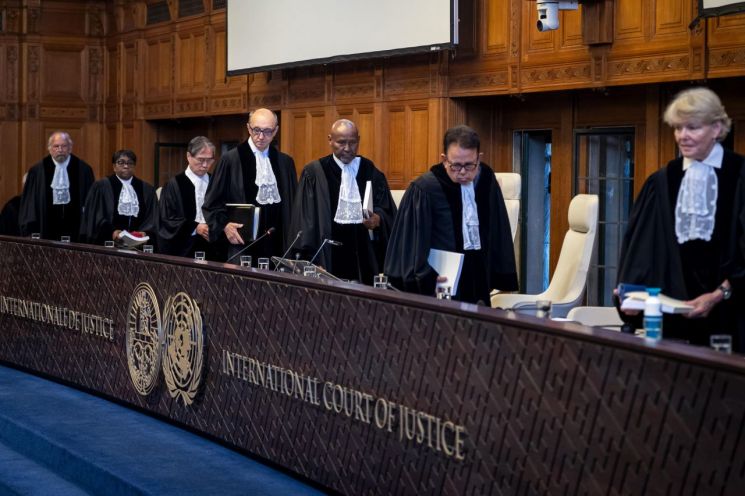 On the 23rd (local time), judges are entering the International Court of Justice (ICJ) in The Hague, Netherlands, to deliver a ruling on the obligations of countries regarding climate protection. Photo by EPA Yonhap News
According to reports from AP and AFP on the 23rd (local time), the ICJ delivered this advisory opinion at its court in The Hague, Netherlands. The ICJ described the climate crisis as "an existential issue that threatens all life and the health of the planet," and stated, "The climate change convention imposes strict obligations on countries. Failure to comply constitutes a violation of international law."
The ICJ also stated, "The legal consequences of internationally wrongful acts may include full reparation for the injured state," indicating that claims for damages between states are possible. However, it limited such reparations to cases "where a sufficiently direct and certain causal link is established between the wrongful act and the injury." Regarding restitution as a form of reparation, the court explained that this "may take the form of rebuilding damaged or destroyed infrastructure and restoring ecosystems and biodiversity."
This is the first time that the ICJ, the United Nations' highest judicial body and often referred to as the "World Court," has issued a judgment regarding state responsibility in relation to the climate crisis. In addition to adjudicating disputes under international law, the ICJ also issues advisory opinions when requested. Although these opinions are not legally binding, they can serve as standards for government policies, court rulings, and interpretations of international law.
The idea to seek a legal opinion from the ICJ originated from law students in Vanuatu, a Pacific island nation facing the risk of being submerged. In March 2023, the United Nations General Assembly adopted a resolution requesting an advisory opinion from the ICJ on the legal responsibilities related to climate change. In response, the ICJ held hearings in December last year, gathering input from the governments of 98 countries and 12 international organizations, including the Organization of the Petroleum Exporting Countries (OPEC). Developed countries generally argued that no legal obligations should be imposed beyond the 1992 United Nations Framework Convention on Climate Change (UNFCCC) and the 2015 Paris Agreement, which implements it in detail. In contrast, Pacific island nations and developing countries insisted that binding measures to reduce greenhouse gas emissions are necessary and that developed countries must provide compensation for damages.
Ralph Regenvanu, Vanuatu's Minister of Environment, stated, "This decision by the ICJ is a groundbreaking milestone in climate action," adding, "It signifies a global consensus on the seriousness of the climate issue and the urgent need for people around the world to address it."
© The Asia Business Daily(www.asiae.co.kr). All rights reserved.
![Clutching a Stolen Dior Bag, Saying "I Hate Being Poor but Real"... The Grotesque Con of a "Human Knockoff" [Slate]](https://cwcontent.asiae.co.kr/asiaresize/183/2026021902243444107_1771435474.jpg)















