Establishing a Social and Disaster Safety Net for Small Business Owners
SMEs as Key Players in the Great Digital Transformation
Leading Innovation Toward Becoming a Global Top Four Venture Powerhouse
Hansung Sook, the newly appointed Minister of SMEs and Startups under the Lee Jaemyung administration, officially began her duties on July 24 with an inauguration ceremony. The Ministry of SMEs and Startups plays a broad role, ranging from supporting small business owners and SMEs to fostering the venture and startup ecosystem, which means there is a vast array of tasks for the minister to address. Unlike her predecessors, who were mostly politicians or bureaucrats, Minister Han comes from the IT industry and has hands-on experience in the field, raising expectations both inside and outside the ministry. She is now tasked with the significant challenge of driving the digital transformation (DX) and artificial intelligence transformation (AX) of SMEs and small business owners, as well as innovating the venture and startup ecosystem to support these changes. In particular, her focus on bridging the digital divide and strengthening innovation capabilities is directly linked not only to the ministry’s duties but also to the future direction of the national economy.
At the inauguration ceremony held at the Sejong Government Complex on the morning of July 24, Minister Han stated, “I will do my utmost to design and create an environment for the ‘real growth’ of SMEs and ventures through innovative technologies such as digital and AI.” She explained that this is because AI and digital transformation are accelerating across all industries, making it impossible for companies to rely on their existing competitive advantages. Minister Han further emphasized, “We are now in an era where it is difficult to survive in the market without properly utilizing technology and data,” adding, “I will ensure that SMEs become the main players in the great digital transformation.”
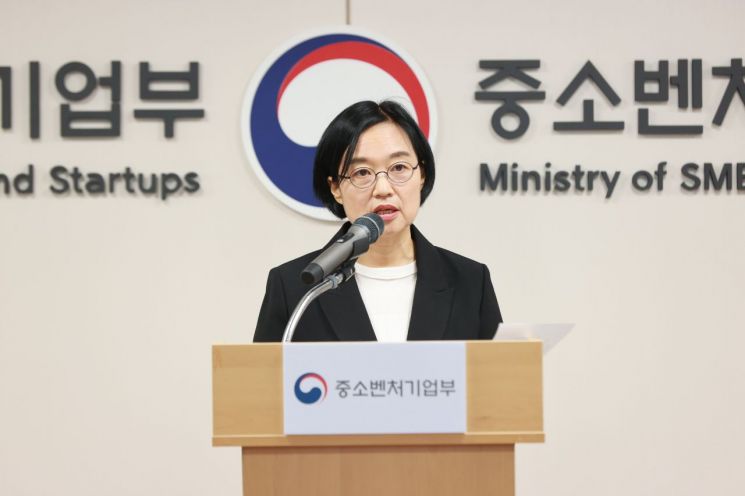 Hansung Sook, Minister of SMEs and Startups, is delivering an inaugural address at the inauguration ceremony held at the Ministry of SMEs and Startups building in Sejong on the 24th. Ministry of SMEs and Startups
AI Must Reach Even Traditional Small Business Owners
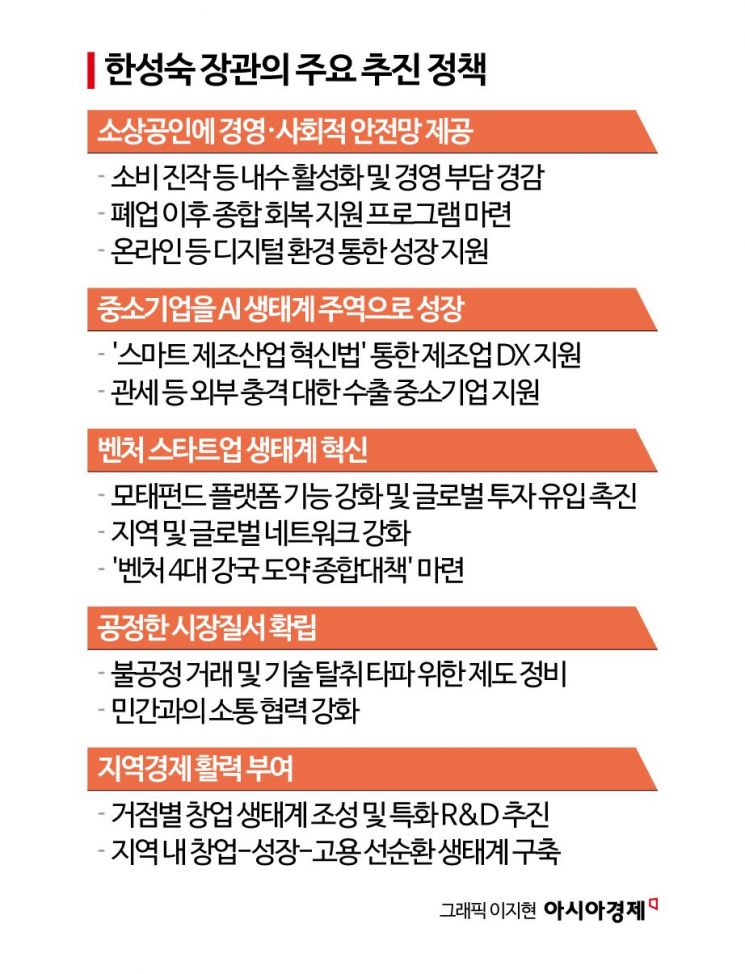
Minister Han’s policies for SMEs and small business owners can largely be summarized into two pillars: digital-based structural improvement and strengthening the social safety net. First, the government’s core policy of introducing AI technology is expected to spread even to traditional small business owners. Citing “Project Flower,” which she promoted during her tenure as CEO of Naver, Minister Han said, “We will actively pursue policies that help small business owners in traditional markets and local commercial districts succeed by utilizing online platforms.” Her vision goes beyond simply helping businesses go online; it aims to enable them to analyze business data and identify new growth opportunities. The goal is to more than double the current digital transformation rate, which stands at about 30%. There are questions about how quickly Minister Han, who has spent many years in large IT corporations, can understand traditional industries and develop concrete solutions for digital transformation. During the confirmation hearing preparation period, she acknowledged, “There are still weak areas when it comes to traditional manufacturing,” and added, “Because new things can feel unfamiliar, I am ready to listen. I will develop solutions through discussions with experts from various fields, associations, and ministry staff.”
Speed is also required in enacting the “Smart Manufacturing Industry Innovation Act,” which she mentioned during the confirmation hearing. This bill is one of the specific policies proposed by Minister Han, aiming to establish an institutional foundation for the smart transformation of manufacturing SMEs. Although previous administrations have repeatedly promoted the adoption of smart factories, as of 2023, less than 20% of SMEs and mid-sized companies have actually introduced smart factories. The Yoon Sukyeol administration shifted the smart factory policy toward advancement, reducing the budget for basic-level support, but since 76% of companies are still at the lowest basic level, comprehensive support for these companies is necessary. Minister Han stated, “Smart factories must now move beyond the introduction stage and into internalization,” and added, “The digital transformation of SMEs will be promoted at various levels, from basic to advanced, and will expand to include AI smart factories and beyond.”
Recovery policies for small business owners, who are facing a complex crisis due to high interest rates, sluggish domestic demand, and disasters in the aftermath of COVID-19, are also considered a major task. She said, “My top priority will be to establish a social and disaster safety net for small business owners,” and added, “I will focus especially on establishing recovery systems for large-scale disasters, supporting employment insurance, and strengthening fire insurance.” The second supplementary budget will also be executed swiftly to stabilize small business operations. Minister Han said, “We will work to ease debt burdens by extending repayment periods and reducing interest rates, and also strive to alleviate fixed costs,” adding, “Even before debt restructuring, we will proactively strengthen one-stop support tailored to small business owners, from business closure to re-employment.” She plans to introduce a “Comprehensive Recovery Support Program” that includes support for business closure and re-employment training, so that those who close their businesses can return to being active participants in the economy.
Innovation in the Venture and Startup Ecosystem
There are high expectations that practical policies to innovate the venture and startup ecosystem will be pursued. As she herself explained, she is a “first-generation venture entrepreneur who has spent over 30 years at the forefront of the IT industry, driving digital innovation and the growth of the platform ecosystem, from startups to large corporations.” The first initiative Minister Han is expected to pursue is creating a market environment in which innovative startups can rapidly scale up. She plans to strengthen the platform function of the Korea Fund of Funds to encourage active inflow of private and foreign capital into the venture investment market and to attract global venture investors to Korea. She stated, “We will actively expand the domestic venture investment market by broadening participation of private capital, such as pension funds, and redefining the functions of the Korea Fund of Funds, including extending its lifespan.”
The “Next Unicorn Project,” which is being actively promoted in the second half of this year with an investment of 300 billion won, is another initiative where Minister Han’s expertise will be crucial. This project aims to make concentrated, stage-specific investments in promising companies in the AI and deep tech sectors, helping AI companies with technological prowess and growth potential to scale up and enter global markets. The details will be included in the comprehensive plan for Korea to become one of the world’s top four venture powerhouses, which Minister Han intends to develop by collecting opinions from the venture and startup community. The goal of this plan is to create a world-class venture and startup ecosystem. Minister Han said, “We will build a robust startup ecosystem where innovative talent can boldly take on entrepreneurship and where entrepreneurs can grow independently, even in the regions.”
© The Asia Business Daily(www.asiae.co.kr). All rights reserved.


















