KCMI Holds Policy Forum on "Incorporating Stablecoins into the Institutional Framework"
There has been a recommendation to establish clear accountability regulations for issuers and distributors in order to institutionalize stablecoins in South Korea, as well as to implement mechanisms to protect users and ensure financial stability. In particular, there was consensus that regulatory measures are also needed for stablecoins issued overseas, given the necessity of consumer protection.
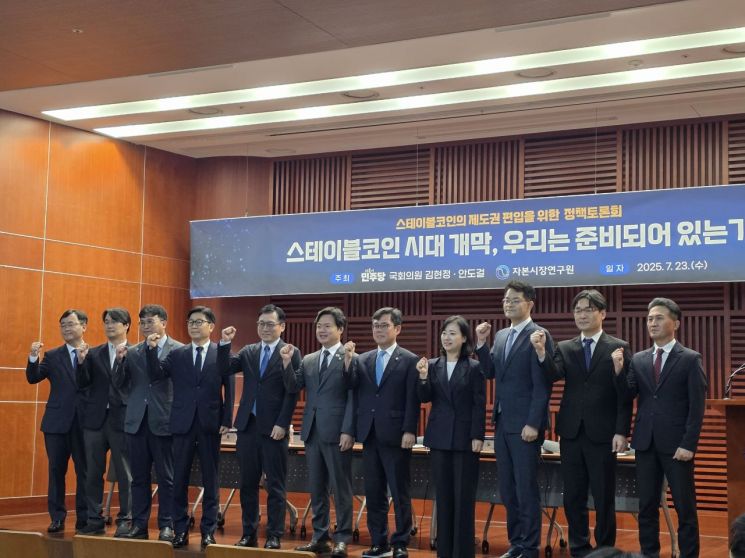
On July 23, Hwang Sewoon, Senior Research Fellow at the Korea Capital Market Institute, stated this during his keynote presentation at the policy forum "Incorporating Stablecoins into the Institutional Framework," held at the KCMI Center in Yeouido, Seoul. The forum was co-hosted by the offices of Democratic Party lawmakers Kim Hyunjung and Ahn Dogeol, along with the Korea Capital Market Institute.
Hwang presented five fundamental directions for the institutionalization of stablecoins: establishing a clear definition and classification system for stablecoins; formulating accountability regulations for issuers and distributors; ensuring user protection and financial stability; laying the groundwork for linkage and activation with CBDCs; and implementing foreign exchange transaction regulations for stablecoins.
He explained, "Issuance should be permitted only to those who meet the eligibility requirements to issue stablecoins, and the issuance qualification should be granted through a licensing system rather than a registration system." He added, "Considering the universality and importance of stablecoins, the capital requirement should be set at a minimum of 5 billion KRW."
He continued, "To ensure market transparency and strengthen user protection, stablecoin issuers should submit a white paper at the time of issuance and publicly disclose a product description." He also stated, "It is necessary to explicitly stipulate the obligation to redeem users' stablecoin holdings and to grant users the right to request redemption from the issuer at face value."
He also emphasized the need for regulations on overseas stablecoins. Hwang said, "The domestic circulation of stablecoins issued overseas is increasing," and stressed, "Supervision and oversight must be strengthened to maintain the stability of the financial system, enhance user protection, and prevent money laundering."
Kim Gaprae, Senior Research Fellow at the KCMI, who also presented at the forum, discussed the current state of global stablecoin regulations and usage.
In the United States, the GENIUS Act was passed on July 18 to strengthen the global status of the US dollar as the key currency, based on a regulatory framework for stablecoins. The GENIUS Act stipulates conditions for stablecoin issuance, requirements for reserve assets, and disclosure obligations. He evaluated, "The United States has clarified entry regulations regarding issuer qualifications and conduct regulations for user protection concerning stablecoins." He added, "Domestically, the US is promoting innovation in payment and settlement, while internationally, it is facilitating the global spread of dollar-based stablecoins."
He also pointed out, in agreement with Senior Research Fellow Hwang, the need for countermeasures regarding stablecoins issued overseas. He explained, "Tether (USDT), which is hardly traded on major virtual asset exchanges in countries like Japan and the European Union (EU), forms a market of comparable size to Bitcoin on domestic virtual asset exchanges." He added, "This increases risks such as the weakening of the Korean won's sovereignty, money laundering, and the misuse of illegal foreign exchange transactions."
He further stated, "As countermeasures for overseas-issued stablecoins, legislative measures such as the obligation for intermediaries to compensate for losses, as in Japan, and the requirement to hold reserve assets domestically, as in the EU, are necessary."
During the panel discussion moderated by Ahn Suhyeon, professor at Hankuk University of Foreign Studies Law School, the necessity and risks of stablecoins were discussed. Ko Kyungcheol, head of the Electronic Finance Team at the Bank of Korea, said, "Stablecoins should be utilized with consideration for issues related to linkage with the traditional financial market," and added, "If institutionalized and scaled up, it will be necessary to consider the impact on the bank-centered financial industry."
Kim Sungjin, Director of the Virtual Asset Division at the Financial Services Commission, also emphasized, "While stablecoins can drive innovation, they also increase financial system risks, so supplementary measures are needed." He stressed, "The most important point is that there are currently no user protection mechanisms for overseas stablecoins."
He also explained that issues could arise in cross-border transactions. Do Jongrok, Director of the Foreign Exchange System Division at the Ministry of Economy and Finance, said, "Stablecoins are increasingly being used as payment and settlement tools in the real economy," and added, "Since they can be used for illegal remittance or embezzlement of export proceeds, it is important to determine the appropriate legal framework."
© The Asia Business Daily(www.asiae.co.kr). All rights reserved.

















