10 Percentage Points Cut from Previous 25% Tariff
"Japan to Invest 759 Trillion Won in the U.S."
Likely to Participate in Alaska LNG Project
On July 22 (local time), U.S. President Donald Trump announced that he had reached a trade agreement with Japan and that a 15% reciprocal tariff would be applied to Japanese imports. With this, Japan has become the fourth Asian country to sign a trade agreement with the United States since the launch of the second Trump administration, following Vietnam, Indonesia, and the Philippines. On the same day, the United States also reached a trade agreement with the Philippines, imposing a 19% tariff. The Japanese government, which had previously maintained a 'no concessions' stance on sensitive items such as automobiles and rice, agreed through this deal to open part of its market to the United States.
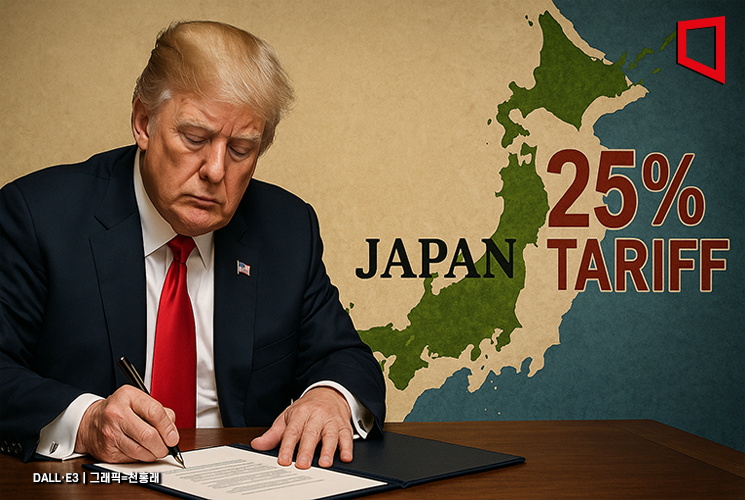
President Trump wrote on Truth Social, his self-created social networking service, "I have just concluded the largest deal ever with Japan," adding, "Japan will pay a 15% reciprocal tariff." This rate is 10 percentage points lower than the previously announced 25% tariff that the United States had warned Japan about. On April 2, President Trump had announced reciprocal tariffs for trade partner countries, stating that a 24% tariff would be imposed on Japan. However, when the so-called 'tariff letter' to Japan was released on July 7, the rate was raised by 1 percentage point to 25%.
After sustained pressure on its ally Japan, President Trump succeeded in securing a massive investment totaling $550 billion (about 760 trillion won). The United States and Japan sat down at the negotiating table a total of eight times to reach this trade agreement.
President Trump evaluated the outcome by stating, "Japan will invest $550 billion in the United States at my request, and the United States will receive more than 90% of the returns." He further stated that this influx of investment would create hundreds of thousands of jobs.
President Trump emphasized that, under this agreement, Japan had decided to open its domestic market to U.S. automobiles and rice. He said, "Japan will open its market to a variety of items including automobiles, trucks, rice, and certain agricultural products," adding, "This is a very exciting time for the United States, and it is even more meaningful in that we can continue our excellent relationship with Japan."
The tariff rate for the automotive sector was also set at 15%. Citing a Japanese government official, NHK, Japan's public broadcaster, reported on July 23 that the most contentious issue in the U.S.-Japan tariff negotiations was the automotive sector. The United States reduced the additional tariff it had demanded from 25% to 12.5%, and, by adding the original base rate of 2.5%, the final agreed tariff rate was set at 15%. This is interpreted as a compromise, with Japan opening its automobile market and the United States partially adjusting the tariff increase. However, tariffs on steel and aluminum will remain at the existing rate of 50%.
Japanese Prime Minister Shigeru Ishiba stated immediately after the agreement, "I believe this agreement allows the government to protect the national interest while also enabling Japan and the United States to work together to create jobs, produce excellent products, and play diverse roles on the world stage."
Until recently, however, the mood within the Japanese government had been different. During a recent campaign for the House of Councillors election, Prime Minister Ishiba emphasized a 'struggle for the national interest' and stated that Japan could not simply comply with U.S. tariff demands. Automobiles and rice were core sensitive items that the Japanese government had declared as 'absolutely non-negotiable.' Automobiles, steel, and agricultural products are Japan's main export items, and if the 25% reciprocal tariff announced by the United States were to take effect as planned, these industries would inevitably suffer significant damage.
In the end, it appears that Japan agreed to lower the existing 25% tariff rate to 15% in exchange for opening its automobile and agricultural markets and making large-scale investments in the United States, including in the Alaska liquefied natural gas (LNG) project.
The weakening of Prime Minister Ishiba's political position due to his party's defeat in the House of Councillors election is also cited as a reason for his shift from a hardline stance. In the House of Councillors election held on July 20, the ruling party failed to secure a majority, significantly shaking the foundation of the Ishiba Cabinet. In this situation, there were concerns that an escalation of tariff conflict with the United States could trigger calls for Prime Minister Ishiba's resignation and further heighten the sense of political crisis.
In fact, immediately after the election defeat, Prime Minister Ishiba stated that he would decide his future political course after monitoring the progress of the U.S.-Japan tariff negotiations. Reuters interpreted this as a strong determination to make the outcome of the negotiations a political turning point, amid growing internal and external pressure following the recent defeat in the House of Councillors election.
© The Asia Business Daily(www.asiae.co.kr). All rights reserved.

















