No Mandatory Retirement for Legitimate Reasons Such as Employee Compensation
Bills Under Discussion: "Retirement Within Six Months or One Year If No Valid Reason"
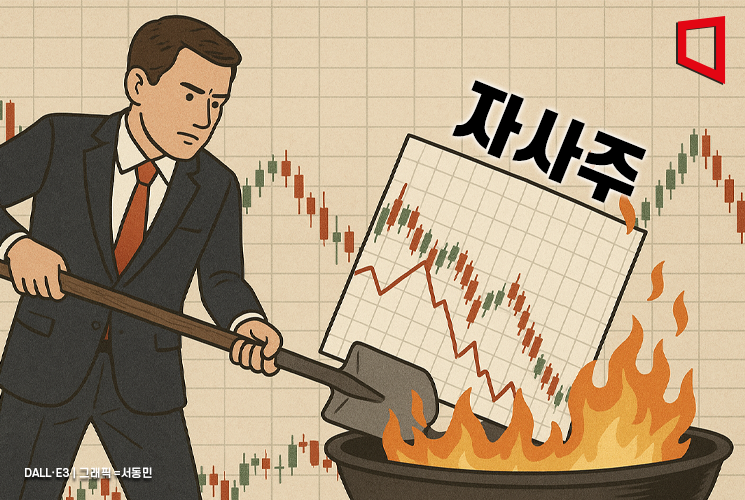
Earlier this month, the amended Commercial Act passed the National Assembly, putting into effect the provision requiring directors to act in the best interests of shareholders. Follow-up amendments to the Commercial Act, which could be addressed in the National Assembly as early as September, include the mandatory retirement (cancellation) of treasury shares. Following last year's strengthening of disclosure obligations regarding treasury shares for listed companies, and with signs that mandatory retirement of treasury shares may be introduced this year, some domestic companies have already begun to respond by "self-disposing" treasury shares within affiliates or issuing bonds using treasury shares as collateral.
On the 23rd, Hanwha Investment & Securities analyzed laws and bills related to treasury shares in its report titled "[ESG] Corporate Governance Regulation: Quick Response Before Mandatory Retirement? Actual Status of Treasury Share Disposal After the Presidential Election."
According to the amended Enforcement Decree of the Financial Investment Services and Capital Markets Act (Capital Markets Act Enforcement Decree) and the Regulation on Issuance and Disclosure of Securities, which have been in effect since December 31 of last year, listed companies holding treasury shares amounting to 5% or more of their total issued shares are required to prepare a report detailing their treasury share holdings, the purpose of holding them, and future plans for disposal (such as additional acquisition or retirement). This report must be approved by the board of directors and disclosed publicly. Additionally, when a listed company disposes of treasury shares, it must now disclose the purpose of the disposal, the counterparty and the reasons for their selection, and the expected dilutive effect on share value in more detail than before.
Regarding the mandatory retirement of treasury shares?a policy mentioned by President Lee Jaemyung since his candidacy?the ruling Democratic Party of Korea plans to address the issue during the regular National Assembly session in September. Various amendments to the Commercial Act have been proposed in this context. An amendment introduced on July 9 by Democratic Party lawmaker Kim Namgeun and others stipulates that, in principle, treasury shares must be retired within one year of acquisition. Exceptions are allowed only for legitimate reasons such as employee compensation, and in such cases, approval must be obtained at the next regular general meeting of shareholders. For these shareholder meetings, the voting rights of major shareholders are limited to 3% of the total issued shares. A similar amendment proposed by Cha Kyugeun of the Innovation of the Motherland Party on July 14 sets the retirement deadline at six months. An amendment submitted by Democratic Party lawmaker Kim Hyunjung on July 22 requires newly acquired treasury shares to be retired immediately and existing holdings to be retired within six months. Another amendment, proposed the same day by Democratic Party lawmaker Min Byungdeok, generally requires retirement within one year, but extends the deadline to two years if the total treasury shares at the time of acquisition are less than 3% of the total issued shares.
Recently, there has been a surge in cases of treasury share disposal for purposes other than the usual ones such as employee compensation, welfare, or delivery upon exercise of stock options. For example, on the 21st, Sebang and High Vision System each held board meetings and resolved to dispose of treasury shares to each other. Sebang Lithium Battery, an affiliate of Sebang, has a business relationship with High Vision System in the secondary battery sector, and officially disclosed "strengthening strategic business cooperation, including the secondary battery business" as the purpose of the disposal. Eom Sujin, an analyst at Hanwha Investment & Securities, explained, "The largest shareholder of Sebang is ENS Global, with an 18.53% stake, and Chairman Lee Sangwoong holds 17.99% directly. Excluding Chairman Lee, there is no clear individual major shareholder, so the underlying purpose may be to strengthen control through treasury shares. For High Vision System, the largest shareholder, CEO Choi Doowon, holds only 12.0%, so the cross-disposal of treasury shares between the two companies can be interpreted as a move to secure friendly shareholders."
Previously, on July 2, Taekwang Industrial announced that it would issue exchangeable bonds (EB) using treasury shares as collateral to raise funds for mergers and acquisitions (M&A). When the second-largest shareholder, Truston Asset Management, filed for an injunction and the Financial Supervisory Service requested a revised report, the company announced it would suspend the EB issuance until a court ruling. On June 26, Lotte Corporation resolved to dispose of treasury shares equivalent to 5% of its total issued shares to its affiliate Lotte Property & Development. Analyst Eom Sujin stated, "Under the Commercial Act, unless otherwise specified in the articles of incorporation, the board of directors can decide the type and number of treasury shares to be disposed of, the disposal price and payment date, the counterparty, and the method of disposal. However, declaring just a few months ago that there were 'no plans to dispose of treasury shares,' and then soon after disposing of them to related parties or using them for fundraising, is far removed from protecting the rights of minority shareholders. Therefore, strict supervision of insincere disclosures regarding treasury shares is needed to ensure that the amended Capital Markets Act Enforcement Decree is not rendered ineffective."
© The Asia Business Daily(www.asiae.co.kr). All rights reserved.
![Clutching a Stolen Dior Bag, Saying "I Hate Being Poor but Real"... The Grotesque Con of a "Human Knockoff" [Slate]](https://cwcontent.asiae.co.kr/asiaresize/183/2026021902243444107_1771435474.jpg)















