Kim Daejung's Exile Diary Discovered by Chance While Sorting His Belongings
Records of His Movements, Thoughts, and Prayers Across Japan and the United States
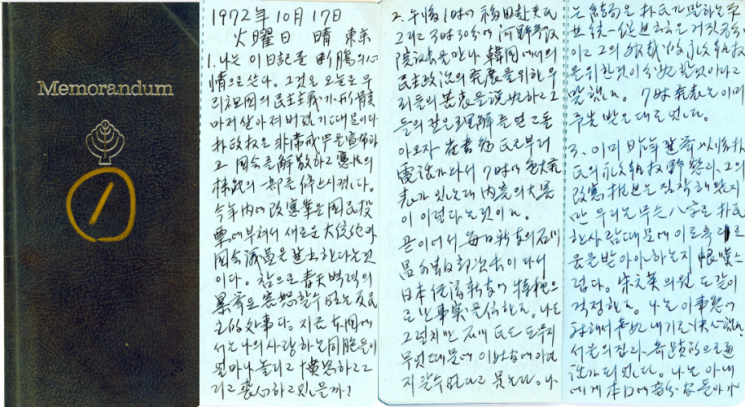
At the time this diary entry was written, former President Kim Daejung, then an opposition lawmaker, was staying in Tokyo, Japan, for medical treatment. On October 17, 1972, when the so-called "October Yushin" martial law was suddenly declared, he resolved to go into exile. Having narrowly lost to Park Chunghee in the presidential election the previous year, he was burdened with massive debt, while his wife and three children remained in Seoul. In his diary entry on the 17th, he wrote, "I was miraculously able to reach my home in Seoul by phone. I hinted to my wife that I had decided not to return for some time. She is calm. I am grateful for my wife. I left her with a debt of 40 million won, so I wonder how I could ever comfort her for the pain she must endure."
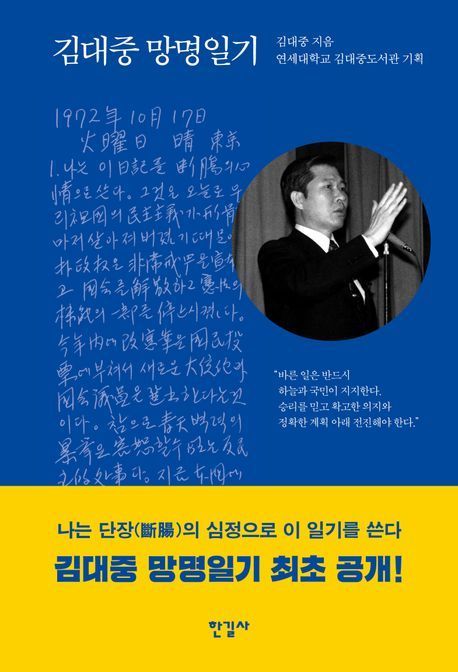
The diary that Kim Daejung wrote during his exile in Japan and the United States before and after the declaration of the Yushin martial law has been published as "Kim Daejung Exile Diary" (Hangilsa). The book contains handwritten entries in six notebooks, written in a mixture of Chinese characters, Japanese, and English. It covers a total of 223 entries from August 3, 1972, to May 11, 1973. The notebooks were discovered last summer. Kim Honggul, the youngest son of Kim Daejung and director of the Kim Daejung & Lee Heeho Memorial Foundation, found them while organizing his father's belongings at the family home in Donggyo-dong. At a book launch event held on the 22nd at the Kim Daejung Library in Donggyo-dong, Mapo-gu, Seoul, Kim Honggul said, "I didn't even know they existed, so they could have ended up in the trash, but I was really lucky to find them."
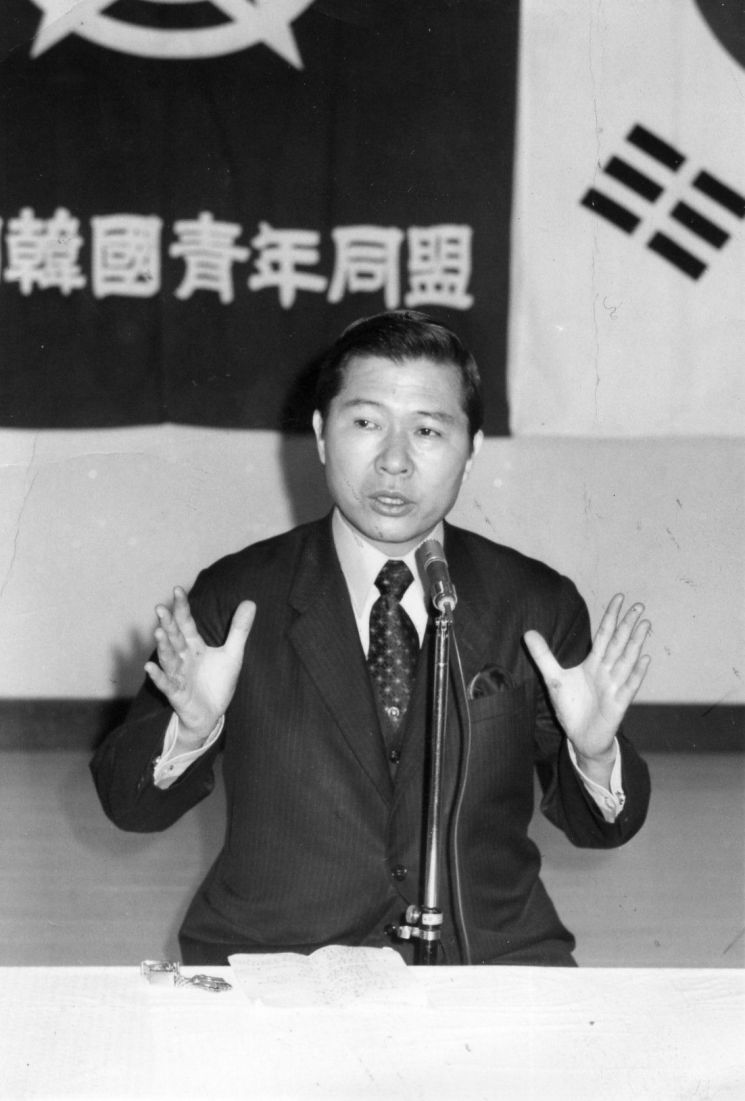 In February 1973, while in exile, Congressman Kim Daejung is giving a speech at a lecture hosted by the Korean Youth League in Japan. Hangilsa
At the time of exile, Director Kim Honggul was a nine-year-old elementary school student. He said, "I was looking forward to the gifts my father would bring back, but when the Yushin was suddenly declared, even at a young age, I could feel the atmosphere change drastically. The people who used to visit our home suddenly stopped coming." Although the political situation was chaotic due to the Yushin martial law, former President Kim Daejung had anticipated such developments. Kim Honggul said, "In his 1971 (presidential candidate) speech, my father said, 'If Park Chunghee stays in power, there will be no next election. It will become a presidential dictatorship.' As you can see from the diary, his reaction was not 'What a sudden disaster,' but rather, 'What I feared has finally happened.'"
The diary also raises the possibility that there were certain agreements between North and South Korea at the time. "It is said that North Korea's attitude is unexpectedly moderate, and that mutual understanding was reached at the meeting between Lee Hu-rak (then Director of the Korean Central Intelligence Agency) and Park Sungchul on the 12th" (October 18, 1972). "The South-North Red Cross talks are being held in Pyongyang, and it is said that North Korea will amend its constitution in step with South Korea. I cannot help but feel that there is something behind the events between the two Koreas." (October 24, 1972) Park Myunglim, director of the Kim Daejung Library at Yonsei University, said, "According to various classified documents from the past, Park Chunghee notified North Korea twice before the Yushin. The claim that the South Korean government incited anti-communism against North Korea before the Yushin was all a fabrication."
The diary contains detailed records of meetings and conversations that Kim Daejung had with various politicians and journalists in Japan and the United States during his exile. It specifies whom he met, what topics were discussed (including interviews), and his own thoughts on these matters. Prayers for the nation are also included. Kim Eunho, CEO of Hangilsa, the publisher of the book, said, "I believe this is historical evidence recorded with his whole mind and spirit during a harsh era. Even though the narrative is extremely dry, the prayers for the country and the people are deeply moving. The burning passion is powerfully expressed."
Meanwhile, 30 volumes of national policy notebooks that former President Kim Daejung kept during his presidency, recording daily tasks and issues, are also scheduled to be organized and published in the future.
© The Asia Business Daily(www.asiae.co.kr). All rights reserved.
![Clutching a Stolen Dior Bag, Saying "I Hate Being Poor but Real"... The Grotesque Con of a "Human Knockoff" [Slate]](https://cwcontent.asiae.co.kr/asiaresize/183/2026021902243444107_1771435474.jpg)


















