Hanmiyeon Hosts 'Shrinking Population, Changing Cities' Seminar
"92% of Local Governments Face Dead Cross, 30 Years of Balanced Regional Development Policy Show Limitations"
"Experts Agree: Regional Survival Strategies Must Be Developed Through Selection and Concentration"
"By 2120, Japan's population will plummet to about 35 million, which is one quarter of its current size. Most regions, except for a few major metropolitan areas such as Tokyo, Osaka, Nagoya, and Fukuoka, will face the risk of extinction."
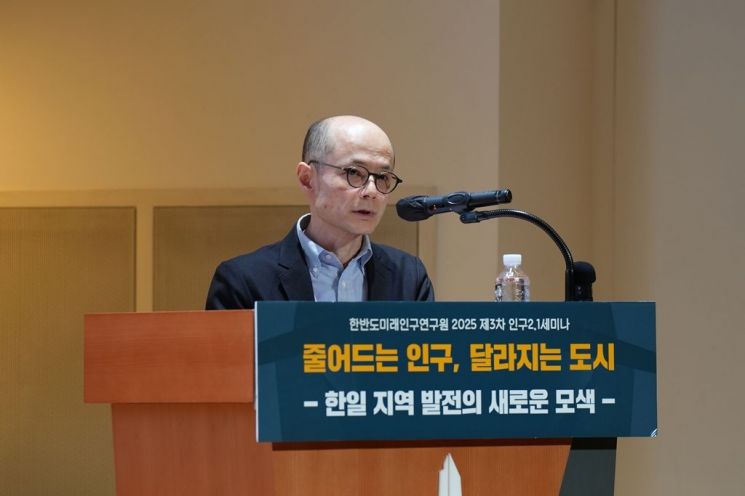 Professor Tomoya Mori of the Institute of Economic Research at Kyoto University in Japan is giving a keynote presentation at the "Shrinking Population, Changing Cities" seminar hosted by the Korea Future Population Institute on the 22nd. Korea Future Population Institute
Tomoya Mori, a professor at the Institute of Economic Research at Kyoto University in Japan, made this statement during his keynote presentation titled "The Future of Japanese Cities and Regions in the Era of Population Decline" at the "Shrinking Population, Changing Cities" seminar hosted by the Korea Future Population Institute on the 22nd. He stated that, among the 83 Japanese cities with populations over 10,000, only 26 are expected to survive. He also projected that the number of cities with populations over one million would shrink from 11 to 4.
Professor Mori pointed to the "trap of transportation infrastructure investment" as the reason for the failure of Japan's regional revitalization policies. He explained, "The construction of the Shinkansen and expressways actually produced a 'straw effect,' drawing local populations into major cities." He analyzed that "since 1992, when the Nozomi high-speed train enabled 200 round trips per day between Tokyo and Osaka, the concentration in Tokyo has intensified."
He proposed "two-way commuting" as a future model. Professor Mori described this model as "a structure where people live in cities but work at automated production facilities in regional areas, connected by scalable transportation means such as flying cars." He also highlighted positive aspects, stating that "a decrease in population density will enhance disaster resilience and revitalize local communities."
In his presentation, Kim Youngsoo, president of the Small and Medium Enterprise Policy Development Institute, diagnosed that the concentration in the Seoul metropolitan area has intensified since 2015. Kim explained, "Since 2015, as high-tech strategic industries such as semiconductors, secondary batteries, and renewable energy have become concentrated in the Seoul metropolitan area and Chungcheong region, the share of gross value added in non-metropolitan areas has plummeted below 50%." He predicted that "in the era of artificial intelligence (AI) and digital transformation, this concentration will accelerate even further." As a solution, he proposed a "strategy of selection and concentration centered on five core and three specialized mega-regional economic zones." He argued that, rather than trying to develop all regions evenly through traditional balanced development policies, the focus should be on fostering key hubs and developing specialized industries in each region based on these hubs.
During the panel discussion, experts agreed on the need for a fundamental shift in regional development strategies. Lee Young, president of the Korea Institute of Public Finance, emphasized, "An industrial base is the most important factor for balanced regional development. Regions themselves must take the lead in attracting businesses and establishing systems that connect education, research, talent, and companies." He asserted, "Policies that try to artificially revive all regions will not be effective," and suggested that "establishing regional R&D and start-up systems, such as the practical research institute (RIST) model at POSTECH, is key."
Lee Junghwan, professor at the College of Economics and Finance at Hanyang University, stressed that without a sense of crisis and a systematic approach, it will be difficult to prevent the polarization of the Seoul metropolitan area. Professor Lee stated, "Rather than trying to develop all regions equally, the key is to establish a successful model in at least one region."
Cha Misook, senior research fellow at the Korea Research Institute for Human Settlements, pointed out, "With 92% of all basic local governments experiencing a population dead cross, where deaths outnumber births, the balanced development policies pursued over the past 60 years have revealed their limitations." She said, "It is inevitable to move away from the approach of developing all regions evenly and instead focus on selection and concentration around key hubs." Kim Seyong, president of the Korea University Urban Research Institute and moderator of the panel discussion, emphasized, "A regional development strategy suited to the era of population decline is necessary."
Lee Insil, president of the Korea Institute for International Economic Policy, stated, "Through this seminar, we were able to suggest the direction of a Korean-style regional development model based on lessons learned from Japan's earlier experience." She added, "We will contribute to building social consensus through ongoing research and policy proposals for establishing regional survival strategies in the era of population decline."
© The Asia Business Daily(www.asiae.co.kr). All rights reserved.
![Clutching a Stolen Dior Bag, Saying "I Hate Being Poor but Real"... The Grotesque Con of a "Human Knockoff" [Slate]](https://cwcontent.asiae.co.kr/asiaresize/183/2026021902243444107_1771435474.jpg)















