 (From the top left) Professor Hyunho Jung, Department of Electrical Engineering and Computer Science, GIST; Professor Youngmin Song, Department of Electrical Engineering, KAIST; Researcher Gyu-rin Kim, Department of Electrical Engineering and Computer Science, GIST; Dr. Seyun Heo; Researcher Juhwan Kim; Researcher Joohyung Lee; Dr. Doeun Kim.
On July 22, the Gwangju Institute of Science and Technology (GIST) announced that a joint research team led by Professor Hyunho Jung from the Department of Electrical Engineering and Computer Science at GIST and Professor Youngmin Song from the Department of Electrical Engineering at the Korea Advanced Institute of Science and Technology (KAIST) has developed an unreplicable security authentication technology inspired by nano-optical techniques found in nature.
This technology can be easily embedded in various physical products such as ID cards or QR codes. Since it is indistinguishable from existing products to the naked eye, it provides robust anti-counterfeiting and anti-tampering functions without compromising the design. In particular, it can be widely applied in fields where genuine product authentication is crucial, such as luxury goods, pharmaceuticals, and electronic devices.
Until now, QR codes, barcodes, and similar technologies used for anti-counterfeiting have had limitations, as they are easy to replicate and difficult to assign unique information to each product.
Recently, "Physical Unclonable Functions (PUFs)" have attracted attention as a technology to address these issues. PUFs utilize randomness that naturally occurs during the manufacturing process to impart unique physical characteristics to each device, thereby enhancing security and authentication reliability.
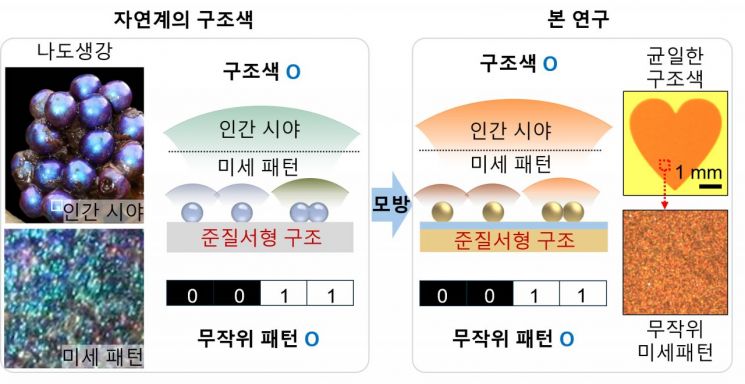
However, existing PUF technologies, while achieving randomness and uniqueness, have had drawbacks such as difficulty in controlling surface color and vulnerability to security breaches due to easy external identification. A Physical Unclonable Function (PUF) is a technology that generates a unique authentication key using physical changes formed during the manufacturing process. Because the randomness of the process cannot be replicated, even if authentication information is stolen, it is impossible to create hardware for actual authentication.
To address this, the research team focused on the unique structural color phenomena observed in nature. For example, butterfly wings, bird feathers, and seaweed leaves are composed of nanoscale microstructures arranged in a "quasi-order"?neither perfectly ordered nor completely disordered. These structures appear to have a uniform color to the naked eye, but internally exhibit subtle randomness, enabling functions advantageous for survival such as camouflage, communication, and predator avoidance.
The research team mimicked these natural principles by thinly depositing a dielectric (HfO₂) on a metallic mirror, then electrostatically self-assembling gold nanoparticles, each tens of nanometers in size, on top to fabricate a plasmonic metasurface with a quasi-ordered structure. This structure appears to have a consistent reflective color to the naked eye, but when observed under a high-magnification optical microscope, each region displays different random scattering patterns?essentially optical fingerprints.
Thanks to these nanostructures, which are visually identical on the surface but internally impossible to replicate, the technology can be used as a high-level security authentication device that can conceal or selectively reveal invisible unique information.
The research team also confirmed that utilizing the random patterns generated by the nanostructures improves the PUF performance of the device compared to existing technologies. While the structures themselves are only tens of micrometers in size, the patterns containing the information are at the nanometer scale, allowing for the storage of an immense amount of information?exceeding the global population. Furthermore, if a hacker were to attempt to arbitrarily fabricate a device to hack this security system, the time required to decode it would exceed the age of the Earth, making replication virtually impossible.
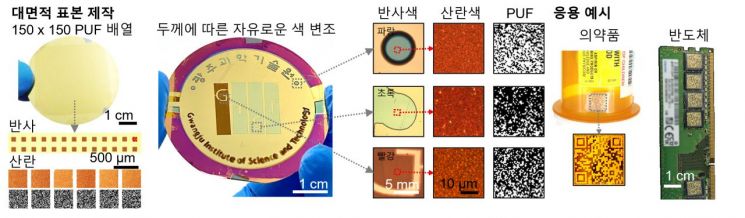
The research team demonstrated the industrial applicability of the developed security device by applying the technology to pharmaceuticals, semiconductors, and QR codes. After generating and analyzing more than 500 PUF keys, the average distribution of bit values was found to be 0.501, which is close to the ideal balance of 0.5, and the average Hamming distance between different keys was measured at 0.494, indicating high uniqueness and stability. In addition, the scattering patterns remained stable under various environmental changes such as high temperature, high humidity, and friction, confirming excellent durability.
Professor Hyunho Jung of GIST stated, "By recreating the coexistence of order and disorder in nature through nanotechnology, we have realized optical information that is fundamentally impossible to replicate, even if the appearance seems identical. This technology can serve as a powerful anti-counterfeiting tool in a wide range of fields, from luxury goods to pharmaceutical authentication and national security."
Professor Youngmin Song of KAIST emphasized, "While conventional security labels can be easily damaged by minor scratches, this technology achieves both structural stability and unclonability. In particular, the ability to separate visible color information from invisible unique key information could present a new paradigm in security authentication."
© The Asia Business Daily(www.asiae.co.kr). All rights reserved.
![Clutching a Stolen Dior Bag, Saying "I Hate Being Poor but Real"... The Grotesque Con of a "Human Knockoff" [Slate]](https://cwcontent.asiae.co.kr/asiaresize/183/2026021902243444107_1771435474.jpg)

















