Koo Yoonchul and Yeo Hankoo Meet Besant and Greer in Washington
First Joint Meeting at U.S. Suggestion
"U.S. Requested Finance Minister and Chief Trade Negotiator"
Defense Costs, Agricultural Products, and Exchange Rates on the Agenda
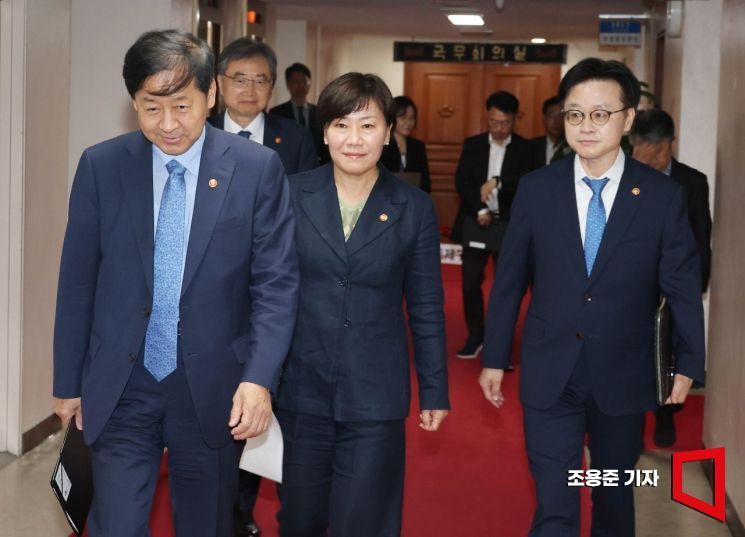 Economic Deputy Prime Minister and Minister of Economy and Finance Koo Yoonchul (left), Minister of Trade, Industry and Energy Kim Jungkwan (right), Minister of Foreign Affairs Cho Hyun (second from left), and Minister of Agriculture, Food and Rural Affairs Song Miryung (second from right) are attending the External Economic Ministers' Meeting on US tariff negotiations held at the Government Seoul Office in Jongno, Seoul on the 22nd.
South Korea and the United States will hold a 2+2 Finance and Trade negotiation in Washington, D.C. on July 25. For the first time, the Deputy Prime Minister for Economic Affairs and the Chief Trade Negotiator of the inaugural cabinet of the Lee Jaemyung administration will sit at the negotiation table with the United States simultaneously. With only ten days left until the deadline set by U.S. President Donald Trump to impose a 25% reciprocal tariff on Korean products, the challenge is to lower item-specific tariffs on key export products such as automobiles and steel, while minimizing the impact of non-tariff barriers such as currency exchange rates, agricultural products, and platform regulations.
Deputy Prime Minister and Minister of Economy and Finance Koo Yoonchul told reporters on July 22, after a closed-door External Economic Ministers' Meeting at the Government Seoul Office, "It has been confirmed that I will visit the United States together with Yeo Hankoo, Chief Trade Negotiator of the Ministry of Trade, Industry and Energy, on July 25 to conduct 2+2 tariff negotiations."
On the U.S. side, Treasury Secretary Scott Besant and U.S. Trade Representative (USTR) Chief Trade Policy Officer Jamieson Greer will participate. Regarding the change in the Korean delegation from the Minister of Trade, Industry and Energy to the Chief Trade Negotiator, unlike the 2+2 trade consultations held last April, Deputy Prime Minister Koo explained, "We made this change at the request of the U.S. side."
This negotiation was made possible at the suggestion of the United States. Kim Jungkwan, Minister of Trade, Industry and Energy, and Cho Hyun, Minister of Foreign Affairs, also plan to visit the United States as early as this week to meet with their respective counterparts.
The government is devising a strategy to comprehensively discuss trade negotiations, including tariffs and non-tariff barriers, as well as security issues such as the increase in defense cost sharing. On the table are President Donald Trump's demand to increase defense cost sharing to $10 billion, imports of beef over 30 months of age, relaxation of agricultural quarantine standards, and a ban on regulating U.S. platform companies.
The first trade issue of the new cabinet was discussed at the External Economic Ministers' Meeting on this day, attended by the Minister of Foreign Affairs, the Minister of Trade, Industry and Energy, the Chief Trade Negotiator, the Minister of Agriculture, Food and Rural Affairs, the Vice Minister of Land, Infrastructure and Transport, the Vice Minister of Oceans and Fisheries, and the Vice Chairperson of the Fair Trade Commission. In particular, the inclusion of Minister Song Miryung of the Ministry of Agriculture, Food and Rural Affairs and Vice Chairperson Nam Dongil of the Fair Trade Commission in the meeting appears to be aimed at coordinating and determining the extent to which South Korea can make concessions to the United States in the areas of agricultural and livestock products and platform regulations.
Deputy Prime Minister Koo said of the government's negotiation plan, "We discussed the maximum we can do today, from the perspective of national interest and practicality," adding, "We plan to prepare a very detailed strategy and do our utmost until the very end."
Since the tariff deferral ends on August 1, the government intends to reach a broad agreement within this month and continue negotiations on an ongoing basis. A government official noted, "While we must defend against U.S. demands as much as possible, we also need to offer an acceptable concession. Given that the most contentious issues have a significant impact on industry, and that reaching agreement with stakeholders, including each ministry, is a major domestic challenge, it is important to continue negotiations over the long term."
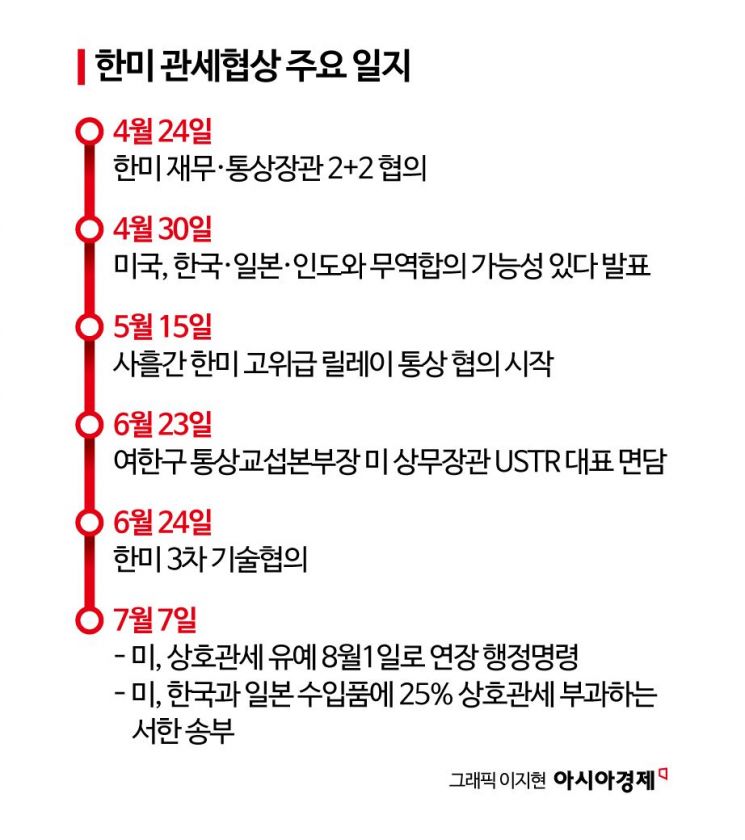
With the launch of the new government's inaugural cabinet's tariff negotiations, the high-level consultative body between South Korea and the United States, which had been suspended, has resumed after three months. Former Deputy Prime Minister Choi Sangmok and former Minister of Trade, Industry and Energy Ahn Deokgeun met with Treasury Secretary Besant and USTR Representative Greer on April 24, agreeing to specify discussions in four key areas: tariff and non-tariff measures, economic security, investment cooperation, and currency exchange rate policy. However, these discussions did not continue due to the resignation of former Deputy Prime Minister Choi and the early presidential election. While Treasury Secretary Besant, who oversees U.S. tariff negotiations, has considered the Korean Deputy Prime Minister as his counterpart, there has been a nearly three-month vacancy in the high-level diplomatic line between the two countries.
South Korea is already subject to item-specific tariffs and a basic tariff of 10% on products such as automobiles and steel. If negotiations do not progress, the basic tariff will rise to 25% starting in August. Although the impact of these tariffs has not yet become fully apparent, South Korea's economic growth rate has hovered around 0% for four consecutive quarters, resulting in a prolonged period of low growth. In the first quarter, the country's gross domestic product (GDP) growth rate was -0.2% compared to the previous quarter and -0.1% year-on-year. With the issuance of consumer coupons worth about 14 trillion won to support economic recovery, growth is expected to increase by 0.1 to 0.2 percentage points from the second half of this year through the first half of next year. However, if the anticipated 25% reciprocal tariff is imposed, Korean companies' exports will be hit hard. Market forecasts suggest that if the basic tariff is raised to 25%, exports to the United States could decrease by an additional 2 to 4%, and South Korea's growth rate this year could fall by 0 to 0.1 percentage points.
© The Asia Business Daily(www.asiae.co.kr). All rights reserved.
![Clutching a Stolen Dior Bag, Saying "I Hate Being Poor but Real"... The Grotesque Con of a "Human Knockoff" [Slate]](https://cwcontent.asiae.co.kr/asiaresize/183/2026021902243444107_1771435474.jpg)

















