First Health Minister Appointed Under Lee Jaemyung Administration
Attention on Resident Doctors' Return Measures Amid "Preferential Treatment" Controversy
"Establishment of Public Medical School" Signals Further Conflict
Test of Leadership in Welfare, Healthcare, and Industrial Policy
With President Lee Jaemyung approving the appointment of Jeong Eunkyung as Minister of Health and Welfare, a new leader responsible for national health and medical policy has been decided just over a month and a half after the launch of the new administration. As a physician who enjoys broad support from various professional groups takes office amid a medical-government conflict that has lasted for a year and six months, there is growing anticipation both inside and outside the medical community that the chaotic situation in hospitals will be resolved and the collapsed healthcare system will be restored to normal.
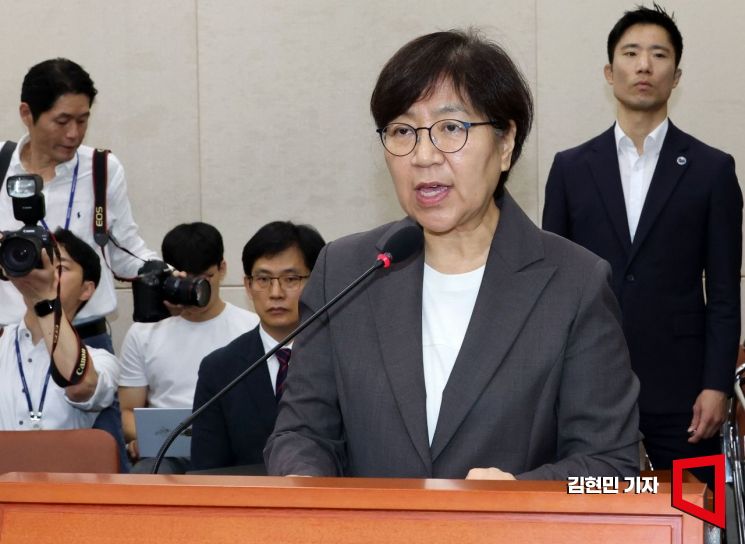 Jeong Eunkyung, Minister of Health and Welfare, is delivering an opening statement at the confirmation hearing held by the National Assembly’s Health and Welfare Committee on the 18th, when she was still a nominee. Photo by Kim Hyunmin
According to the Ministry of Health and Welfare on the 22nd, the new minister Jeong will attend a Cabinet meeting at the presidential office in Yongsan, Seoul, in the morning to discuss flood recovery measures, and then hold an inauguration ceremony at the ministry’s Sejong office building in the afternoon, officially beginning her duties as minister. As a result, the ministry will welcome a new minister for the first time in 34 months since Minister Cho Kyuhong, who was appointed by the Yoon Sukyeol administration.
Minister Jeong Emphasizes Restoring Trust, Expected to Initiate Dialogue with Medical Community
Minister Jeong’s top priority is undoubtedly resolving the conflict between the government and medical professionals and restoring trust in the medical community. Previously, President Lee evaluated Jeong as the right person for the job, citing her proven ability to coordinate policies on the front lines of the “K-Quarantine” response as Director of the Korea Disease Control and Prevention Agency during the COVID-19 pandemic, and her capacity to provide solutions even in crisis situations such as the current medical turmoil.
Jeong herself, when meeting with reporters as a nominee, said, “The biggest problem in the conflict between the government and the medical community is distrust. The most urgent task is to restore a relationship of trust and cooperation with the medical sector,” adding, “I will work to ensure that the voices of the public, experts, and medical professionals are fully reflected in medical reform.”
What is encouraging is that, immediately after Jeong’s nomination, not only physician groups such as the Korean Medical Association and the National Council of Medical School Professors, but also organizations representing nurses, nurse assistants, pharmacists, and even patient groups, issued a series of welcoming statements. This is an unusually positive response from the entire healthcare sector. A medical community official commented, “Minister Jeong earned the trust and respect of the public as the nation’s chief quarantine officer throughout the COVID-19 period. In the recent confirmation hearing, she fully demonstrated the responsibility, trustworthiness, and dignity expected of a senior public official, making her the right person to resolve the current conflict between the government and the medical community.”
Accordingly, Minister Jeong is expected to begin dialogue with the medical community immediately after taking office. In particular, with the “fall turn” approaching in September and recruitment for the second half of the year’s resident doctors set to begin at the end of this month, attention is focused on whether negotiations for their return can proceed quickly, whether enough residents will return to fill the gaps in the field, and whether the public can be convinced in the process.
Regarding the demands of the resigning residents for the formation of a new consultative body and guarantees of training continuity, the ministry stated the previous day, “We will operate a training consultative body involving the Korean Intern Resident Association, the Council for Training Hospitals, the Korean Academy of Medical Sciences, and the Training Environment Evaluation Committee to discuss improvements to the training environment and guarantees of training continuity.” However, the ministry also made it clear that it would not accept demands that could be seen as preferential treatment, stating, “We will consult to ensure that plans for normalizing the healthcare system meet public expectations.”
Minister Jeong herself also stated at the National Assembly confirmation hearing on the 18th, “If I take office as minister, I will introduce a Medical Workforce Supply and Demand Estimation Committee to scientifically estimate the appropriate workforce size. I will pursue people-centered medical reform that both the public and the medical community can agree on, to secure the sustainability of the health and medical system.”
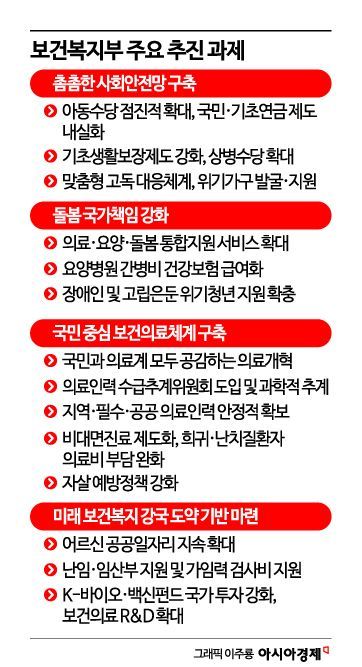
Numerous Challenges Ahead, Including Expansion of Integrated Medical, Nursing, and Care Services
Minister Jeong is also expected to fully implement President Lee’s pledges to strengthen regional, essential, and public healthcare, including establishing a public medical school and introducing a regional doctor system. However, as the medical community strongly opposes these issues as well, there is concern that they could trigger further conflict between the government and medical professionals, making it crucial to see how Minister Jeong will persuade and convince stakeholders.
Although Minister Jeong’s ability to design health policy and respond to crises has already been proven, as Minister of Health and Welfare, she will need to demonstrate broader policy planning and execution skills to lead diverse sectors such as welfare, healthcare, and industry.
In addition, most of the major issues under the ministry’s jurisdiction?such as the increased demand for care due to the entry into a super-aged society, the world’s highest elderly poverty and suicide rates?are urgent challenges that must be addressed. Policies such as expanding child allowances, strengthening the national and basic pension systems, reinforcing the basic livelihood security system, expanding sickness benefits, nationwide expansion of integrated medical, nursing, and care support services, and reducing the medical cost burden for patients with rare and intractable diseases all require securing sufficient budgets or expanding health insurance finances as prerequisites for implementation.
At the confirmation hearing, Minister Jeong said, “For over 30 years, I have worked as a physician, health and medical administrator, and researcher, always on the front lines of the healthcare field and policy. I will closely communicate with experts in each field, gather opinions from the field, and seek reasonable alternatives for health and welfare policy.”
© The Asia Business Daily(www.asiae.co.kr). All rights reserved.
![Clutching a Stolen Dior Bag, Saying "I Hate Being Poor but Real"... The Grotesque Con of a "Human Knockoff" [Slate]](https://cwcontent.asiae.co.kr/asiaresize/183/2026021902243444107_1771435474.jpg)
















