LDP and Komeito Secure Only 47 Seats
Fail to Achieve Majority... Opposition Holds Both Houses
Criticism Over Inflation Response Hampers Ruling Coalition
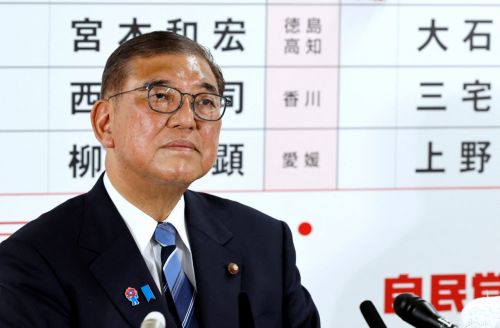 Shigeru Ishiba, Prime Minister of Japan and President of the Liberal Democratic Party, is listening to reporters' questions at the LDP headquarters on the day of the House of Councillors election held in Tokyo, Japan, on the 20th. Photo by Reuters Yonhap News
On July 20, the ruling party suffered a crushing defeat in the House of Councillors election, which served as a midterm evaluation of the Shigeru Ishiba Cabinet in Japan. The Liberal Democratic Party (LDP) and its coalition partner Komeito secured only 47 seats, falling short of half the total. This has resulted in a classic scenario where the opposition holds a majority in both houses. Although Prime Minister Ishiba expressed his intention to remain in power, concerns have grown that the current administration will lose its momentum in managing state affairs, both in responding to inflation and in handling trade negotiations with the United States.
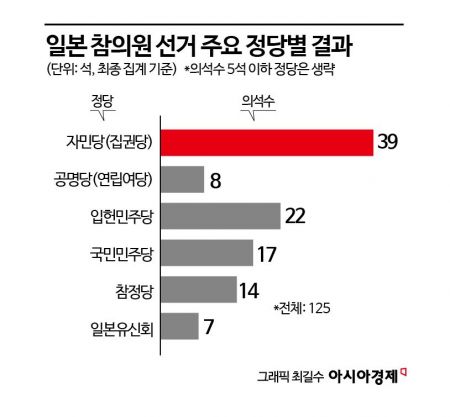
According to NHK and the Nikkei newspaper on July 21, the final tally of the election showed that the ruling LDP won only 39 seats, while its coalition partner Komeito secured just 8 seats. As a result, both the House of Representatives (lower house) and the House of Councillors (upper house) are now under opposition control. Initial NHK exit polls had projected the LDP to win between 27 and 41 seats, and Komeito between 5 and 12 seats.
The House of Councillors election is held every three years to elect half of its 248 members, or 124 seats. In this election, a total of 125 seats were contested, including 75 from local constituencies (with one vacancy in the Tokyo district) and 50 from proportional representation. The ruling coalition needed 50 seats to maintain a majority. When combined with seats not up for election (62 for the LDP and 13 for Komeito), the two parties now hold a total of 122 seats in the House of Councillors?falling short of the majority threshold of 125 seats.
Prime Minister Ishiba had originally set a goal of winning at least 50 seats in this election to secure a majority, but failed to achieve this target. This marks the first time in 16 years, since 2009, that the LDP has failed to secure a majority in both the House of Representatives and the House of Councillors.
This election served as a de facto midterm evaluation of the Ishiba administration. The main reasons for the public turning away from the ruling party include the lack of progress in trade negotiations with the United States, as well as the limited effectiveness of policies to address high inflation. Even before the final results were confirmed, Prime Minister Ishiba appeared on NHK and attributed the ruling party's poor performance to the difficulty in gaining public support for inflation countermeasures such as the proposed 20,000 yen cash handout.
Last April, the LDP considered a plan to provide 30,000 to 50,000 yen per person, but withdrew the proposal amid worsening public sentiment. There was strong criticism that this amounted to a "vote-buying cash handout" ahead of the election.
As in the lower house election last October, in which the ruling party also suffered a heavy defeat, calls for Prime Minister Ishiba's resignation have resurfaced. However, he has refused to step down. Before the final vote count was confirmed, Ishiba appeared on multiple programs, including NHK and Asahi TV, stating, "It is my responsibility to present the right direction for state affairs to the people." He also said, "The LDP must fully recognize the weight of being chosen as the largest party in the House of Councillors," effectively acknowledging his intention to remain in power.
The future direction of political management is now seen as a key challenge. After failing to secure a majority in the snap general election last October, the Ishiba administration has been weakened. Forming coalitions and cooperating with opposition parties on specific policies have become more urgent. Regarding this, Prime Minister Ishiba stated, "We need to carefully consider which approach is most appropriate for policy implementation."
Despite being one of the United States' closest allies, Japan has faced difficulties in trade negotiations. On June 16, U.S. President Donald Trump indicated his intention to impose a 25% reciprocal tariff on Japanese goods as scheduled starting August 1. Speaking to reporters at the White House in Washington on that day, President Trump said, "We are negotiating with Japan, but we will probably proceed as stated in the letter," suggesting this outcome. The Ishiba administration has maintained a tough stance on opening Japan's rice market, reflecting public sentiment.
In the wake of the election results, various scenarios are being discussed, ranging from Prime Minister Ishiba's resignation to a change of government, making it difficult for the Japanese government to act in an organized manner. The United States is also likely to take a wait-and-see approach to Japan's political situation for the time being. The Sankei newspaper noted, "Clouds have gathered over the negotiations scheduled until August 1," and pointed out, "President Trump may not be fully aware of Japan's proposals, such as expanding investment in the U.S."
© The Asia Business Daily(www.asiae.co.kr). All rights reserved.



















