Demand for Distribution Network Expands Due to Increase in Distributed Energy Sources
Up 40% in Five Years... Accounts for 20% of Power Generation
Investment Grows with Underground Cabling and Direct Current Conversion
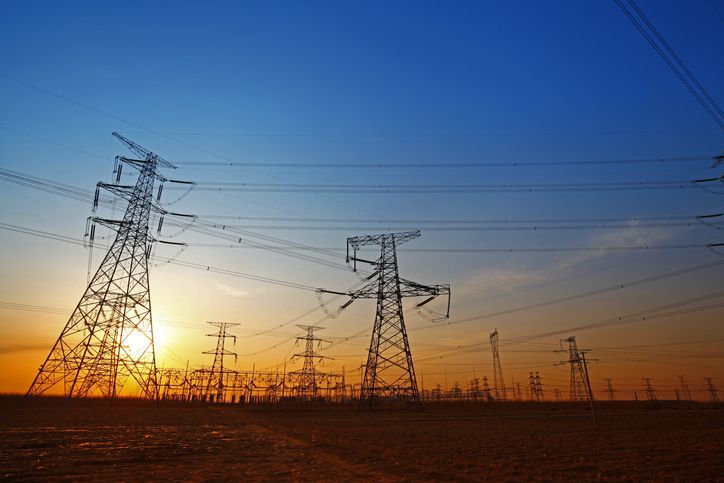
Korea Electric Power Corporation (KEPCO) has begun formulating its first-ever long-term distribution network plan this year, signaling a full-scale transformation of the power grid structure. As the number of small-scale, distributed renewable energy sources such as solar power and fuel cells rapidly increases nationwide, demand for the distribution network has surged.
At the same time, technological changes such as underground cabling and the adoption of direct current (DC) are progressing, making facility upgrades and increased investment unavoidable. This move is interpreted as a response to the transition of the power system from a structure centered on large-scale power plants and transmission lines to a regionally distributed supply system.
17% of Power Generation Uses the Distribution Network... Mostly Solar Power
On July 22, KEPCO announced that, after collaborating with 173 local governments last year to survey the status of distributed energy sources connected to the distribution network, it found that currently, 26 gigawatts (GW) of generation capacity supplies electricity through the distribution network. This accounts for about 17% of the total generation capacity. Of this, 95% is solar power.
KEPCO expects this figure to increase by about 40% to 36 GW by 2028, accounting for 20% of total generation capacity. While solar power is currently concentrated in the Honam region, it is expected to spread nationwide, including to the Yeongnam and Chungnam regions.
The power system is divided into transmission/substation and distribution. The section that sends high-voltage electricity from power plants to substations is the transmission/substation network, while the section that supplies electricity from substations to homes and buildings via utility poles or underground (subsurface) lines is the distribution network. Typically, substations supply electricity at a voltage of 22.9 kilovolts (kV), which is then stepped down to 220V at the utility pole before reaching consumers.
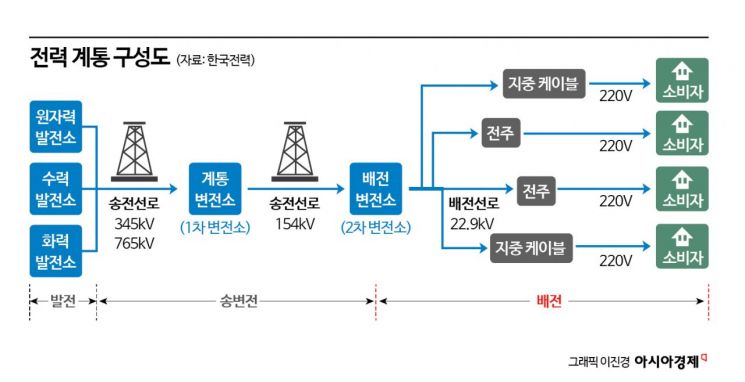
In the past, it was common for electricity produced at large-scale coal, gas, and nuclear power plants, as well as large wind farms, to be transmitted to substations via high-voltage transmission networks of 154 kV or higher.
In contrast, the recent surge in solar power generation has resulted in most installations being small-scale and dispersed nationwide, with the majority directly connected to the 22.9 kV distribution network. Other sources with lower output, such as fuel cells, also supply electricity via the distribution network. The increase in distributed energy sources has led to a rapid rise in demand for the distribution network. In response, Article 18 of the Special Act on the Promotion of Distributed Energy obligates KEPCO, as the distribution network operator, to establish plans for expanding the distribution network.
The first long-term distribution network plan to be established this time will reflect the outlook for expanded distributed energy included in the 11th Basic Plan for Electricity Supply and Demand (2024?2038). Previously, KEPCO announced a long-term transmission/substation investment plan worth 72.8 trillion won based on the 11th plan, which is a 28.8% increase compared to the 10th plan (56.5 trillion won).
Investment in the distribution network is also expected to expand proportionally. Based on the 10th plan, KEPCO estimated the scale of distribution network investment at 31 trillion won. If this is simply adjusted in line with the increase in transmission/substation investment, it would amount to about 40 trillion won, and some experts believe it could reach as much as 50 trillion won.
Yoo Seunghoon, a professor at Seoul National University of Science and Technology, said, "Due to the expansion of renewable energy and underground cabling, investment in the distribution network could approach 50 trillion won." The expansion of underground cabling, which involves relocating overhead lines underground, has also significantly increased construction costs.
Push for 'Direct Current' Conversion of Distribution Network... Investment to Increase Further
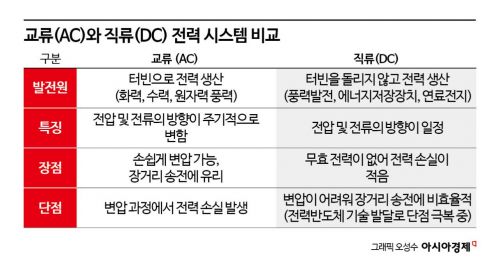
If the distribution network is converted from alternating current (AC) to direct current (DC) in the future, the scale of investment is expected to grow even larger. Most of the distributed generation sources that are increasing today, such as solar power, energy storage systems (ESS), fuel cells, and electric vehicles, either produce or use DC electricity. Currently, this DC electricity is converted to AC via inverters before being supplied, resulting in energy loss during the process.
KEPCO explained that if the distribution network is converted to DC, these power conversion steps can be reduced, improving overall power efficiency by about 10?15%. Facilities that use DC electricity directly, such as data centers, can reduce energy waste if supplied with DC power directly.
DC distribution technology is divided by voltage into low-voltage direct current distribution (LVDC, 1.5 kV or less) and medium-voltage direct current distribution (MVDC, 1.5?100 kV). LVDC is still in its early stages, while MVDC is being actively developed both domestically and internationally.
The United States plans to apply MVDC to its electric vehicle charging network. Germany is conducting demonstration projects using a hybrid approach that combines both LVDC and MVDC. High-voltage direct current transmission (HVDC) has already been applied to transmission networks and is being rapidly commercialized both in Korea and abroad.
However, DC distribution was not included in this first long-term distribution network plan. A KEPCO official stated, "Since DC distribution requires further technological demonstration and institutional improvements, it is likely to be included starting from the second plan."
© The Asia Business Daily(www.asiae.co.kr). All rights reserved.



















