Supply Chain Reorganization and China's Rise Threaten Manufacturing
Emergence of Korea-Japan Cooperation for Industry Survival
Need to Build AI Manufacturing Platform Through Data Sharing
Choi Tae Won: "Need for AI Data Cooperation with Japan in Manufacturing"
Korea Excels in AI Speed, Japan in Precision Data
There is a growing perception that, as in the case of OCI's Korea-Japan joint venture, cooperation between Korea and Japan is necessary for the survival of industries during times of crisis. The Korean business community has introduced "data-driven manufacturing cooperation" with Japan as a new strategic card. This is a pragmatic approach to respond to the global supply chain reorganization and intensifying US-China competition, and especially to China's rapid technological catch-up, by combining the two countries' digital transformation capabilities and precision manufacturing know-how.
The call for Korea-Japan industrial cooperation has gained further attention as it has been emphasized by Choi Tae Won, chairman of the Korea Chamber of Commerce and Industry. At the 48th Korea Chamber of Commerce and Industry Summer Forum held recently in Gyeongju, Gyeongbuk, Choi warned, "If we do not consider transforming our manufacturing industry now, we could face a crisis in ten years," and added, "If we fail to revitalize manufacturing with AI, a significant portion could be forced out." He also pointed out, "There is too much baseless optimism that things will continue to go well just because they have so far."
The biggest cause of the manufacturing crisis is the rapid change in the global competitive environment. Korea's manufacturing sector has lost ground due to China's improved technological prowess and price competitiveness, as well as the United States' strengthened protectionism. In particular, some industries such as petrochemicals are already facing such a large gap with the Middle East, India, and China that competition itself has become difficult, according to some analyses.
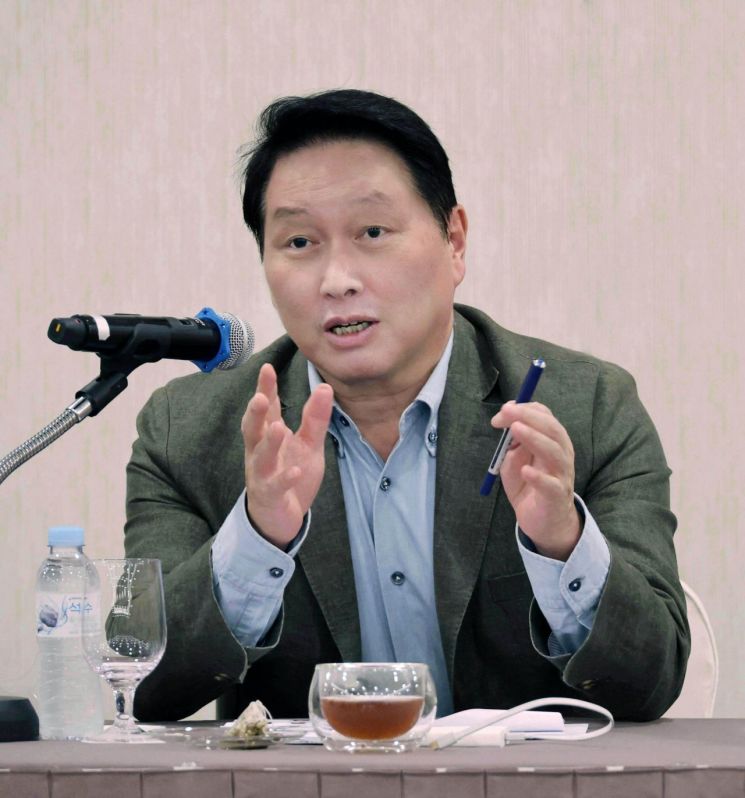 Choi Tae Won, chairman of the Korea Chamber of Commerce and Industry, is answering questions from reporters at a press conference during the 48th Korea Chamber of Commerce and Industry Summer Forum held in Gyeongju, Gyeongbuk. Korea Chamber of Commerce and Industry
To respond to this structural crisis, manufacturing innovation through AI is essential. In this process, cooperation with Japanese industry is necessary. According to the business community, Korea has a large volume of data, which is essential for AI, but faces limitations in quality and refinement, while Japan possesses precise data and know-how but lags in digitalization. Citing this complementarity, Choi emphasized, "It is time to consider industrial cooperation in ways we have not tried before." There is a growing view that a realistic alternative is for the two countries to share data and jointly build an AI manufacturing platform.
This argument is also convincing from the perspective of industrial structure. According to a report published last year by KOTRA titled "Japan's Digital Transformation Strategy and New Opportunities for Entry," "Japan possesses high-precision production facilities and long-term operational know-how, but its structure is slow to adopt digital transformation," and "Korea, with its startup-driven rapid AI adoption, has high potential for complementary cooperation."
Korea has strengths in assembly-based system manufacturing, but a strategy focused solely on price and speed makes it difficult to maintain a competitive edge. Japan, on the other hand, is equipped with advanced, long-life facilities for precision machinery, materials, and components, but its slow digital transformation has resulted in stagnant productivity and aging workforce issues. There is a diagnosis that a joint response combining Korea's 'speed and volume' with Japan's 'precision and quality' is needed.
High-quality data is now emerging as a core asset for the survival of the manufacturing industry. There is a consensus in the industrial sector that "data with both quantity and quality" is an essential condition for the advancement of artificial intelligence (AI), and competition to secure data is already expanding into competition between countries.
In his book "Revolution Korea," published before taking office, Deputy Prime Minister and Minister of Economy and Finance Koo Yun Cheol analyzed, "The core of AI advancement is data that has both quantity and quality," and added, "High-quality data is a new form of resource, and the time will soon come when we will have to pay to use it." He emphasized, "The competition to secure data between countries has already begun in earnest."
Regarding the need for Korea-Japan cooperation, Yang Ki Ho, professor of Japanese Studies at Sungkonghoe University, stressed, "It is realistic for Korea to take the initiative in reaching out to Japan, especially in strategic industries such as semiconductors." He explained, "Japanese companies have also suffered losses since the export restrictions, and there is clearly demand for joint investment or technology transfer within Korea." He further suggested, "It would be effective to pursue joint technology development between companies in strategic sectors such as materials, components, and equipment (Sobu-jang), liquefied natural gas (LNG), and the defense industry."
© The Asia Business Daily(www.asiae.co.kr). All rights reserved.
![Clutching a Stolen Dior Bag, Saying "I Hate Being Poor but Real"... The Grotesque Con of a "Human Knockoff" [Slate]](https://cwcontent.asiae.co.kr/asiaresize/183/2026021902243444107_1771435474.jpg)















