Intensive Monitoring After Wildfires:
Over 5,700 Village Patrol Members Mobilized
Comprehensive Response Beyond Official Statistics to Prevent Further Damage
Although heavy rainfall continued in the Gyeongbuk region for four days, there were no additional damages reported in areas that suffered from large-scale wildfires in March.
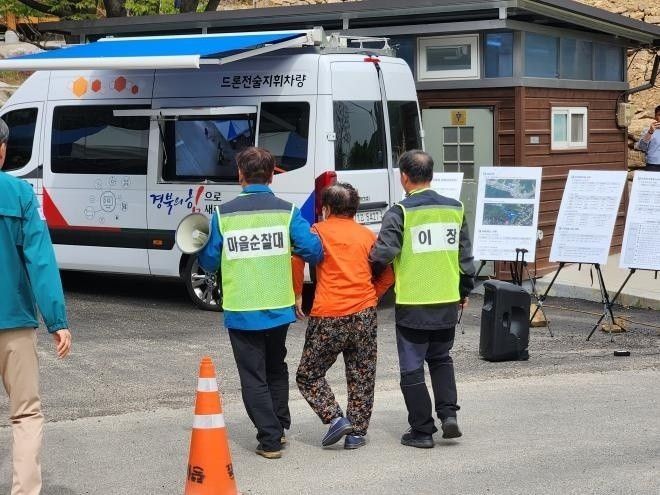
On July 20, Yonhap News, citing an announcement from the Gyeongbuk Provincial Government, reported that despite the recent heavy rains, no secondary damages such as landslides or flooding were officially reported in wildfire-affected areas, including Uiseong, Andong, Cheongsong, Yeongyang, and Yeongdeok.
The Gyeongbuk Provincial Government and each city and county activated intensive monitoring systems, concerned about possible secondary damages such as soil runoff in areas where the ground had been weakened by wildfires. Previously, Gyeongbuk Governor Lee Cheolwoo had ordered a strengthening of the emergency response system, emphasizing the "principle of excessive response" on June 16 and 18, when the monsoon season began in earnest.
Accordingly, the province and each local government deployed 3,178 personnel and maintained the highest level of response until 9 p.m. on July 19, when the heavy rain warning was lifted. In particular, 5,696 members of village patrols (including 1,529 public officials) patrolled 3,445 villages in 22 cities and counties across Gyeongbuk, checking on residents' safety and assisting with preemptive evacuations.
During this monsoon period, a total of 547 residents from 395 households in 10 cities and counties, including Pohang (96 people), Cheongdo (174 people), Goryeong (145 people), and Yeongju (42 people), evacuated to 81 locations such as village halls, senior centers, and motels. Relief supplies such as blankets, meals, and daily necessities were provided to them immediately.
In 16 villages with a history of landslides, including Yeongju, Mungyeong, Yecheon, and Bonghwa, patrol teams remained on standby and continuously monitored the situation. In addition, 95 temporary modular homes within wildfire-affected areas were also included as separate inspection targets.
As of the time the heavy rain warning was lifted, a total of 2,055 patrol members (including 419 public officials) were active, covering villages such as 86 in Gyeongju, 314 in Andong, 154 in Gumi, 405 in Sangju, and 146 in Cheongdo.
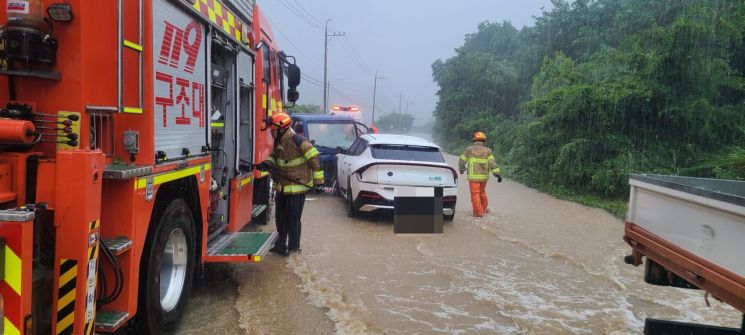 On the 17th, roads in Wonri area, Cheongdo-eup, Cheongdo-gun, Gyeongbuk, where a heavy rain warning was issued, were flooded, and fire authorities and police are taking action at the scene. Yonhap News
A Gyeongbuk Provincial Government official explained, "Preemptive evacuation measures were implemented only in areas where cumulative rainfall exceeded 300mm or where more than 80mm of heavy rain was expected in a single day," adding, "In addition to the official statistics, all cities and counties took comprehensive action to prevent casualties."
In addition to the village patrols, real-time disaster monitoring was carried out in various locations. At Wangsan Reservoir in Yeongcheon and Mundeok 3 Bridge on Naengcheon Stream in Pohang, CCTV monitoring and on-site inspections were conducted as water levels rose. Pre-monsoon inspections were also strengthened, with a total of 627 sites?including 358 landslide risk areas, 54 steep slopes, and 215 riverside parking lots?being inspected in advance.
Governor Lee stated, "Although the rain has stopped, we will continue thorough inspections and monitoring in vulnerable areas."
Major cumulative rainfall amounts in Gyeongbuk included 320.3mm in Cheongdo, 286.4mm in Goryeong, 250mm in Gyeongsan, 206.3mm in Yeongcheon, 175.5mm in Gyeongju, 105.5mm in Andong, and 138.3mm in Pohang.
© The Asia Business Daily(www.asiae.co.kr). All rights reserved.
![Clutching a Stolen Dior Bag, Saying "I Hate Being Poor but Real"... The Grotesque Con of a "Human Knockoff" [Slate]](https://cwcontent.asiae.co.kr/asiaresize/183/2026021902243444107_1771435474.jpg)
















