Generating Reactive Oxygen Species via Water Decomposition to Attack Intractable Solid Tumors
Two Patent Applications Filed, Published in Nature Communications
The next-generation photodynamic therapy technology developed by Professor Kwon Taehyuk's research team in the Department of Chemistry at UNIST (President Park Jongrae) has been selected as one of the "Top 30 Outstanding Achievements in Healthcare R&D 2025."
This therapy has drawn attention as the world's first method to activate immune responses against intractable cancer cells using light.
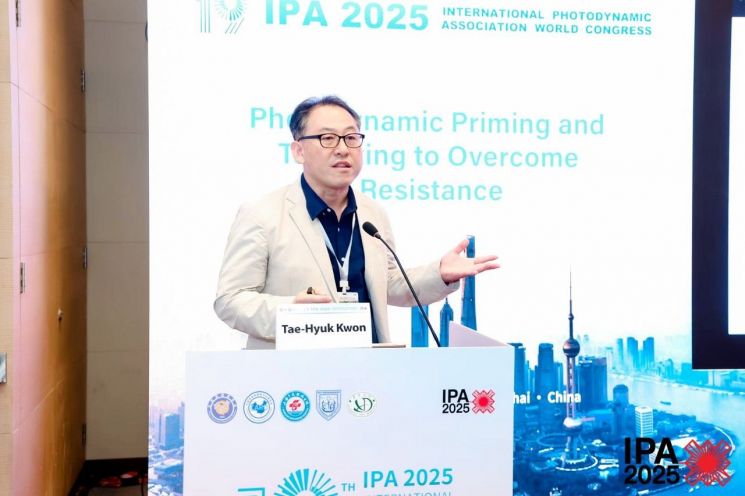
Professor Kwon's team developed a photosensitizer-based anticancer therapy targeting hypoxic solid tumors such as pancreatic cancer. The principle involves decomposing water with light, during which the generated reactive oxygen species (ROS) attack cancer cells and stimulate immune cells.
Conventional photodynamic therapy (PDT) was limited in efficacy because it relied on oxygen around the tumor. This new technology generates reactive oxygen species by oxidizing water, thereby demonstrating excellent anticancer effects even in oxygen-deficient environments.
The research team applied this method to a pancreatic cancer model and confirmed its effectiveness in inducing a strong immune response. In particular, they discovered that, at both the cellular and organismal levels, the reactive oxygen species selectively oxidize membrane proteins of cancer cells, leading to cell death in the form of pyroptosis.
The study was co-led by Dr. Lee Chaeheon and Dr. Park Mingyu as first authors, and was conducted in collaboration with the bio startup O2Medi. The results were published last year in Nature Communications, and two domestic patents have been filed.
Professor Kwon stated, "By integrating photosensitizer design, cell death biology, and immunology, we have demonstrated the potential to revolutionize existing anticancer strategies," adding, "This will have a significant impact by overcoming the limitations of solid tumor treatment and opening possibilities for combination with immunotherapy."
Based on these research achievements, UNIST plans to lead the convergence of technologies in photomedicine, precision anticancer therapy, and immunotherapy, contributing to the development of high-value-added domestic therapeutics and bridging the global healthcare gap.
© The Asia Business Daily(www.asiae.co.kr). All rights reserved.
![Clutching a Stolen Dior Bag, Saying "I Hate Being Poor but Real"... The Grotesque Con of a "Human Knockoff" [Slate]](https://cwcontent.asiae.co.kr/asiaresize/183/2026021902243444107_1771435474.jpg)
















