Chairman Wei Reveals Plans During Q2 Conference Call
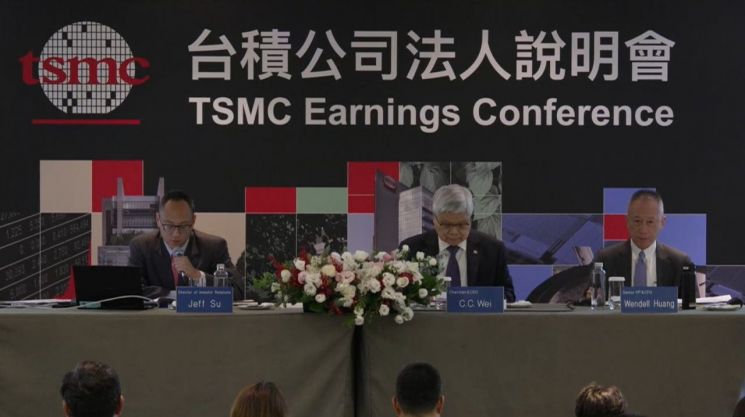 Wai Jaza, Chairman and CEO of TSMC, along with the management team, is conducting the Q2 earnings conference call on the 17th. Screenshot of the TSMC conference call video
TSMC, the world’s largest semiconductor foundry, will begin mass production of its cutting-edge 2nm (nanometer, one-billionth of a meter) process as scheduled in the second half of this year.
According to Taiwanese media outlets such as Liberty Times on the 18th, TSMC Chairman and CEO C.C. Wei stated this position during the Q2 earnings conference held the previous day. Chairman Wei explained that mass production of the 2nm process is scheduled to begin in the second half of the year, and that the mass production process will follow a pattern similar to that of the 3nm process.
Regarding the return on investment (ROI) for the 2nm process, he noted that the price of 2nm products is higher than that of 3nm products, so profitability will also be higher. He added that once mass production begins in the second half, it will contribute to the company’s performance in the first half of next year.
He went on to say that, in line with TSMC’s strategy to expand its 2nm product lineup, the company plans to begin mass production of N2P?which supports smartphones and high-performance computing (HPC) applications?in the second half of 2026.
Wei also emphasized that, by adopting the industry’s best back-side power delivery (SPR) technology, TSMC will begin mass production of the A16 (1.6nm process) product, which is the optimal solution for HPC products, starting in the second half of 2026.
In addition, he announced that the development of A14 (1.4nm), a next-generation advanced silicon technology based on a complete node transition, is proceeding smoothly as planned. As its performance and yield (the proportion of good chips among finished products) have exceeded expectations, mass production is scheduled to begin in 2028.
He further explained that TSMC plans to apply SPR technology to the A14, which adopts the second generation of gate-all-around (GAA) transistors that dramatically improve transistor performance and power efficiency, around 2029.
In semiconductors, a nanometer refers to the width of the circuit lines; the narrower the width, the lower the power consumption and the faster the processing speed. Currently, the 3nm processes mass-produced by TSMC and Samsung Electronics represent the most advanced technology available.
Meanwhile, Chairman Wei stated that, despite uncertainties such as tariffs, demand for artificial intelligence (AI) remains strong, and he expects TSMC’s revenue to increase by about 30% year-on-year in US dollar terms in 2025. Previously, in April last year, he projected that total revenue for this year would increase to a level close to the mid-20% range.
© The Asia Business Daily(www.asiae.co.kr). All rights reserved.
![Clutching a Stolen Dior Bag, Saying "I Hate Being Poor but Real"... The Grotesque Con of a "Human Knockoff" [Slate]](https://cwcontent.asiae.co.kr/asiaresize/183/2026021902243444107_1771435474.jpg)















